
HealthcareBy City Prime Care Team
How Do You Tell a Common Childhood Illness From One That Needs a Doctor? Reading the Illness Patterns, the Five Call-the-Doctor Triggers and the Sample Sick-Day Timeline
Colds, ear infections, strep, stomach bugs and croup all look alike at first. Learn the usual course of each, five triggers to call a doctor, school return rules and a sample sick-day timeline.
Medically reviewed by City Prime Care Administrator10 min read
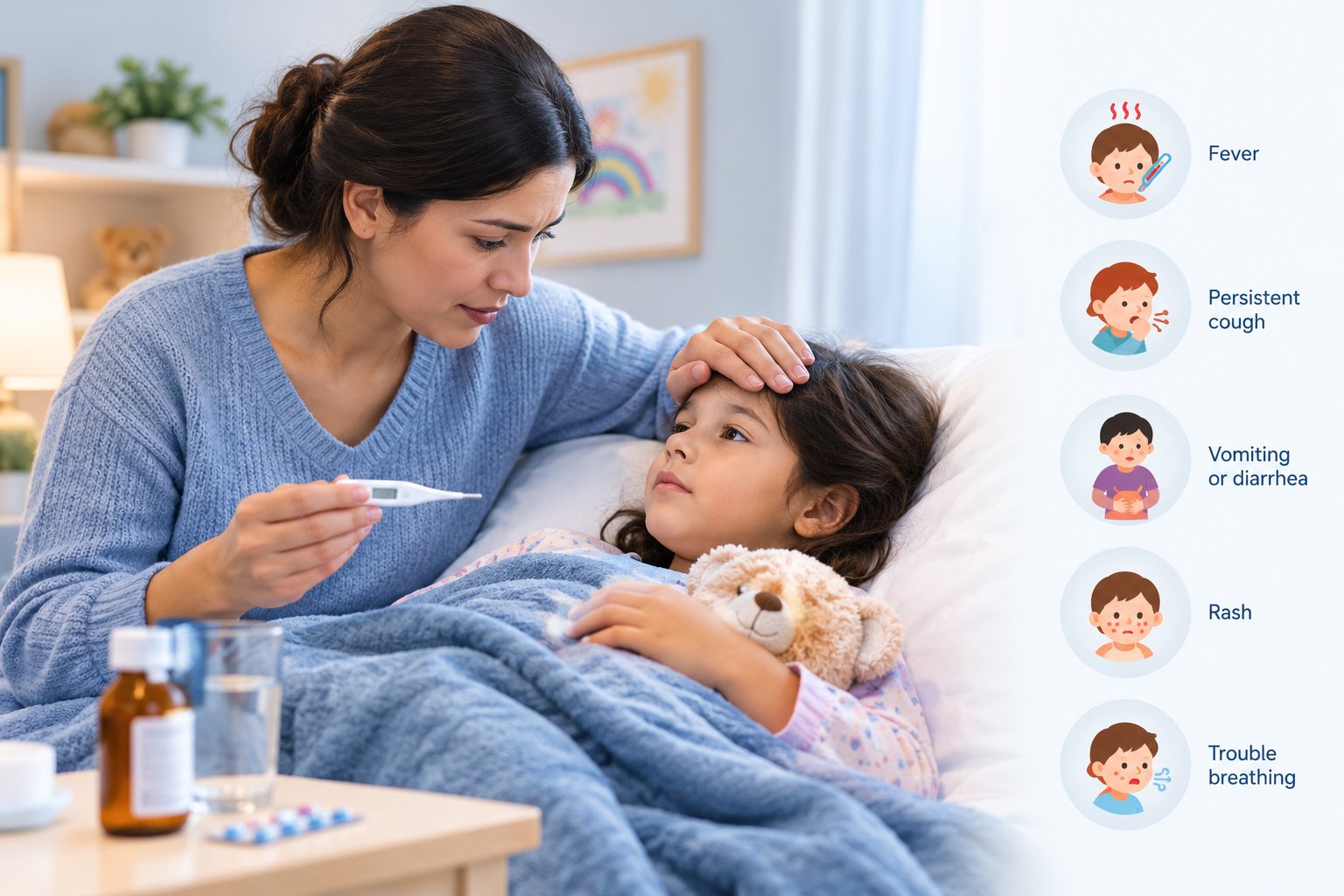
Table of contents
- 1. Why Children Get Sick So Often
- 2. Common Childhood Illnesses
- 3. How Long Each Illness Usually Lasts
- 4. Five Call-the-Doctor Triggers
- 5. Home Care That Helps
- 6. When Can Your Child Go Back to School
- 7. Why Antibiotics Are Not Always the Answer
- 8. A Sample Sick-Day Timeline
- 9. Prevention: Vaccines, Handwashing and Sleep
- Conclusion
- Frequently Asked Questions
- See a Doctor in Elmhurst or Chinatown
Most parents learn quickly that children get sick often. Young children can catch eight or more colds a year as their immune systems meet new germs at home, daycare and school. Most of these illnesses pass with rest and fluids. A few need a doctor, and the early signs of a minor illness and a serious one can look very similar. This guide helps you sort them out.
Below you will find the usual course of common childhood illnesses, five triggers that mean you should call a doctor, school return rules, a sample sick-day timeline and answers to common questions. It draws on parent guidance from the American Academy of Pediatrics HealthyChildren site, the CDC RSV page and the CDC group A strep page. This is general education, not personal medical advice. Services available on site can differ, so ask City Prime Care, and you can also find the clinic on Google.
In this article:
- 1. Why children get sick so often
- 2. Common childhood illnesses (table)
- 3. How long each illness usually lasts (graph)
- 4. Five call-the-doctor triggers
- 5. Home care that helps
- 6. When can your child go back to school (table)
- 7. Why antibiotics are not always the answer
- 8. A sample sick-day timeline
- 9. Prevention: vaccines, handwashing and sleep
1. Why Children Get Sick So Often
A child's immune system learns by exposure. Every cold, ear infection or stomach bug trains it, and group settings such as daycare and school spread germs quickly. Small children also touch their faces often and share toys, which makes spread easy. Frequent mild illness is usually a normal part of growing up rather than a sign that something is wrong.
What matters is not how often your child is sick but how the illness behaves. A child who is drinking, playing a little and improving day by day is usually on a normal course. A child who is getting worse, struggling to breathe or hard to wake needs care now. For help choosing a place of care, see where to go when illness strikes suddenly.
2. Common Childhood Illnesses
| Illness | Typical signs | Usual course | See a doctor when |
|---|---|---|---|
| Common cold | Runny nose, sneezing, mild cough, low fever | 7 to 10 days | Fever lasts more than 3 days or breathing is labored |
| Flu | Sudden fever, aches, tiredness, cough | About 5 to 7 days; cough can linger | High-risk child, trouble breathing or fever that returns |
| Strep throat | Sore throat, fever, swollen glands, often no cough | Improves in 1 to 2 days on antibiotics | Any sore throat with fever, to get a test |
| Ear infection | Ear pain, tugging, fussiness, fever | 2 to 3 days; many ease without antibiotics | Pain beyond a day or two, fever, or fluid draining from the ear |
| Stomach bug | Vomiting, watery diarrhea, mild fever | 1 to 3 days | Cannot keep fluids down, no urine in 8 hours, blood in stool |
| Croup | Barking cough, hoarse voice, noisy breathing, worse at night | 3 to 5 days | Noisy breathing at rest, drooling or struggling to breathe |
| Bronchiolitis or RSV | Cough, wheeze, fast breathing, feeding problems in babies | 1 to 2 weeks | Fast breathing, poor feeding or pauses in breathing in a baby |
| Pinkeye | Red, itchy or sticky eye | About 1 week | Eye pain, vision change or thick discharge |
| Hand, foot and mouth disease | Fever, mouth sores, blisters on hands and feet | 7 to 10 days | Not drinking because of mouth pain |
| Rash illnesses | Spots, hives or red patches with or without fever | Varies | Rash with trouble breathing, swelling, or purple spots that do not fade |
For more on ear symptoms, read how ear infections show up in children and adults. For fever, cold and throat patterns, see our guide to whether urgent care handles fever, cold and sore throat. For wheezing and tight chest, see what asthma really is and how to keep it under control.
3. How Long Each Illness Usually Lasts
Knowing the normal length of an illness helps you spot when something is off. The graph shows typical durations at the upper end of normal. Each block is about one day. If an illness runs past its expected window, or gets worse after seeming to improve, call a doctor.
| Illness | Usual length (graph) | Call if it lasts longer than |
|---|---|---|
| Stomach bug | ███ 1 to 3 days | 3 days, or sooner if dehydrated |
| Croup | █████ 3 to 5 days | 5 days or any breathing trouble |
| Ear infection | ███ 2 to 3 days | 3 days |
| Flu | ███████ 5 to 7 days | 7 days or fever that returns |
| Pinkeye | ███████ about 7 days | 7 days |
| Cold | ██████████ 7 to 10 days | 10 days or worsening |
| Bronchiolitis or RSV | ██████████████ 7 to 14 days | Any fast breathing or poor feeding |
4. Five Call-the-Doctor Triggers
Call your child's doctor or a clinic the same day when you notice any of these:
- Fever in a baby under 3 months, or a fever lasting more than 24 hours in a child under 2, or more than 3 days in an older child.
- Breathing that looks hard: fast breathing, noisy breathing at rest, ribs pulling in or wheezing that does not ease.
- Signs of dehydration: fewer wet diapers or no urine for 8 hours, no tears when crying, dry mouth or sunken eyes.
- Unusual behavior: very sleepy, hard to wake, limp, confused, or inconsolable crying.
- Illness that improves and then suddenly gets worse, or a new symptom such as ear pain, a stiff neck or a rash.
Call 911 for trouble breathing, blue lips, seizure, unresponsiveness or a baby under 3 months with a fever. When unsure, a quick call to a clinician is always better than waiting. See also our guide to when to bring your child to pediatric urgent care.
5. Home Care That Helps
For mild illness without warning signs, these steps support recovery:
- Offer small, frequent sips of water or an oral rehydration solution if there is vomiting or diarrhea.
- Let your child rest, and do not force food; appetite returns as they recover.
- Use a cool-mist humidifier or steamy bathroom for a croupy cough, and saline drops with a bulb syringe for a stuffy nose in babies.
- Use fever medicine only for comfort, by weight and as labeled, and never give aspirin to a child.
- Do not give over-the-counter cough and cold medicine to young children unless a doctor advises it, and do not give honey to a baby under 1 year.
- Keep a short log of temperature, drinks, wet diapers and symptoms to share with the doctor.
For small cuts and burns that happen along the way, see first aid at home for cuts and burns. Look at the MedlinePlus fever guide for more on home care.
6. When Can Your Child Go Back to School
School and daycare rules differ, so check yours. These common guidelines are a starting point.
| Illness | Common return guideline |
|---|---|
| Fever from any cause | Fever-free for 24 hours without fever medicine |
| Vomiting or diarrhea | No vomiting or diarrhea for 24 hours and able to drink and eat |
| Strep throat | After at least 12 to 24 hours of antibiotics and no fever |
| Flu | Fever-free for 24 hours without medicine and improving |
| Pinkeye | Many schools allow return once treated or symptoms improve; policies vary |
| Hand, foot and mouth disease | Fever gone and child able to participate; mouth sores alone may not require staying home |
| Common cold | Child feels well enough to take part in activities |
7. Why Antibiotics Are Not Always the Answer
Antibiotics work only against bacteria. Colds, most coughs, croup, stomach bugs, flu and hand, foot and mouth disease are caused by viruses, so antibiotics will not help and can cause diarrhea, rash and resistance. Strep throat and some ear, sinus and skin infections are bacterial and may need them. A clinician decides using your child's symptoms, an exam and sometimes a rapid test.
If antibiotics are prescribed, give the full course exactly as directed. See the CDC antibiotic use page and our guide to which infections and injuries an acute care visit can treat.
8. A Sample Sick-Day Timeline
This sample shows how a typical viral illness with fever and cough might look in a school-age child. It is an illustration, not a prediction.
| Day | What you may see | What to do |
|---|---|---|
| Day 1 | Fever, tiredness, sore throat or runny nose | Rest, fluids, comfort medicine as labeled; keep home from school |
| Day 2 | Fever may peak, cough starts | Watch drinking and breathing; call if concerned |
| Day 3 | Fever often easing | Call a doctor if fever persists or child looks worse |
| Days 4 to 5 | Energy returns slowly, cough continues | Return to school after 24 hours fever-free |
| Days 6 to 7 | Cough lingers, appetite recovers | Call if cough gets worse or fever returns |
| Days 8 to 10 | Cold symptoms fading | See a doctor if symptoms have not improved by day 10 |
9. Prevention: Vaccines, Handwashing and Sleep
These habits lower the number and severity of illnesses:
- Keep vaccines up to date using the CDC immunization schedules, and ask your doctor about the yearly flu shot; see our flu season guide.
- Wash hands with soap for 20 seconds before meals and after the bathroom, coughing or sneezing.
- Teach children to cough or sneeze into an elbow and not to share cups and utensils.
- Make sure children get age-appropriate sleep, balanced meals and outdoor play.
- Keep sick children home until they meet the return guidelines.
- Book regular checkups so the pediatrician can track growth and catch problems early.
Conclusion
Most childhood illnesses are mild, short and manageable at home. Learn the usual course of each, use the five triggers to know when to call and trust your instincts about how your child looks and acts. Early care for the illnesses that need it, and rest for the ones that do not, keeps your child on the road to recovery.
Contact Us: To ask whether your child can be seen for a sick visit, reach City Prime Care through our Contact Us page, or find us on Google. This article is for general information and does not replace personal medical advice. In an emergency, call 911.
Frequently Asked Questions
See a Doctor in Elmhurst or Chinatown
Have a question about your own health? Book a visit at our Elmhurst, Queens clinic or our Chinatown, Manhattan clinic, or explore our primary care services.
Related articles
Healthcare
Sore Throat That Won't Quit: When It's Strep and When It's Not
Not every sore throat is strep. Learn how strep throat differs from a viral sore throat, how the rapid test works, why antibiotics matter, home care tips, and warning signs to watch.
Healthcare
What Are the Warning Signs of Pneumonia, and Who Needs Care Fast? Reading the Symptom Clues, the Five Risk Groups and the Sample Recovery Timeline
Pneumonia is a lung infection that can be mild or serious. Learn how it differs from a cold or the flu, the warning signs, the five higher-risk groups, how severity is judged and what recovery usually looks like.
Healthcare
How Do You Know If a Head Injury Is a Concussion? Reading the Symptom Checklist, the Five Danger Signs and the Sample Return-to-Activity Plan
A concussion does not need a knockout and often shows nothing on a scan. Learn the symptom checklist, the five danger signs that need the ER, how recovery usually goes and a step-by-step return-to-activity plan.





