
HealthcareBy City Prime Care Team
Where Should You Go When Illness Strikes Suddenly? Reading the Care-Level Ladder, the Five Emergency Signs and the Sample Same-Day Visit Flow
Not sure whether to go to acute care, your own doctor or the ER? See the care-level ladder, the five emergency signs, a symptom-by-symptom guide and what a same-day visit looks like.
Medically reviewed by City Prime Care Administrator9 min read
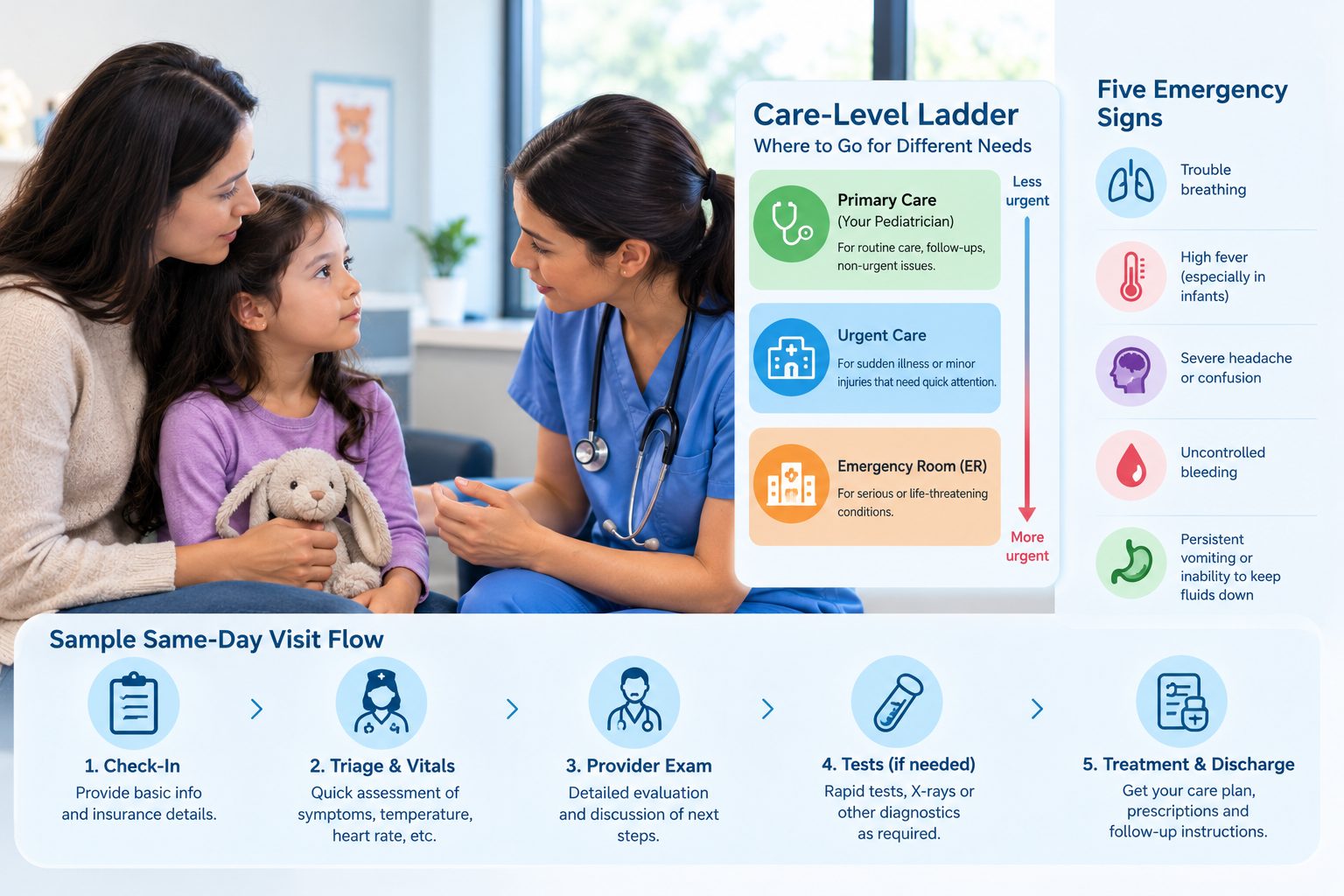
Table of contents
- 1. What Acute Care Is
- 2. The Care-Level Ladder
- 3. Five Emergency Signs That Need 911
- 4. Where to Go for Common Symptoms
- 5. Acute Care, Urgent Care and Primary Care Compared
- 6. What to Bring
- 7. A Sample Same-Day Visit Flow
- 8. Costs and Insurance
- 9. After Your Visit: Follow-Up Plan
- Conclusion
- Frequently Asked Questions
- See a Doctor in Elmhurst or Chinatown
A sore throat that will not quit, a twisted ankle, a fever that spikes at night: these moments force a quick decision about where to go. The emergency room is built for life-threatening problems and can mean a long wait and a high bill, while waiting days for a regular appointment can let a treatable problem worsen. Acute care fills the middle.
This guide explains the levels of care, the five emergency signs that always need 911, how to match common symptoms to the right setting and what a same-day visit looks like. It draws on national patient guidance, including the American Heart Association and the American Stroke Association. Availability of same-day visits varies, so call City Prime Care to ask. This is general education, not personal medical advice. You can also find the clinic on Google.
In this article:
- 1. What acute care is
- 2. The care-level ladder (graph)
- 3. Five emergency signs that need 911
- 4. Where to go for common symptoms (table)
- 5. Acute care, urgent care and primary care compared (table)
- 6. What to bring
- 7. A sample same-day visit flow
- 8. Costs and insurance
- 9. After your visit: follow-up plan
1. What Acute Care Is
Acute care means treatment for a sudden illness or injury that needs prompt attention but is not a life-threatening emergency. Think of infections, flu-like illness, sprains, minor cuts, rashes and dehydration. A clinician examines you, may run quick tests and starts treatment the same day.
Acute care does not replace your regular doctor. For ongoing conditions, see our guides on the primary care services offered in Elmhurst and chronic disease management.
2. The Care-Level Ladder
The ladder below shows how seriousness rises from simple home care to the emergency room. It is an illustrative scale, not a medical score: each block is one step up in seriousness.
| Level of care | Seriousness (graph) | Typical use |
|---|---|---|
| Self-care at home | █ | Mild cold, minor sore throat, small scrape |
| Telehealth or phone advice | ██ | Questions, mild symptoms, medicine advice |
| Primary care visit | ███ | Ongoing issues, follow-up, planned care |
| Acute care visit | ████ | Urgent but not life-threatening, same-day need |
| Emergency room / 911 | █████ | Life-threatening signs |
3. Five Emergency Signs That Need 911
Call 911 immediately for any of these:
- Chest pain or pressure, or severe trouble breathing. See the heart attack warning signs.
- Stroke signs: face drooping, arm weakness, speech difficulty or sudden loss of balance or vision. See stroke symptoms.
- Severe bleeding that does not stop with pressure, or a deep wound.
- A severe allergic reaction with swelling of the face or throat, or trouble breathing.
- Loss of consciousness, a seizure, or a serious head injury with confusion or repeated vomiting.
If you or someone you know is thinking about suicide, call or text 988 at any time through the 988 Lifeline. For poisoning, call Poison Control at 1-800-222-1222 or visit poison.org.
4. Where to Go for Common Symptoms
| Symptom or problem | Usually fits | Go to the ER if |
|---|---|---|
| Sore throat, cough, congestion | Acute care or primary care | Trouble breathing or cannot swallow |
| Fever | Acute care; call if it lasts more than a few days | Fever in a baby under 3 months, or with stiff neck, confusion or a rash that does not fade |
| Ear pain, sinus pain | Acute care | Swelling behind the ear or severe headache with fever |
| Burning urination, urgency | Acute care | Fever with back pain and vomiting |
| Sprained ankle, minor fracture | Acute care, X-ray if needed | Bone through the skin or severe deformity |
| Small cut | Acute care for cleaning and stitches | Heavy bleeding or a deep wound |
| Vomiting or diarrhea | Acute care if mild; ask about hydration | Blood, severe belly pain or signs of dehydration that do not improve |
| Rash or insect bite | Acute care | Swelling of face or throat, or trouble breathing |
For asthma flare-ups, review our guide on keeping asthma under control through every season in Queens, and for dehydration see when IV hydration makes sense.
5. Acute Care, Urgent Care and Primary Care Compared
| Setting | Best for | Strengths | Limits |
|---|---|---|---|
| Primary care | Ongoing health, prevention, follow-up | Knows your history; continuity | Appointments may not be same-day |
| Acute care | Sudden but non-life-threatening problems | Same-day focus; common tests and treatment | Not built for critical emergencies |
| Urgent care (walk-in) | Similar to acute care | Walk-in access in many locations | Varies by center; continuity may be limited |
| Emergency room | Life-threatening emergencies | Full emergency staff and equipment | Longer waits and higher costs for minor problems |
6. What to Bring
Gathering these items makes the visit faster:
- Photo ID and insurance card
- A list of your medicines, supplements and allergies
- A short note of when symptoms began and what changed
- Names of your primary doctor and pharmacy
- Any recent test results or discharge papers
7. A Sample Same-Day Visit Flow
| Step | What happens | Notes |
|---|---|---|
| 1. Call or check in | Describe symptoms; staff may advise a different setting if needed | Call 911 for emergencies |
| 2. Triage | Vital signs, temperature, oxygen level | Most serious cases are seen first |
| 3. Clinician exam | History and examination | Be specific about timing and changes |
| 4. Tests | Rapid tests, urine, X-ray or blood work if needed | Ask which tests are done on site |
| 5. Treatment | Medicine, wound care, splint or fluids | Ask about side effects |
| 6. Plan | Instructions, prescriptions, warning signs | Ask when to return |
| 7. Follow-up | Primary care visit or referral | Book through referral services |
8. Costs and Insurance
Costs depend on your insurance, the services you need and the clinic. Acute care visits generally cost less than emergency room visits for similar problems, but tests, procedures and medicines can add to the bill. Call the clinic and your insurer before you go if the situation allows, and see our guide on whether insurance pays for preventive and routine care for questions to ask.
9. After Your Visit: Follow-Up Plan
A good follow-up plan keeps a one-time visit from becoming a repeat problem:
- Take medicine exactly as prescribed, and finish antibiotics only if they were prescribed.
- Watch for warning signs and know when to return.
- Book a follow-up with your primary care provider through the appointment page.
- Ask for copies of test results for your records.
- Review your vaccines, including flu, in our adult vaccines guide.
Conclusion
When illness or injury hits suddenly, the best place to go depends on how serious it is. Use emergency care for life-threatening signs, acute care for urgent but not life-threatening problems and your own doctor for follow-up. When unsure, call first.
Contact Us: For a same-day concern or to ask whether acute care is right for your symptoms, reach City Prime Care through our Contact Us page, or find us on Google. This article is for general information and does not replace personal medical advice. In an emergency, call 911.
Frequently Asked Questions
See a Doctor in Elmhurst or Chinatown
Have a question about your own health? Book a visit at our Elmhurst, Queens clinic or our Chinatown, Manhattan clinic, or explore our primary care services.
Related articles
Healthcare
Is It Normal Wear and Tear or Arthritis? Reading the Joint Pain Patterns, the Five Self-Care Steps and the Sample Joint-Protection Plan
Joint pain has many causes, from overuse to osteoarthritis, rheumatoid arthritis and gout. Learn how the patterns differ, what helps at home, when to see a doctor, when a hot swollen joint is urgent, and a sample joint-protection plan.
Healthcare
What Are the Warning Signs of Pneumonia, and Who Needs Care Fast? Reading the Symptom Clues, the Five Risk Groups and the Sample Recovery Timeline
Pneumonia is a lung infection that can be mild or serious. Learn how it differs from a cold or the flu, the warning signs, the five higher-risk groups, how severity is judged and what recovery usually looks like.
Healthcare
How Do You Know If a Head Injury Is a Concussion? Reading the Symptom Checklist, the Five Danger Signs and the Sample Return-to-Activity Plan
A concussion does not need a knockout and often shows nothing on a scan. Learn the symptom checklist, the five danger signs that need the ER, how recovery usually goes and a step-by-step return-to-activity plan.





