
Urgent CareBy City Prime Care Team
When Does a Problem Call for the Emergency Room Instead of Urgent Care in Queens? Reading the Symptom Split, the Five Red Flags and the Sample Decision Path
Not sure whether to go to urgent care or the emergency room in Queens? Compare the two side by side, learn five red flags, see a severity scale and follow a simple decision path with examples.
Medically reviewed by City Prime Care Administrator10 min read
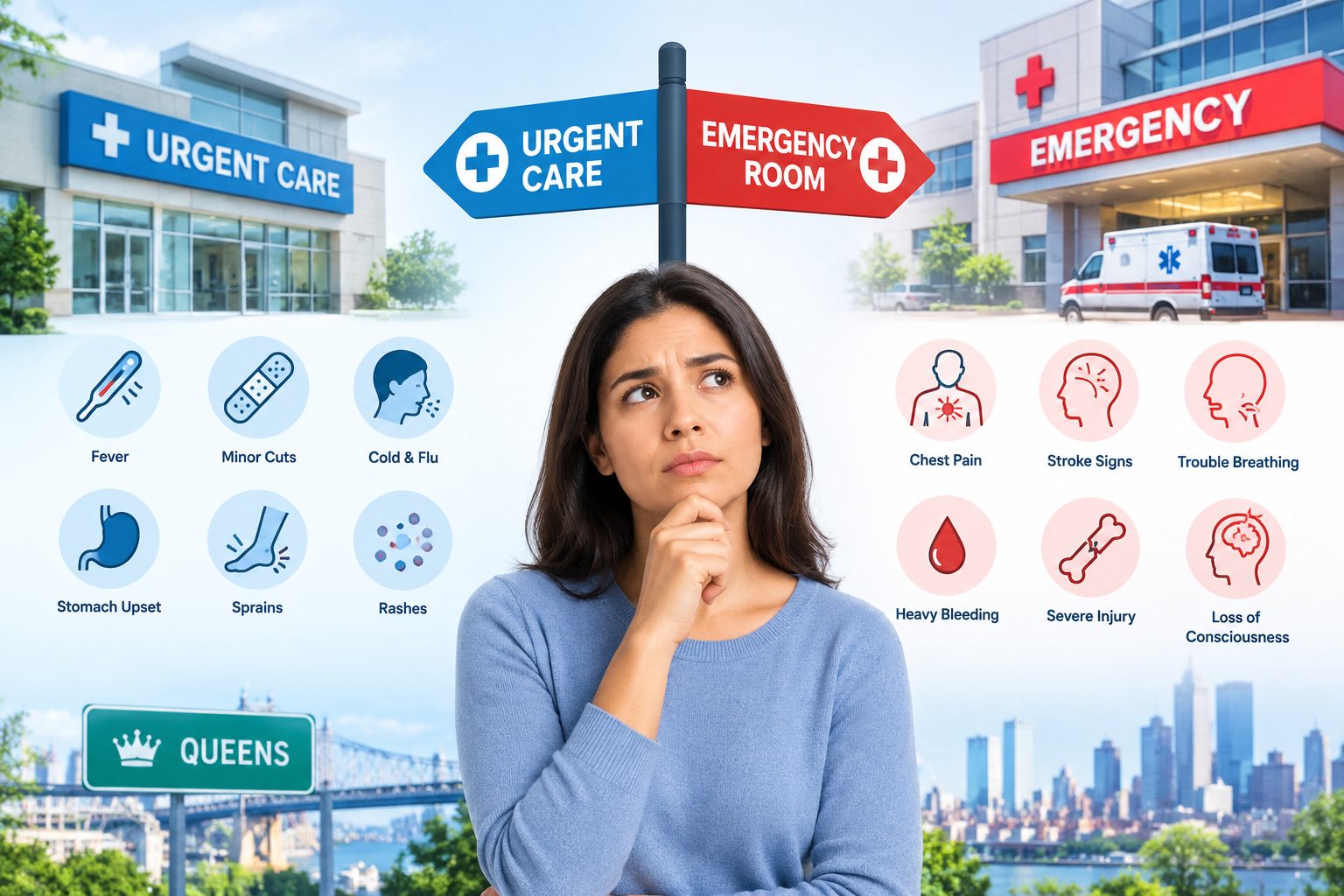
Table of contents
- 1. The Core Difference
- 2. Urgent Care and the ER Side by Side
- 3. Which Conditions Go Where
- 4. Five Red Flags That Mean 911
- 5. A Severity Scale
- 6. A Simple Decision Path
- 7. What the ER Can Do That Urgent Care Cannot
- 8. Sample Scenarios
- 9. If Urgent Care Sends You to the ER
- Conclusion
- Frequently Asked Questions
- See a Doctor in Elmhurst or Chinatown
When illness or injury strikes, the first decision is often the hardest: urgent care or the emergency room? Choose urgent care for a problem that is not life-threatening and you may be seen faster and spend less. Choose the ER when the problem is serious and you may lose precious time. The right choice depends on how severe the symptoms are, not on how scared you feel.
This guide compares urgent care and the emergency room side by side, shows which symptoms go where, lists five red flags that mean calling 911, offers a severity scale and walks through a decision path with real-life examples. It draws on guidance from the American College of Emergency Physicians and the American Stroke Association symptom guide. Services on site can differ, so ask City Prime Care what is available. This is general education, not personal medical advice, and you can also find the clinic on Google.
In this article:
- 1. The core difference
- 2. Urgent care and the ER side by side (table)
- 3. Which conditions go where (table)
- 4. Five red flags that mean 911
- 5. A severity scale (graph)
- 6. A simple decision path (table)
- 7. What the ER can do that urgent care cannot
- 8. Sample scenarios (table)
- 9. If urgent care sends you to the ER
1. The Core Difference
Emergency rooms are built for life-threatening and limb-threatening problems and are open around the clock with surgeons, specialists, advanced imaging and the ability to admit patients. Urgent care centers treat illnesses and injuries that need prompt attention but are not emergencies, with shorter waits for many minor problems. Neither is better in general. Each is best for a different level of severity.
If you are unsure, remember this simple rule: if you think the problem could cause death or permanent harm without immediate care, call 911 or go to the ER. For a wider guide, see where to go when illness strikes suddenly.
2. Urgent Care and the ER Side by Side
| Feature | Urgent care | Emergency room |
|---|---|---|
| Best for | Minor illness and injury that cannot wait for your doctor | Serious or life-threatening conditions |
| Typical wait | Often shorter for minor problems | Can be long, since the sickest patients are seen first |
| Hours | Often extended evenings and weekends; check hours | Open 24 hours a day, every day |
| Equipment | X-ray and rapid tests at many clinics | Advanced imaging such as CT and MRI, operating rooms and intensive care |
| Staff | Clinicians trained in general acute care | Emergency physicians, specialists and trauma teams |
| Cost | Generally lower for similar minor problems | Generally higher; varies by insurance |
| Admission | Cannot admit; refers when more care is needed | Can admit you to the hospital |
To see how a walk-in clinic fits in, read walk-in clinic vs urgent care and when to visit urgent care instead of waiting for your doctor.
3. Which Conditions Go Where
| Problem | Urgent care often fits | ER is the safer choice |
|---|---|---|
| Fever or flu symptoms | Adult with fever, cough and aches who is breathing normally | Trouble breathing, confusion or fever with stiff neck |
| Chest symptoms | Mild cough or chest cold | Chest pain, pressure or tightness, especially with sweating or shortness of breath |
| Injuries | Sprains, minor cuts, minor burns, suspected small fractures | Bone through skin, severe bleeding, head injury with confusion or vomiting |
| Stomach problems | Mild vomiting or diarrhea with fluids tolerated | Severe pain, vomiting blood or black stool |
| Urinary symptoms | Burning and urgency | High fever, severe flank pain or confusion |
| Allergic reactions | Mild hives or itching | Swelling of lips or throat, trouble breathing |
| Neurologic symptoms | Tension headache without red flags | Sudden weakness, facial droop, speech trouble or worst headache of life |
| Breathing | Mild asthma flare that responds to treatment | Struggling to breathe, blue lips or cannot speak in full sentences |
See also which infections and injuries an acute care visit can treat and sprain vs fracture: how to tell the difference.
4. Five Red Flags That Mean 911
Call 911 or go straight to the ER if you or someone with you has any of these:
- Chest pain, pressure or tightness, especially with shortness of breath, sweating, nausea or pain spreading to the arm, jaw or back.
- Signs of a stroke: sudden face drooping, arm weakness, speech difficulty, confusion, vision loss or a sudden severe headache.
- Trouble breathing, choking, blue lips, or swelling of the face, lips or throat after an allergen.
- Severe bleeding that does not stop with firm pressure, a deep wound, a bone through the skin or a serious head injury.
- Sudden confusion, loss of consciousness, a seizure, or thoughts of harming yourself or someone else.
Do not drive yourself if you are having chest pain, stroke signs or severe symptoms. Call 911 so treatment can begin on the way. Time matters most for heart attack and stroke. For more on stroke signs, see the stroke symptoms guide.
5. A Severity Scale
This graph is a simple way to think about severity. More blocks mean more urgent. Use it as a rule of thumb, and if you are unsure, move up one level.
| Severity level | Examples | Where to go (graph) |
|---|---|---|
| 1: Mild, can wait | Mild cold, mild rash, routine refill | █ Primary care appointment |
| 2: Needs care today | Sore throat with fever, minor cut, ear pain, UTI symptoms | ██ Urgent care or same-day doctor |
| 3: Needs prompt testing | Possible sprain or fracture, moderate flu, dehydration | ███ Urgent care with X-ray or labs |
| 4: Possibly serious | Persistent high fever, severe abdominal pain, deep wound | ████ Emergency room |
| 5: Life-threatening | Chest pain, stroke signs, trouble breathing, severe bleeding | █████ Call 911 |
6. A Simple Decision Path
Answer these questions in order and stop at the first yes.
| Question | If yes | If no |
|---|---|---|
| Could this threaten life, breathing or a limb right now? | Call 911 | Continue |
| Is there chest pain, stroke signs, severe bleeding or serious trouble breathing? | Call 911 | Continue |
| Is the problem serious but you can travel safely, such as a high fever with severe pain? | Go to the ER | Continue |
| Does it need attention today but not emergency treatment? | Go to urgent care | Continue |
| Can it wait for your doctor within a few days? | Call your primary care provider | Use self-care and watch for changes |
For options when you need a doctor the same day, see same-day doctor appointments in Elmhurst.
7. What the ER Can Do That Urgent Care Cannot
Emergency rooms are equipped for care that urgent care cannot provide:
- Advanced imaging such as CT scans and MRI, and rapid heart and stroke testing.
- Surgery and specialist care for trauma, heart attack, stroke and severe infections.
- Intravenous medicines and monitored care for unstable patients.
- Intensive care and admission to the hospital.
- Treatment of serious allergic reactions, overdoses and major injuries.
- Mental health crisis evaluation and stabilization.
Urgent care can still treat many conditions quickly and can refer you onward when needed through referral services.
8. Sample Scenarios
| Scenario | Best choice | Why |
|---|---|---|
| Sore throat, fever and swollen glands for two days | Urgent care | Rapid strep test and treatment are available |
| Twisted ankle, swelling, can put some weight on it | Urgent care | Exam and X-ray can check for a fracture |
| Sudden crushing chest pain and sweating | 911 and ER | Possible heart attack |
| Face drooping and slurred speech | 911 and ER | Possible stroke; every minute counts |
| Small cut that may need stitches, bleeding controlled | Urgent care | Cleaning, glue or stitches and tetanus check |
| Baby under 3 months old with a fever of 100.4°F or higher | ER | Young infants need urgent evaluation |
| Burning with urination, no fever | Urgent care | Urine test and treatment |
| Fall with head strike, vomiting and confusion | 911 and ER | Possible serious head injury |
For milder wounds you can manage first, see first aid at home for cuts and burns.
9. If Urgent Care Sends You to the ER
Sometimes a problem turns out to be more serious than it first looked. If the clinician finds something that needs hospital-level care, they will tell you and may help arrange transport. Go as directed and bring your discharge papers, medicine list and insurance information. This is not a mistake on your part. It means the system worked, because the clinician found a sign that needed more care.
After an ER visit, remember to:
- Ask for written instructions and a copy of your results.
- Follow up with your primary care provider within a few days.
- Fill prescriptions and take them exactly as directed.
- Return immediately if symptoms worsen or new warning signs appear.
Conclusion
Choose urgent care for problems that need prompt attention but are not life-threatening, and choose the emergency room or 911 when life, breathing or a limb is at risk. Learn the five red flags, use the severity scale and decision path, and when in doubt, choose the higher level of care.
Contact Us: To ask whether your problem can be seen at urgent care today, reach City Prime Care through our Contact Us page, or find us on Google. This article is for general information and does not replace personal medical advice. In an emergency, call 911.
Frequently Asked Questions
See a Doctor in Elmhurst or Chinatown
Have a question about your own health? Book a visit at our Elmhurst, Queens clinic or our Chinatown, Manhattan clinic, or explore our primary care services.
Related articles
Urgent Care
What Happens at Your First Urgent Care Visit in Elmhurst? Reading the Check-In Steps, the Five Things to Bring and the Sample Visit Timeline
Nervous about your first urgent care visit? See how check-in, triage and the exam work, the five things to bring, what tests and treatments to expect and a sample timeline from arrival to follow-up.
Urgent Care
Which Conditions Can Urgent Care in Elmhurst Treat? Reading the Fifteen-Condition List, the Five Quick Checks and the Sample Treatment Path
See 15 common conditions urgent care in Elmhurst can evaluate and treat, with signs, tests and usual treatment for each, plus five quick checks, what is not suited to urgent care and a sample treatment path.
Healthcare
Is It Normal Wear and Tear or Arthritis? Reading the Joint Pain Patterns, the Five Self-Care Steps and the Sample Joint-Protection Plan
Joint pain has many causes, from overuse to osteoarthritis, rheumatoid arthritis and gout. Learn how the patterns differ, what helps at home, when to see a doctor, when a hot swollen joint is urgent, and a sample joint-protection plan.





