
HealthcareBy City Prime Care Team
How Can You Recognize a Stroke in Time? Reading the BE-FAST Warning Signs, the Five Emergency Steps and the Sample Hospital Timeline
Stroke care is a race against time. Learn the BE-FAST warning signs, the five emergency steps, what happens at the hospital, why a TIA is a warning and which risk factors you can control.
Medically reviewed by City Prime Care Administrator9 min read
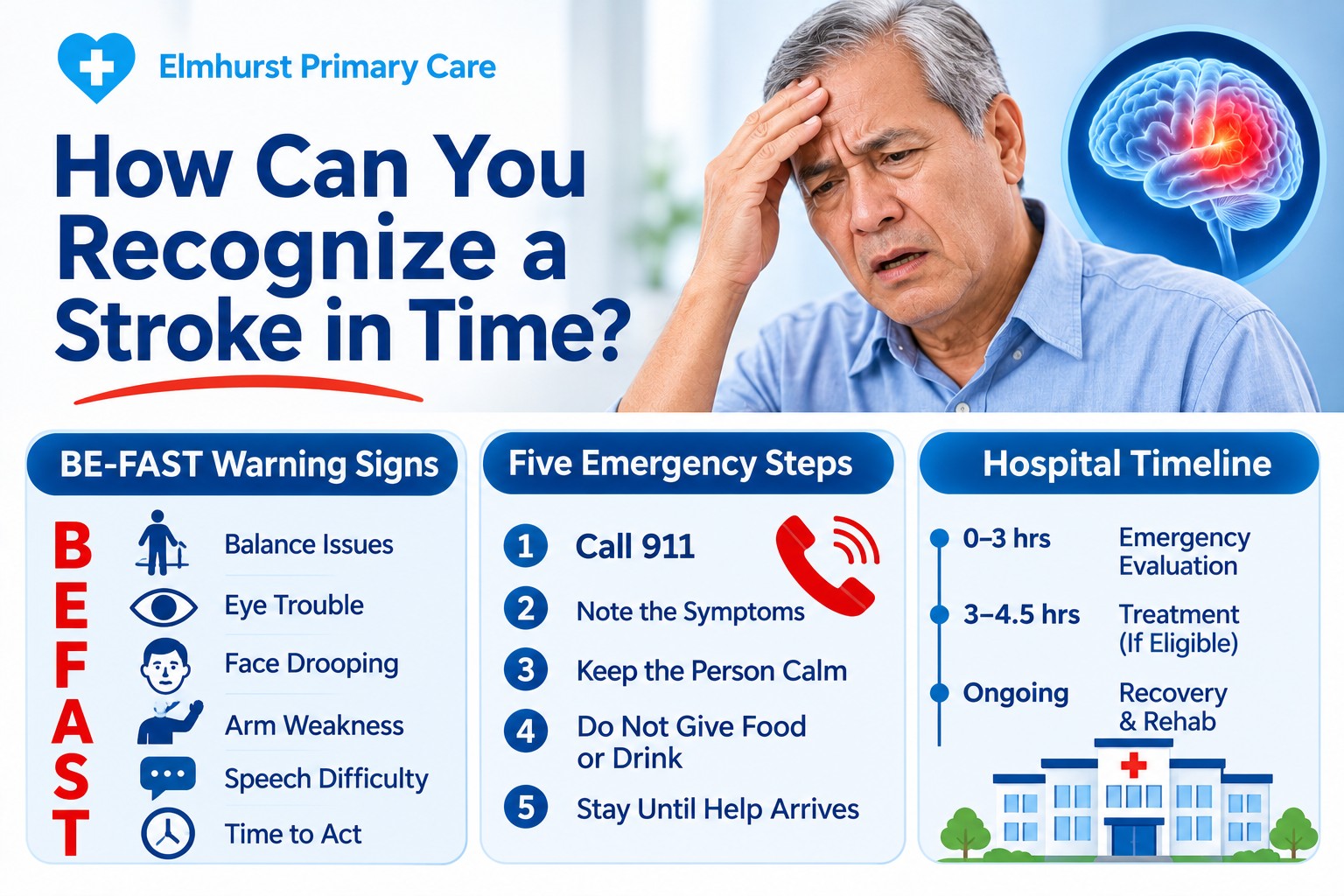
Table of contents
- 1. The Two Kinds of Stroke
- 2. The BE-FAST Warning Signs
- 3. The Five Emergency Steps
- 4. What Happens at the Hospital: A Sample Timeline
- 5. TIA: The Warning Stroke
- 6. Risk Factors You Can Control
- 7. Recovery and Follow-Up Care
- 8. Red Flags, When to Call and Booking
- Conclusion
- Frequently Asked Questions
- See a Doctor in Elmhurst or Chinatown
Every second counts in a stroke. Brain cells begin to die within minutes when blood flow stops, which is why stroke care is built around speed. The good news is that most people can learn the warning signs in a few minutes, and acting on them quickly gives the best chance of survival and recovery. Stroke is also largely preventable: many of the biggest risk factors can be treated.
This guide explains the two kinds of stroke, the BE-FAST warning signs, the five emergency steps to take, what happens at the hospital, how mini-strokes (TIAs) are warnings, the risk factors you can control and how a primary care clinic fits into prevention and recovery. It is general education, not personal medical advice, and it should never delay a 911 call. City Prime Care provides primary care in Elmhurst, and you can find the clinic on Google: City Prime Care on Google. See also the clinic's lifestyle counseling page.
In this article:
- 1. The two kinds of stroke (table)
- 2. The BE-FAST warning signs (table)
- 3. The five emergency steps
- 4. What happens at the hospital: a sample timeline (table and graph)
- 5. TIA: the warning stroke
- 6. Risk factors you can control (table)
- 7. Recovery and follow-up care
- 8. Red flags, when to call and booking
1. The Two Kinds of Stroke
Strokes are caused by either a blockage or a bleed. Treatment differs, which is why brain imaging at the hospital comes first.
| Type | What happens | How common | Typical cause |
|---|---|---|---|
| 1. Ischemic stroke | A clot or narrowed vessel blocks blood flow to part of the brain | About 87 out of 100 strokes | Fatty plaque, clots from the heart (for example in atrial fibrillation) |
| 2. Hemorrhagic stroke | A blood vessel in or around the brain bursts and bleeds | About 13 out of 100 strokes | High blood pressure, weak vessel walls (aneurysm) |
| 3. Transient ischemic attack (TIA) | A brief blockage with symptoms that resolve within minutes to hours | A warning sign, not harmless | Same causes as ischemic stroke |
The American Stroke Association offers more detail at stroke.org, and the Centers for Disease Control and Prevention has facts at cdc.gov.
2. The BE-FAST Warning Signs
BE-FAST is an easy way to remember the signs. They come on suddenly, often on one side of the body. Check each one, and call 911 if any of them is present.
| Letter | Sign | How to check |
|---|---|---|
| 1. B: Balance | Sudden loss of balance or coordination, dizziness | Can the person stand or walk steadily? |
| 2. E: Eyes | Sudden blurred, double or lost vision in one or both eyes | Ask about changes in vision or a dark patch |
| 3. F: Face | One side of the face droops | Ask the person to smile; is it uneven? |
| 4. A: Arm | Weakness or numbness in one arm or leg | Ask the person to raise both arms; does one drift down? |
| 5. S: Speech | Slurred, strange or confused speech; trouble understanding | Ask the person to repeat a simple sentence |
| 6. T: Time | Note the time symptoms started and call 911 right away | Time last seen normal is the key detail for treatment |
Other possible signs include a sudden severe headache with no known cause, confusion, trouble walking and nausea. Symptoms can be different in women, who may report general weakness, confusion or fainting. Do not wait to see if symptoms pass.
3. The Five Emergency Steps
If you see signs of a stroke in yourself or someone else:
- 1. Call 911 right away: Say you think it is a stroke and give your exact location. Do not drive yourself or the person to the hospital.
- 2. Note the time: Write down when symptoms started, or when the person was last seen well. This guides treatment choices.
- 3. Keep the person safe and comfortable: Have them sit or lie down, loosen tight clothing and stay with them. Do not give food, drink or medicine, including aspirin, unless the 911 operator tells you to.
- 4. Gather key information: Medicines the person takes, especially blood thinners, medical conditions and allergies. Bring pill bottles if you can.
- 5. Tell the team when they arrive: Report the start time, the symptoms and any changes, and send a family member to the hospital with contact details.
For help deciding where to go in other situations, see our guide on urgent care vs the emergency room. Stroke is always an emergency room situation, not an urgent care one. See also where to go when illness strikes suddenly.
4. What Happens at the Hospital: A Sample Timeline
Hospitals use stroke teams and standard goals to move quickly. The timeline below is an illustrative example of common national targets, not a promise for any one hospital. Each block shows relative time, and shorter is better.
| Step | Common goal | Relative time (graph) | What happens |
|---|---|---|---|
| 1. Arrival and triage | Within minutes | █░░░░░░░░░ | Quick check of signs, blood sugar, vital signs |
| 2. Brain scan (CT or MRI) | Often within about 20 to 25 minutes of arrival | ██░░░░░░░░ | Shows whether it is a clot or a bleed |
| 3. Lab tests and review | Within about 45 minutes | ████░░░░░░ | Blood tests, heart rhythm, medicines list |
| 4. Clot-dissolving medicine (if eligible) | Often within about 60 minutes of arrival; usually within 4.5 hours of onset | ██████░░░░ | Medicine given through a vein to break up the clot |
| 5. Clot removal procedure (if eligible) | Possible up to many hours after onset in selected patients | ████████░░ | A specialist removes a large clot with a thin tube |
| 6. Stroke unit and rehab planning | Starts within the first days | ██████████ | Monitoring, therapy and prevention plan |
These treatments do not suit every person, for example when there is bleeding in the brain. That is why a scan comes first and why the start time matters so much.
5. TIA: The Warning Stroke
A TIA causes the same signs as a stroke, but they fade within minutes to hours as the blockage clears. Many people feel fine afterwards and are tempted to ignore it. That is a mistake: a TIA is a strong warning that a larger stroke may follow, sometimes within days.
| Question | Answer |
|---|---|
| 1. Should I go to the ER after symptoms disappear? | Yes. Call 911 or go to the ER the same day; a rapid work-up can find the cause and start prevention |
| 2. What tests may be done? | Brain imaging, scans of the neck vessels, heart rhythm monitoring and blood tests |
| 3. What treatment follows? | Often a blood-thinning medicine, cholesterol and blood pressure treatment and a plan for any heart rhythm problem |
6. Risk Factors You Can Control
Many strokes are preventable. Controlling the factors below can lower risk significantly, and a primary care visit is a good place to start.
| Risk factor | Why it matters | What helps | Related reading |
|---|---|---|---|
| 1. High blood pressure | The leading controllable cause of stroke | Regular checks, medicines if needed, less salt, activity | Blood pressure guide |
| 2. Irregular heart rhythm (atrial fibrillation) | Clots form in the heart and travel to the brain | Rhythm check, blood-thinning medicine when advised | Heart palpitations |
| 3. High cholesterol | Builds plaque in neck and brain arteries | Diet, activity, statins when needed | Cholesterol guide |
| 4. Diabetes and prediabetes | Damage blood vessels over time | Blood sugar control, weight management | Prediabetes |
| 5. Smoking and vaping | Narrows vessels and makes blood stickier | Quit with medical support | Quit smoking or vaping |
| 6. Sleep apnea | Raises blood pressure and strains the heart | Sleep study and treatment | Could it be sleep apnea? |
| 7. Heavy alcohol use | Raises blood pressure and heart rhythm risk | Cut back or stop | How much alcohol is too much |
7. Recovery and Follow-Up Care
Recovery depends on the part of the brain affected and how quickly treatment started. Rehabilitation usually begins in the hospital and continues for weeks or months. It may include physical therapy for strength and walking, occupational therapy for daily tasks, speech therapy and support for mood, since depression and anxiety are common after a stroke.
A primary care clinician can help after a stroke or TIA by:
- Reviewing medicines, including blood thinners, blood pressure and cholesterol treatment
- Checking blood pressure, blood sugar and cholesterol regularly; see common blood tests
- Watching for low mood, anxiety and sleep problems; see stress, low mood and anxiety
- Coordinating referrals to neurology, cardiology and rehabilitation; see when your doctor refers you to a specialist
- Reducing the chance of falls; see fall prevention for seniors
8. Red Flags, When to Call and Booking
| Situation | Action |
|---|---|
| Any sudden BE-FAST sign: balance, eyes, face, arm or speech | Call 911 immediately, even if symptoms pass |
| Sudden, severe "worst ever" headache | Call 911 |
| Chest pain with sudden weakness, shortness of breath or fainting | Call 911; see chest discomfort decoded |
| Blood pressure readings repeatedly high at home | Book a visit soon and bring your log |
| Fluttering or irregular heartbeat | Book a visit for a heart rhythm check |
| You want a stroke-prevention review | Use the appointment page and choose Primary Care |
Conclusion
A stroke is a medical emergency, but it is also one where quick action changes the outcome. Learn the BE-FAST signs, note the time symptoms began, and call 911 without waiting to see whether things improve. The best long-term protection is steady control of blood pressure, cholesterol, blood sugar, heart rhythm and smoking.
Contact Us: To ask about stroke prevention, blood pressure checks or follow-up after an emergency, reach City Prime Care through our Contact Us page, or find the clinic on Google: City Prime Care on Google. This article is for general information and does not replace personal medical advice. If you think someone is having a stroke, call 911 immediately.
Frequently Asked Questions
See a Doctor in Elmhurst or Chinatown
Have a question about your own health? Book a visit at our Elmhurst, Queens clinic or our Chinatown, Manhattan clinic, or explore our primary care services.
Related articles
Healthcare
What Are the Warning Signs of Pneumonia, and Who Needs Care Fast? Reading the Symptom Clues, the Five Risk Groups and the Sample Recovery Timeline
Pneumonia is a lung infection that can be mild or serious. Learn how it differs from a cold or the flu, the warning signs, the five higher-risk groups, how severity is judged and what recovery usually looks like.
Healthcare
What Causes Acid Reflux, and When Is Heartburn More Than Heartburn? Reading the Trigger List, the Five Warning Signs and the Sample Meal-and-Sleep Plan
Occasional heartburn is common, but frequent reflux can damage the esophagus and sometimes mimics heart trouble. Learn the triggers, lifestyle steps and medicines, five warning signs, and a sample meal-and-sleep plan.
Healthcare
Chest Discomfort Decoded: Heartburn, Muscle Strain, Anxiety or Something Serious?
Chest pain can come from the heart, the stomach, the muscles or even stress. Learn the usual patterns, the warning signs of a heart attack, and why unexplained chest pain should never be ignored.





