
HealthcareBy City Prime Care Team
How Do Kidney Stones Cause Sudden Severe Pain? Reading the Warning Signs, the Five Prevention Steps and the Sample Stone-Size Outlook
Kidney stones can cause sudden, intense flank pain and blood in the urine. Learn the warning signs, how size affects passing a stone, five prevention steps, and when pain with fever or vomiting needs urgent care.
Medically reviewed by City Prime Care Administrator9 min read
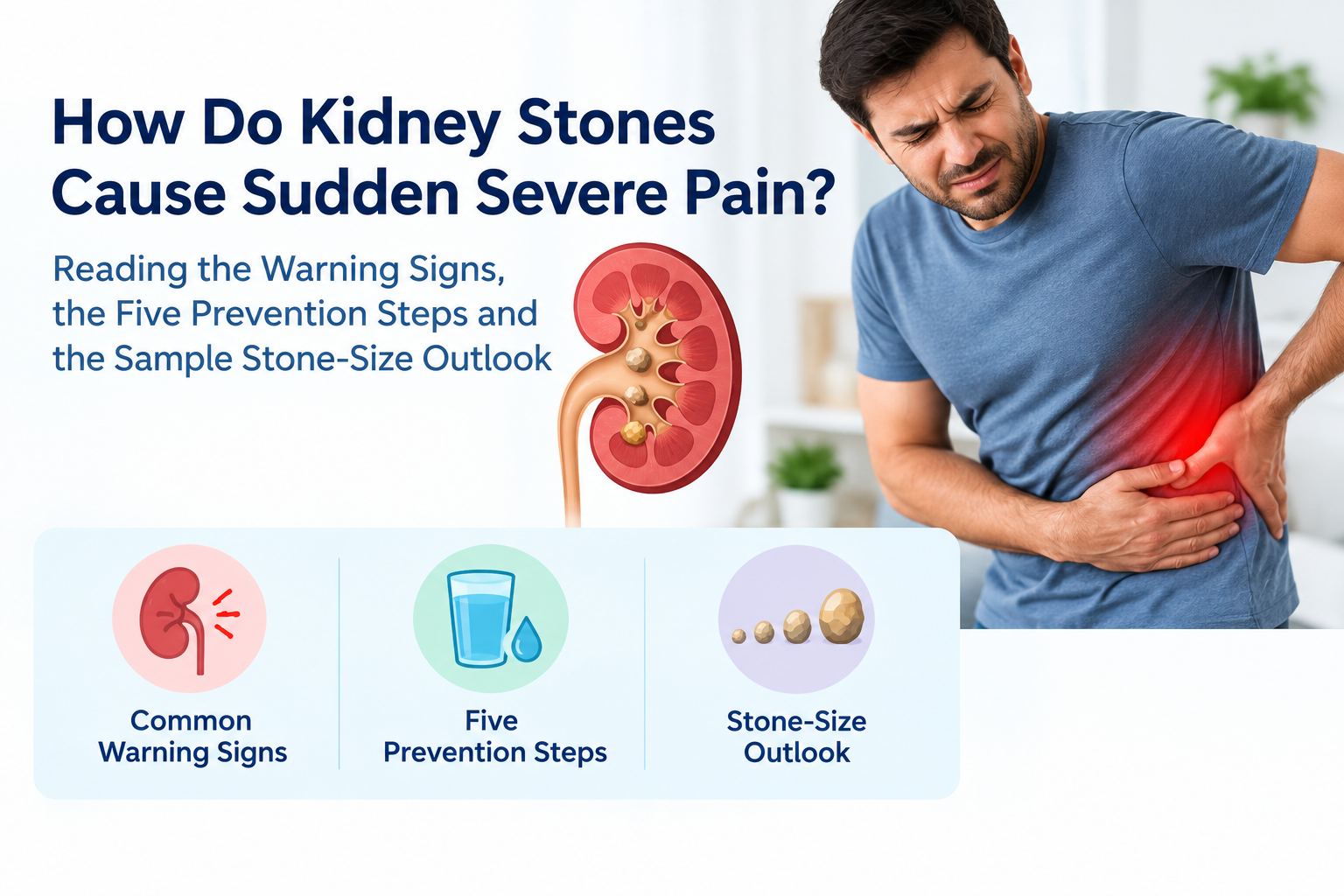
Table of contents
- 1. How Kidney Stones Form
- 2. Types of Kidney Stones
- 3. Reading the Warning Signs
- 4. Sample Stone-Size Outlook
- 5. How Stones Are Diagnosed and Treated
- 6. Red Flags: When to Seek Urgent Care
- 7. The Five Prevention Steps
- 8. Daily Habits and Follow-Up
- Conclusion
- Frequently Asked Questions
- See a Doctor in Elmhurst or Chinatown
Kidney stones are hard deposits of minerals and salts that form inside the kidneys. Small stones may pass without much notice. Larger stones can block the flow of urine and cause some of the most intense pain people describe, often coming in waves that start in the back or side and move toward the groin.
This guide reads the warning signs, shows how stone size affects the outlook, explains how clinicians diagnose and treat stones, and gives five practical prevention steps. It also covers the red flags that mean you should not wait. Because stone symptoms can overlap with infections, our article on urinary tract infections is a helpful companion.
In this article:
- 1. How kidney stones form
- 2. Types of stones (table)
- 3. Reading the warning signs
- 4. Sample stone-size outlook (graph)
- 5. How stones are diagnosed and treated
- 6. Red flags: when to seek urgent care
- 7. The five prevention steps
- 8. Daily habits and follow-up
1. How Kidney Stones Form
Urine normally contains minerals and salts dissolved in water. When there is too little fluid or too much of certain substances, crystals can clump together and grow into stones. Stones may stay in the kidney or travel into the ureter, the narrow tube leading to the bladder, where they can cause blockage and pain.
For general reading, see the MedlinePlus kidney stones page and the NIDDK kidney stone information.
2. Types of Kidney Stones
| Type | Relative frequency | Common contributors |
|---|---|---|
| 1. Calcium oxalate | Most common | Low fluid intake, high-sodium diet, high oxalate foods in some people |
| 2. Calcium phosphate | Less common | Certain metabolic conditions |
| 3. Uric acid | Less common | High-purine diet, gout, acidic urine |
| 4. Struvite | Less common | Recurrent urinary infections |
| 5. Cystine | Rare | Inherited condition |
A clinician can sometimes tell the type if you pass a stone and bring it for analysis, which guides prevention.
3. Reading the Warning Signs
| Symptom | What it may mean | Note |
|---|---|---|
| Sharp, cramping pain in the side or back, below the ribs | Stone moving or blocking the ureter | Often comes in waves |
| Pain spreading to the lower belly or groin | Stone moving toward the bladder | May shift location |
| Blood in the urine (pink, red, or brown) | Irritation from the stone | Needs medical review |
| Painful or frequent urination | Stone near the bladder or infection | Overlaps with UTI |
| Nausea and vomiting | Common with severe pain | Watch for dehydration |
| Cloudy or foul-smelling urine | Possible infection | Call a clinician |
| Restlessness, unable to get comfortable | Typical of stone pain | Different from pain that eases when still |
Flank pain is also a feature of muscle strain. Our guide on sprain vs fracture covers injury-related pain, while stone pain tends to be wave-like and unrelated to movement.
4. Sample Stone-Size Outlook
Size is one of the biggest factors in whether a stone passes on its own. The graph below is an approximate, illustrative guide based on commonly cited ranges. Individual outcomes vary and a clinician should assess your situation.
| Stone size | Chance of passing without a procedure (graph) | Typical approach |
|---|---|---|
| Under 4 mm | ████████░░ High | Fluids, pain control, watchful waiting |
| 4 to 6 mm | ██████░░░░ Moderate | Observation, possible medicines to help passage |
| 6 to 10 mm | ███░░░░░░░ Lower | Often needs urology input |
| Over 10 mm | █░░░░░░░░░ Low | Usually needs a procedure |
Passing a small stone can take days to a few weeks. Pain control, fluids, and follow-up are the focus during that time.
5. How Stones Are Diagnosed and Treated
A typical evaluation includes:
- History and exam: where the pain is, how severe, and any fever or urinary symptoms
- Urine tests to look for blood and signs of infection
- Blood tests to check kidney function and substances linked to stones; see our guide to common blood tests
- Imaging, such as a CT scan or ultrasound, to find the stone and see whether it blocks urine flow
- A treatment plan: pain relief, fluids, medicines to help passage when appropriate, or a procedure such as shock wave therapy or ureteroscopy for larger or blocking stones
- Follow-up and, if you pass a stone, testing it to guide prevention
Learn more about our diagnostic testing and referral services, which can connect you to specialists such as urologists.
6. Red Flags: When to Seek Urgent Care
| Warning sign | Why it matters | Action |
|---|---|---|
| Severe flank pain with fever or chills | Possible infected, blocked kidney | Go to the ER now |
| Pain so severe you cannot get comfortable | May need strong pain control or imaging | Seek urgent care or ER |
| Vomiting that prevents drinking fluids | Dehydration risk | Be seen the same day |
| Very little or no urine | Possible blockage | Go to the ER |
| Blood in the urine with dizziness or fainting | Needs urgent evaluation | Seek urgent care |
| Single kidney, kidney disease, or pregnancy with stone symptoms | Higher risk of complications | Be seen promptly |
If vomiting is limiting fluids, our guide on dehydration warning signs explains when IV fluids may help.
7. The Five Prevention Steps
These steps are widely recommended to lower the chance of new stones:
- Drink enough fluids through the day. Many guidelines aim for urine output of roughly 2 to 2.5 liters daily, though your clinician may give a personal target.
- Check your urine color. Pale yellow suggests good hydration, and darker urine is a cue to drink more.
- Limit sodium. Too much salt raises calcium in urine and the risk of stones.
- Eat balanced portions of animal protein, and keep dietary calcium normal, since cutting calcium can sometimes raise stone risk. Ask a clinician about oxalate if you form calcium oxalate stones.
- Follow up and ask about testing. Blood and urine tests, plus stone analysis, can reveal causes and guide medicines if you are a repeat stone former.
8. Daily Habits and Follow-Up
Everyday habits that support kidney health:
- Carry a water bottle and drink steadily, especially in hot weather or during exercise
- Add lemon or citrus to water if your clinician agrees, since citrate can help some people
- Keep a healthy weight and stay active
- Manage conditions such as diabetes and high blood pressure; see our guides on type 2 diabetes and high blood pressure
- Review medicines and supplements with your clinician, as some raise stone risk
- Schedule regular checkups; see our annual physical guide
Conclusion
Kidney stones are painful but often treatable, and many can be prevented with hydration and smart habits. The key is to recognize the warning signs, seek urgent care when fever, vomiting, or blockage is present, and follow up to prevent the next stone.
Contact Us: If you have urinary symptoms, a history of stones, or questions about prevention, reach City Prime Care through our Contact Us page. This article is for general education and does not replace personal medical advice. For severe pain with fever or inability to urinate, seek emergency care or call 911.
Frequently Asked Questions
See a Doctor in Elmhurst or Chinatown
Have a question about your own health? Book a visit at our Elmhurst, Queens clinic or our Chinatown, Manhattan clinic, or explore our primary care services.
Related articles
Healthcare
Chest Discomfort Decoded: Heartburn, Muscle Strain, Anxiety or Something Serious?
Chest pain can come from the heart, the stomach, the muscles or even stress. Learn the usual patterns, the warning signs of a heart attack, and why unexplained chest pain should never be ignored.
Healthcare
Sore Throat That Won't Quit: When It's Strep and When It's Not
Not every sore throat is strep. Learn how strep throat differs from a viral sore throat, how the rapid test works, why antibiotics matter, home care tips, and warning signs to watch.
Healthcare
Flu vs Cold vs COVID-19 in Queens, NY: Symptoms, Home Care, and When to See a Doctor
Not sure if it is the flu, a cold, or COVID-19? Compare symptoms side by side, learn how to care for yourself at home, and know the warning signs that mean it is time to get medical care.





