
HealthcareBy City Prime Care Team
Why Does Intense Itching Worsen at Night With Tiny Bumps Between Your Fingers, and Is It Scabies? Reading the Rash Clues, the Five Treatment Steps and the Sample Four-Week Clearing Timeline
Relentless nighttime itching with tiny bumps between the fingers can point to scabies, a mite infestation that spreads through close contact. Learn the rash clues, five treatment steps and a sample four-week clearing timeline.
Medically reviewed by Dr. Karl E. Latortue11 min read
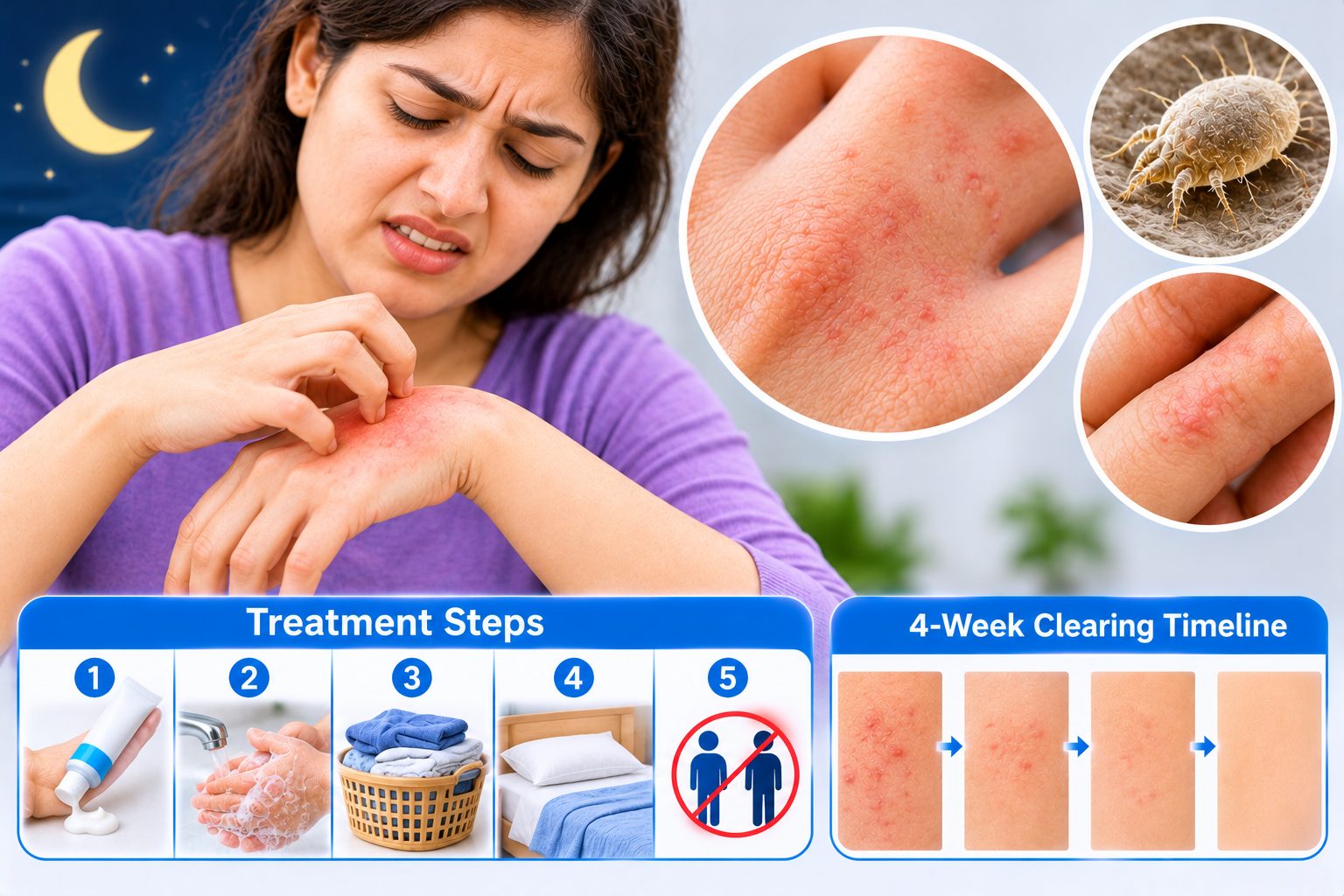
Table of contents
- 1. What Is Scabies?
- 2. Reading the Rash Clues
- 3. Scabies vs Look-Alike Rashes
- 4. How Scabies Spreads and Who Is at Higher Risk
- 5. How a Clinician Diagnoses Scabies
- 6. The Five Treatment Steps
- 7. Treatment Options at a Glance
- 8. Graph: Illustrative Itch Intensity After Treatment
- 9. Sample Four-Week Clearing Timeline
- 10. Red Flags: When to Get Care Promptly
- 11. Where to Get Care: Elmhurst, Chinatown and Lower Manhattan
- 12. Related Reading From City Prime Care
- 13. Contact Us
- Conclusion
- Frequently Asked Questions
- See a Doctor in Elmhurst or Chinatown
It starts as a small itch, then becomes an urge to scratch that grows stronger every evening and keeps you awake at night. You may notice tiny red bumps or thin wavy lines between your fingers, on your wrists or around your waist. Family members or a partner may begin to itch too. This pattern is the classic story of scabies, a skin infestation caused by a microscopic mite called Sarcoptes scabiei. It is common, it is not a sign of poor hygiene, and it is very treatable once it is recognized.
This guide explains the rash clues, how scabies differs from look-alike rashes, five treatment steps, a sample four-week clearing timeline and the red flags that need prompt care. City Prime Care serves patients in Elmhurst, Queens, Chinatown and Lower Manhattan. This article is general education and not a substitute for personal medical advice. The CDC also explains scabies in its scabies resource page.
Quick takeaways:
- Scabies causes intense itching that is usually worse at night, with tiny bumps, blisters or thin burrow lines in skin folds.
- It spreads through prolonged skin-to-skin contact and sometimes shared bedding, so close contacts usually need treatment at the same time.
- Prescription creams or tablets kill the mites, but itching can continue for two to four weeks after successful treatment.
- Treat the household together and wash bedding and clothing in hot water; crusted sores, fever or spreading redness need prompt care.
1. What Is Scabies?
Scabies happens when female mites burrow into the top layer of skin to lay eggs. The itching is an allergic reaction to the mites, their eggs and their waste, which is why it often takes two to six weeks to appear after a first infestation. If a person has had scabies before, symptoms can start within a few days of a new exposure.
Because the mites are tiny, you usually cannot see them. A clinician diagnoses scabies from the pattern of the rash, where it appears, who else is itching and sometimes by scraping the skin to look for mites under a microscope. Early treatment protects family members and reduces the chance of skin infection from scratching.
2. Reading the Rash Clues
| Body area | What you may see | Why it matters |
|---|---|---|
| Between the fingers | Tiny bumps, blisters or thin gray-white wavy lines | The most typical site; often the first clue |
| Wrists, elbows, armpits | Red itchy bumps, scratch marks | Common burrowing sites |
| Waistline, belt line, buttocks | Clusters of small red bumps | Where clothing sits against the skin |
| Genitals and breasts | Itchy nodules that persist | Often missed and mistaken for other conditions |
| Palms and soles in infants | Blisters or pustules | Infants and toddlers may also have it on the scalp and face |
| Face and scalp in adults | Usually spared | If the face is involved in an adult, other causes become more likely |
Itching that worsens at night, the same symptoms in more than one household member and bumps in skin folds are the three strongest clues.
3. Scabies vs Look-Alike Rashes
| Condition | Typical clue | How it differs from scabies |
|---|---|---|
| Eczema | Dry, patchy, long-standing itch; often a personal or family allergy history | Not contagious and does not usually affect several household members |
| Bug bites | Scattered bites, often on exposed skin, each with a central puncture | Bites do not form burrows or spread through the household; see bug bites and bee stings |
| Ringworm | Ring-shaped patch with a clear center and a scaly edge | A single expanding ring rather than widespread tiny bumps; see ringworm |
| Seborrheic dermatitis | Greasy flakes on the scalp, brows and sides of the nose | Targets oily areas; see itchy flaky scalp |
| Rosacea | Flushing and bumps across the cheeks and nose | Facial redness without burrows or night itching; see rosacea |
| Contact dermatitis | Rash where a product or plant touched the skin | Follows a clear exposure pattern and improves when the trigger is removed |
4. How Scabies Spreads and Who Is at Higher Risk
Scabies passes most easily through:
- Prolonged skin-to-skin contact, such as living in the same household or sharing a bed.
- Sexual contact; partners often need treatment together.
- Crowded settings including nursing homes, shelters, child care centers and dormitories.
- Shared bedding, towels and clothing in some cases, particularly with heavy infestations.
- People with weakened immune systems and older adults, who can develop crusted (Norwegian) scabies with very high mite counts.
Scabies does not spread from pets. Animal mites cause a brief, mild itch in people but do not live on human skin.
5. How a Clinician Diagnoses Scabies
A visit usually includes:
- A history of itching pattern, timing, household members with symptoms, recent travel, shelter or care-facility stays and sexual contacts.
- A skin exam of the finger webs, wrists, waistline, genitals and other folds, sometimes with a magnifying dermatoscope.
- A skin scraping, when needed, to look for mites, eggs or droppings under a microscope.
- A review of medicines and allergies before choosing treatment; see when your primary care doctor sends you to a specialist if the rash is unclear or severe.
- A plan for treating close contacts at the same time, even if they have no itching yet.
A negative scraping does not rule out scabies, because only a few mites may be present. Clinicians often treat based on the pattern when the story fits.
6. The Five Treatment Steps
If scabies is suspected or confirmed:
- Get a diagnosis and a prescription: over-the-counter itch creams do not kill mites, so a clinician should choose a scabicide such as permethrin cream or oral ivermectin.
- Apply treatment exactly as directed: with permethrin, apply from the neck down to the toes (including under nails, between fingers and in skin folds) and leave on for about 8 to 14 hours before washing off; children and older adults may also need the scalp, face and neck treated.
- Treat everyone together: household members, sexual partners and close contacts should be treated at the same time, even without symptoms, and the treatment is usually repeated after 7 to 14 days if advised.
- Clean the environment: wash bedding, towels and clothing worn in the past three days in hot water and dry on high heat; items that cannot be washed can be sealed in a plastic bag for at least three days.
- Calm the itch and protect the skin: use cool compresses, moisturizer and a clinician-approved antihistamine at night, trim nails and avoid scratching open the skin.
Do not use animal or agricultural scabies products on people, and do not apply treatment more often than prescribed.
7. Treatment Options at a Glance
| Option | How it is used | Notes |
|---|---|---|
| Permethrin 5% cream | Applied neck to toes, washed off after about 8 to 14 hours, repeated in 1 to 2 weeks | Often first choice; considered safe for most adults, children over 2 months and pregnancy |
| Oral ivermectin | Tablets by body weight, repeated after about 2 weeks | Useful when many people need treatment or creams are hard to apply; not for very small children or pregnancy |
| Sulfur ointment | Applied for several nights in a row | An option for infants or pregnancy when advised by a clinician |
| Benzyl benzoate or crotamiton | Applied as directed | Second-line options in some situations |
| Antihistamines and mild steroid creams | Short-term for itch and inflammation | Do not kill mites, but help sleep and comfort |
| Antibiotics | If sores become infected | Needed only when impetigo or cellulitis develops; see impetigo |
8. Graph: Illustrative Itch Intensity After Treatment
This is a teaching graph, not patient data. It shows how itching can stay high for a while after the mites are killed, because the skin keeps reacting to dead mites and debris. Real recovery varies with the person and the treatment.
| Time | Itch level before and after treatment (illustrative) |
|---|---|
| Before treatment | ██████████ |
| Day 3 | █████████ |
| Week 1 | ███████ |
| Week 2 | █████ |
| Week 3 | ███ |
| Week 4 | █ |
9. Sample Four-Week Clearing Timeline
| When | Goal | Sample actions | Check |
|---|---|---|---|
| Day 0 | Confirm and start treatment | Visit, exam, first dose of treatment, wash bedding, treat household | Did every close contact start treatment? |
| Days 1-3 | Reduce spread | Change clothes and bedding daily, keep nails short, avoid skin contact | Are items washed in hot water? |
| Day 7-14 | Repeat treatment | Second application or dose if prescribed | Was the repeat done on schedule? |
| Weeks 2-3 | Calm lingering itch | Moisturizer, antihistamine at night, cool compresses | Is itch fading and are new burrows absent? |
| Week 4 | Recheck | Follow-up visit if itch or new bumps continue | No new lesions for two weeks means likely cleared |
10. Red Flags: When to Get Care Promptly
See a clinician promptly for:
- Itching that continues for more than four weeks, or new burrows after treatment.
- Yellow crusts, oozing, pus, warm swollen skin or red streaks that suggest a skin infection.
- Fever, severe pain or spreading redness.
- Thick, crusted, scaly skin in an older person, a person with a weakened immune system or someone in a care facility.
- An infant or toddler with blisters on the palms and soles, who should be seen quickly.
- Pregnancy or breastfeeding, so a safe treatment can be chosen.
11. Where to Get Care: Elmhurst, Chinatown and Lower Manhattan
Intense itching and a spreading rash are a common reason people search for urgent care Elmhurst NY, a walk in clinic Elmhurst NY, urgent care 11373, a same day doctor appointment Elmhurst or Same-Day Acute Care in Elmhurst Queens. For household treatment plans, follow-up and ongoing skin and wellness care, patients choose a primary care doctor Elmhurst NY, a family doctor Elmhurst Queens, Primary Care Doctors in Elmhurst NY or chronic disease management Elmhurst NY.
People comparing options often search for Best Primary Care Clinic in Elmhurst Queens, Best Primary Care Doctor in Elmhurst Queens, Primary Care Near Me Elmhurst Queens, Best Primary Care Clinics in Queens NY, Primary Care Clinics and Doctors in Queens NY and Top Primary Care Clinics in Queens NY. City Prime Care offers Men's and Women's Healthcare in Elmhurst NY, a physical exam clinic Elmhurst NY and preventive care Elmhurst NY, including skin checks and treatment for common rashes.
Downtown, people look for primary care Lower Manhattan, primary care Chinatown NYC, a doctor near Catherine Street NYC, primary care 75 Catherine St, a walk-in clinic Chinatown NYC, a Primary Care Clinic in Chinatown Manhattan or a Healthcare Center in Chinatown Manhattan NY. Citywide searches include primary care doctor NYC, family doctor Manhattan NYC, annual physical exam NYC, same day primary care NYC, preventive care Lower Manhattan and primary care doctor near me. Residents searching for Primary Care Doctors Serving Todt Hill Staten Island are welcome to contact the clinic to ask about care options and travel.
| Area | Common searches | How care can help |
|---|---|---|
| Elmhurst (ZIP 11373) | Urgent care 11373, same day doctor appointment Elmhurst | Same-day rash exam and treatment plan |
| Elmhurst, Queens | Family doctor Elmhurst Queens, primary care doctor Elmhurst NY | Household treatment plan and follow-up |
| Queens | Best Primary Care Clinics in Queens NY, Top Primary Care Clinics in Queens NY | Easy-to-reach primary care for the family |
| Lower Manhattan | Primary care Lower Manhattan, preventive care Lower Manhattan | Convenient visits near work |
| Chinatown / Catherine Street | Primary care Chinatown NYC, doctor near Catherine Street NYC, primary care 75 Catherine St | Convenient downtown care |
| Citywide | Primary care doctor NYC, family doctor Manhattan NYC, same day primary care NYC | Same-day or scheduled evaluation |
You can also find the clinic on Google or learn more on the City Prime Care website.
12. Related Reading From City Prime Care
These guides on our site cover connected topics:
- Impetigo: honey-colored crusty sores
- Rosacea: facial redness and triggers
- Ringworm: red itchy ring-shaped patch
- Bug bites and bee stings: when swelling is an allergic reaction
- Itchy flaky scalp: dandruff or seborrheic dermatitis
- Wart types and treatment
- Hair thinning and hair loss
- When your primary care doctor sends you to a specialist
13. Contact Us
Is an itchy rash keeping you or your family awake? Visit our Contact Us page or see our Google listing. If you have fever, spreading redness or pus-filled sores, seek care promptly.
Conclusion
Scabies can feel embarrassing and exhausting, but it is common and curable. The keys are an accurate diagnosis, the right prescription used exactly as directed, treating every close contact at the same time and washing bedding and clothing properly. Expect the itch to fade gradually over a few weeks, and return for a recheck if new burrows or bumps keep appearing.
Frequently Asked Questions
See a Doctor in Elmhurst or Chinatown
Have a question about your own health? Book a visit at our Elmhurst, Queens clinic or our Chinatown, Manhattan clinic, or explore our primary care services.
Related articles
Healthcare
Why Is a Red, Itchy Ring-Shaped Patch Spreading on Your Skin, and Is It Ringworm? Reading the Patch Types, the Five Treatment Steps and the Sample Four-Week Clearing Plan
A red, scaly, ring-shaped itchy patch is often ringworm, a common fungal skin infection that is not caused by a worm. Learn the patch types, look-alike rashes, five treatment steps and a four-week clearing plan.
Healthcare
Why Is a Rough Bump Growing on Your Hand or the Bottom of Your Foot, and Is It a Wart? Reading the Wart Types, the Five Treatment Steps and the Sample Twelve-Week Clearing Plan
Rough bumps on the hands or soles of the feet are often warts caused by HPV. Learn the wart types, five treatment steps, red flags and a sample twelve-week clearing plan.
Healthcare
Chickenpox in Adults and Children in Elmhurst, NY: How the Rash Develops and What to Expect
Itchy red spots that turn into blisters and then crusts are the classic sign of chickenpox. Learn how the rash develops, how long you are contagious, five care steps, a ten-day timeline and when to see a doctor.