
HealthcareBy City Prime Care Team
What Do Queens Families Look for in a Primary Care Practice? Reading the Family Needs, the Five Fit Checks and the Sample Year of Care
Families need a primary care practice that is close, affordable and easy to talk to. See the needs that matter, five fit checks, how City Prime Care describes its approach, and a sample year of care for a household.
Medically reviewed by City Prime Care Administrator9 min read
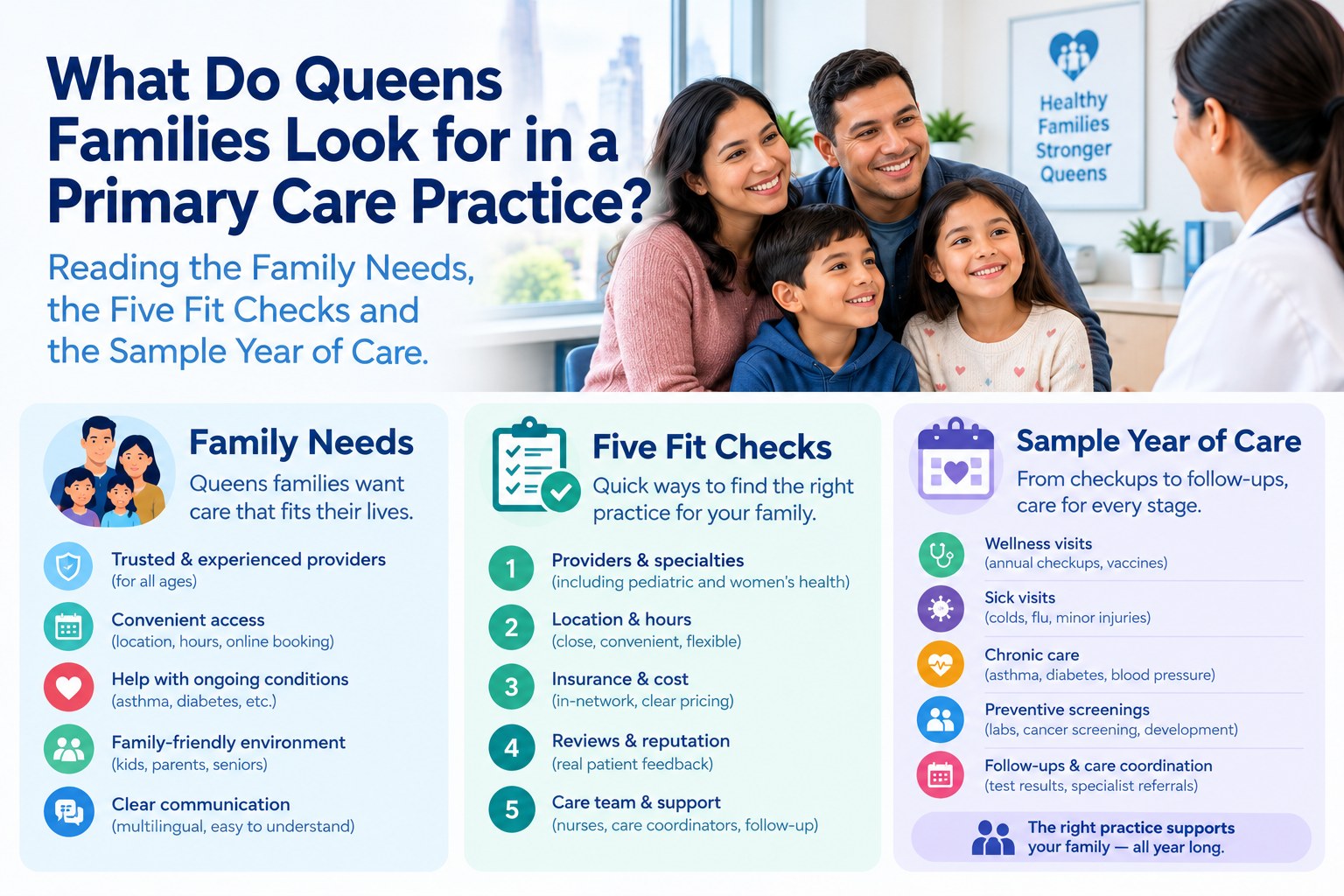
Table of contents
- 1. What Families Need Most
- 2. Matching Needs to Life Stages
- 3. How City Prime Care Describes Its Approach
- 4. The Five Fit Checks
- 5. A Sample Year of Care
- 6. Insurance and Cost: A Family Checklist
- 7. Language, Access, and Accessibility
- 8. When the Family Needs More Than a Weekday Clinic
- Conclusion
- Frequently Asked Questions
- See a Doctor in Elmhurst or Chinatown
Choosing a primary care practice for a household is different from choosing one for yourself. Families juggle school and work schedules, mixed insurance, several languages at home, relatives who need extra care, and the very practical question of how to get everyone to the same place without losing a day. The right practice makes the whole year smoother, and the wrong one adds stress to every visit.
This guide lays out what Queens families commonly need from a primary care practice, how City Prime Care describes its own approach on its website, five fit checks you can apply to any clinic, and a sample year of care showing how prevention and follow-up might fit together. It reflects general information and what the clinic publishes about itself, not a claim about any individual family's experience. Please confirm details such as ages seen and appointment options directly with the clinic.
In this article:
- 1. What families need most (table)
- 2. Matching needs to life stages (table)
- 3. How City Prime Care describes its approach
- 4. The five fit checks
- 5. A sample year of care (graph)
- 6. Insurance and cost: a family checklist
- 7. Language, access, and accessibility
- 8. When the family needs more than a weekday clinic
1. What Families Need Most
Ask a dozen families what they want from their clinic and the answers are remarkably consistent. Most boil down to access, trust, and continuity.
| Need | What it looks like in practice | Question to ask a clinic |
|---|---|---|
| 1. Easy access | Close to home, work, or school, with reachable phones and booking | How do I book, and what are your hours? |
| 2. Insurance that works | Everyone's plan accepted, with no billing surprises | Is each family member's exact plan accepted? |
| 3. Language | Staff or interpreters who speak the family's languages | What languages do you cover, and how are interpreters arranged? |
| 4. Unhurried visits | Time to ask questions and have things explained clearly | How long are typical visits? |
| 5. Continuity | The same team over the years | Can we see the same provider each time? |
| 6. Prevention | Screenings, vaccines, and checkups kept on schedule | How do you remind us about screenings and vaccines? |
| 7. Care coordination | Referrals and test results that do not get lost | How do referrals and results work? |
2. Matching Needs to Life Stages
Different family members need different things from primary care. The table below maps common needs to the services City Prime Care lists on its site. Please note that the clinic describes itself as serving adults and families, so ask directly about the ages it sees if you are looking for care for a young child.
| Family member | Common needs | Relevant clinic service |
|---|---|---|
| Working-age adult | Annual physical, blood pressure and cholesterol checks, sick visits | Primary care, preventive care |
| Woman | Well-woman exam, Pap smear, birth control, menopause care | Women's health |
| Man | Physical with blood pressure, cholesterol, testosterone, and prostate checks | Men's health |
| Adult with a long-term condition | Diabetes, high blood pressure, cholesterol, or asthma plans | Chronic disease management |
| Older relative | Medication review, mobility and safety questions, caregiver involvement | Geriatric care |
| Anyone needing guidance on habits | Diet, activity, stress, and sleep | Lifestyle counseling |
Our guides on high blood pressure, type 2 diabetes, asthma, and sleep explain these topics in detail.
3. How City Prime Care Describes Its Approach
According to its about page, City Prime Care began with the idea that primary care works best when your doctor knows you, your history, and your neighborhood. The practice says its care is built around the relationship between patient and provider, with unhurried visits, results explained in plain language, and the same team following your care from year to year, including arranging referrals and staying involved afterward.
| What the clinic says | What it can mean for a family |
|---|---|
| Visits are unhurried and results explained in plain language | Parents and caregivers can ask questions without feeling rushed |
| The same team follows your care year to year | Less repeating of history; easier to track changes |
| It serves diverse neighborhoods and coordinates interpreters | Families who speak several languages can get support in their own |
| Two clinics, in Elmhurst, Queens and Chinatown, Manhattan | Options if home and work are in different places |
| Medicaid, Medicare, and many commercial plans accepted | Families with mixed coverage may be able to use one practice; confirm each plan |
| Providers certified by national boards for their professions | Credentials are listed on each provider's profile |
These are the clinic's own statements and should be read as such. The best way to know whether the fit is right is to visit. You can meet the listed providers on the doctors page and read the clinic's reviews.
4. The Five Fit Checks
Apply these checks to any clinic you are considering for your family:
- Access check: Can you realistically get there? Time the trip from home and work, and think about the weekday hours. The Elmhurst clinic lists Monday to Friday, 9:00 AM to 6:00 PM, and is closed on weekends.
- Coverage check: Call with every family member's exact plan and member ID. Ask about copays, referrals, and any plan that needs a primary care provider assignment.
- Language check: Ask which languages the care team speaks and how interpreters are arranged for the rest.
- People check: Ask who you would see, whether you can keep the same provider, and how the team handles questions between visits.
- Coordination check: Ask how referrals, test results, and reminders for screenings and vaccines work, and who follows up.
For first-visit logistics, see the clinic's new patients page and our article on choosing a trusted primary care clinic in Queens.
5. A Sample Year of Care
The calendar below is an illustrative example of how preventive and follow-up care might be spread across a year for an adult household. It is not medical advice, and your clinician will tailor timing to your age, history, and risk. Each block represents the relative amount of planned care activity in that period.
| Period | Care activity (graph) | Example focus |
|---|---|---|
| January-March | ███████░░░ | Annual physicals; review of chronic conditions; screening plans |
| April-June | █████░░░░░ | Allergy season check-ins; follow-up on lab results; referrals completed |
| July-September | ████░░░░░░ | Travel and hydration advice; prepare for flu season; school or work forms |
| October-December | ██████░░░░ | Flu and other adult vaccines; blood pressure and blood sugar rechecks; refill planning |
Related reading: flu vs cold vs COVID-19, seasonal allergies, adult vaccines, and the annual physical guide. For vaccine schedules, the CDC adult immunization schedule is a standard reference.
6. Insurance and Cost: A Family Checklist
Households often have more than one kind of coverage. A parent might have employer insurance, a grandparent Medicare, and another family member Medicaid. The clinic's insurance page says it accepts New York Medicaid, Medicare, Medicaid managed care plans from Fidelis Care, Healthfirst, and MetroPlus Health, and a range of commercial plans including Aetna, Cigna, UnitedHealthcare, Empire BlueCross, Anthem Blue Cross, EmblemHealth, and Oscar Health. It asks patients to call to confirm their specific plan.
| Step | What to do |
|---|---|
| 1 | Collect every family member's insurance card and note plan names and member IDs |
| 2 | Call the clinic and confirm each plan; mention if someone has both Medicare and Medicaid |
| 3 | Ask your plan about copays, deductibles, and referral rules |
| 4 | If your card lists a different primary care provider, ask your plan about changing it |
| 5 | If someone is uninsured, ask about self-pay rates and check eligibility on NY State of Health or the New York State Medicaid page |
The full list is on the clinic's insurance page.
7. Language, Access, and Accessibility
Practical access points for families:
- The Elmhurst care team is listed as speaking English and Spanish, and the Chinatown team English, Chinese, and Spanish; other languages are supported through professional interpreters at no cost if requested at booking
- The Elmhurst clinic is a few blocks from the 74 St-Broadway / Jackson Heights-Roosevelt Av hub, served by the 7, E, F, M, and R trains, with several bus routes at the Roosevelt Avenue hub
- There is no patient parking lot, and street parking around Broadway and 75th Street is metered and fills early on weekdays
- If someone uses a wheelchair, walker, or stroller, tell the desk when booking so step-free help can be arranged
- Neighborhood pages describe routes from Jackson Heights, Sunnyside, Astoria, Long Island City, and Maspeth
- Check the MTA site for elevator and service updates before you go
8. When the Family Needs More Than a Weekday Clinic
No primary care practice can cover everything. Because the clinic lists weekday hours only, families should plan for evenings, weekends, and emergencies.
| Situation | Suggested step |
|---|---|
| Chest pain, trouble breathing, signs of stroke, serious injury | Call 911 or go to the ER |
| A problem that cannot wait but is not an emergency, outside clinic hours | Urgent care or your plan's nurse line; see our guide on when to visit urgent care |
| A new problem during weekday hours | Call the clinic early and ask about same-day appointments held back each weekday |
| Routine checkups, vaccines, refills | Book ahead and keep a shared family calendar |
| Cuts or burns at home | See our guide to first aid for cuts and burns |
Conclusion
Families do best with a practice that is reachable, accepts their coverage, speaks their language, and knows them over time. Use the fit checks, ask direct questions, and book a first visit to see how the team works with you.
Contact Us: To ask about booking for your household, check coverage, or find out which services fit your family, reach City Prime Care through our Contact Us page, or learn more about the Elmhurst clinic. This article is for general information and does not replace personal medical advice. In an emergency, call 911.
Frequently Asked Questions
See a Doctor in Elmhurst or Chinatown
Have a question about your own health? Book a visit at our Elmhurst, Queens clinic or our Chinatown, Manhattan clinic, or explore our primary care services.
Related articles
Healthcare
How Do You Find a Trusted Primary Care Clinic Near You in Queens? Reading the Clinic Signals, the Five Steps and the Sample Travel Times
Choosing a primary care clinic in Queens is easier with a checklist. Compare clinic types, read the trust signals, follow five steps, and see sample travel times to the Elmhurst clinic from nearby neighborhoods.
Healthcare
Does Urgent Care Really Make More Sense Than Waiting for Your Doctor? What Your Symptoms Reveal, the Urgency Test It Turns On, and What Each Care Option Counts
This guide explains how to decide between visiting urgent care and waiting for a regular doctor's appointment based on whether symptoms are new, worsening, or significantly affecting daily activities. It also covers when stable concerns can wait, how same-day urgent care can help when primary care is unavailable, and when emergency medical care is more appropriate.
Healthcare
Who Will You See at Your Elmhurst Primary Care Visit? Reading the Provider Roles, the Five Questions and the Sample Care-Team Handoff
Physicians, nurse practitioners and physician assistants all provide primary care. Learn how their roles differ, meet the providers listed at the Elmhurst clinic, and see five questions and a sample care-team handoff.





