
HealthcareBy City Prime Care Team
Who Will You See at Your Elmhurst Primary Care Visit? Reading the Provider Roles, the Five Questions and the Sample Care-Team Handoff
Physicians, nurse practitioners and physician assistants all provide primary care. Learn how their roles differ, meet the providers listed at the Elmhurst clinic, and see five questions and a sample care-team handoff.
Medically reviewed by City Prime Care Administrator8 min read
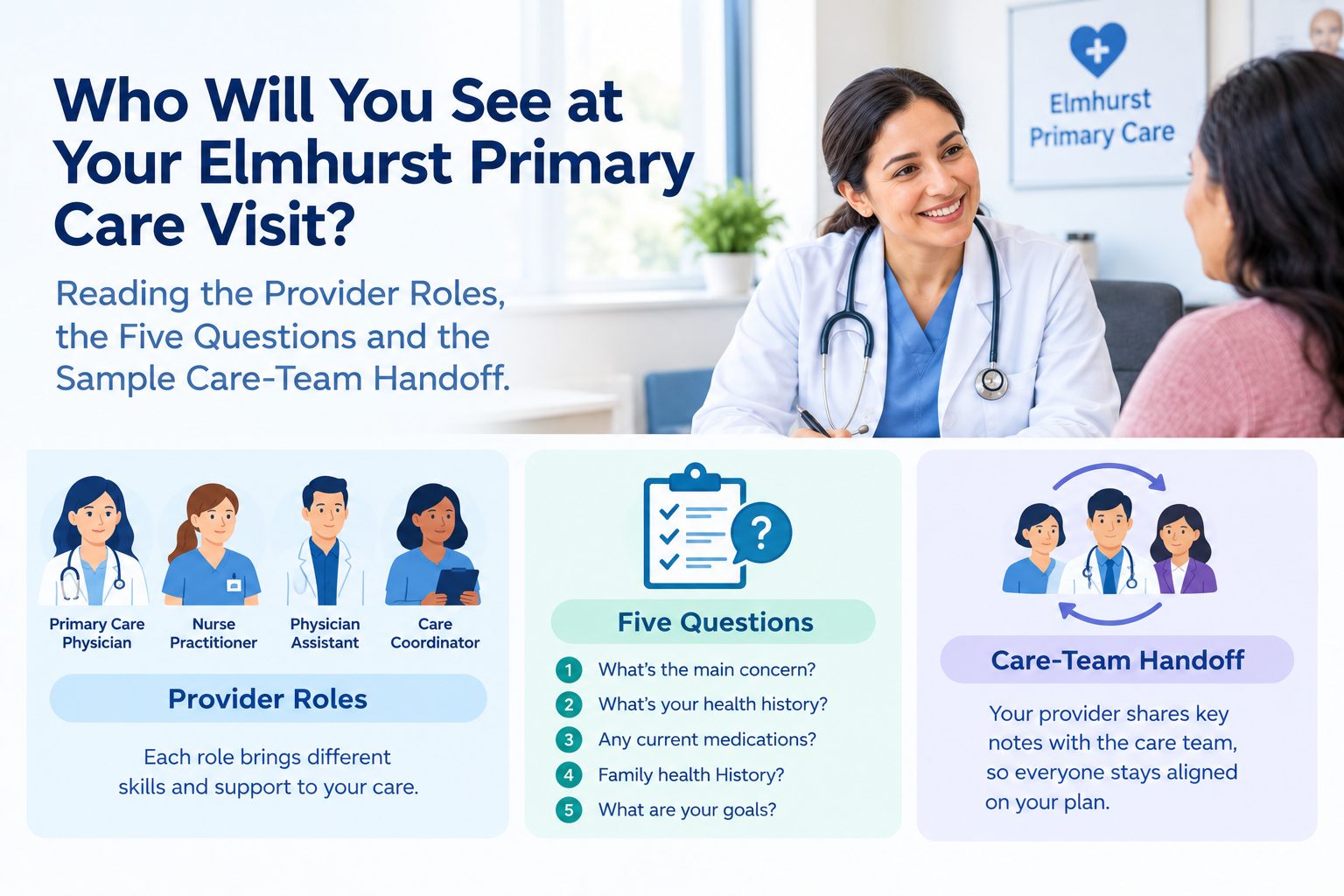
Table of contents
- 1. Physician, Nurse Practitioner, or Physician Assistant?
- 2. Providers Listed at the Elmhurst Clinic
- 3. Experience at a Glance
- 4. Languages and Interpreters
- 5. The Five Questions to Ask Your Provider
- 6. A Sample Care-Team Handoff
- 7. Why Continuity Matters
- 8. Our Chinatown Team and How to Choose
- Conclusion
- Frequently Asked Questions
- See a Doctor in Elmhurst or Chinatown
Most people know their doctor's name but are less sure what the other members of a care team do. In modern primary care, physicians, nurse practitioners, and physician assistants all see patients for checkups, sick visits, and long-term care, and they often work side by side. Understanding who does what helps you book the right visit and ask the right questions.
This article explains how those roles differ, introduces the providers listed on the City Prime Care website for the 75th Street clinic in Elmhurst, shows five questions worth asking at any new practice, and walks through a sample care-team handoff. Provider details below come from the clinic's own doctors and about pages. They can change, so please confirm current availability on the doctors page or by contacting the clinic.
In this article:
- 1. Physician, NP, or PA: how the roles differ (table)
- 2. Providers listed at the Elmhurst clinic (table)
- 3. Experience at a glance (graph)
- 4. Languages and interpreters
- 5. The five questions to ask your provider
- 6. A sample care-team handoff
- 7. Why continuity matters
- 8. Our Chinatown team and how to choose
1. Physician, Nurse Practitioner, or Physician Assistant?
All three are licensed health professionals who can examine patients, order tests, diagnose common conditions, and prescribe medicine within the scope of their license and practice setting. They differ in training path and in how they work with other team members.
| Role | Typical training | Common focus in primary care | How they work in a team |
|---|---|---|---|
| 1. Physician (MD or DO) | Medical school followed by residency training | Complex or multiple conditions, diagnosis, long-term management | Often leads the care team and consults with colleagues |
| 2. Nurse practitioner (NP) | Registered nurse plus advanced nursing degree and clinical training | Whole-person care, chronic conditions, prevention, counseling | Works independently or collaboratively depending on state rules and practice |
| 3. Physician assistant (PA) | Master's-level PA program with clinical rotations | Checkups, acute illness, ongoing care, procedures | Practices with a physician collaboration arrangement as required by law |
Each profile on the clinic's site lists certification and background so you can see how the provider trained. To check any license yourself, use the NYS Office of the Professions verification page.
2. Providers Listed at the Elmhurst Clinic
The doctors page lists the following providers at the 41-02 75th St, Elmhurst clinic. The details below summarize what each public profile states.
| Provider | Role | Experience listed | Board certification listed | Languages listed |
|---|---|---|---|---|
| 1. Dr. Karl E. Latortue, MD | Medical Director and family medicine physician | 20+ years | American Board of Family Medicine | English |
| 2. Sumakmur Holiwell, PA | Physician assistant | 12+ years | National Commission on Certification of Physician Assistants | English, Indonesian |
| 3. Dr. Helen Vasquez, MD | Geriatric medicine physician | 20+ years | American Board of Family Medicine | English |
Mr. Holiwell's profile says he completed a master's degree in advanced physician assistant studies at Touro University's School of Health Sciences in Manhattan and works with patients on health choices. Dr. Vasquez's profile describes longer appointments for older patients and a focus on working with caregivers as part of the visit. Dr. Latortue and Dr. Vasquez are also listed at the Chinatown clinic.
3. Experience at a Glance
Years of experience is only one signal, but it can help you understand the range of a team. The graph below uses the minimum experience figures stated on each profile; each block represents about two years.
| Provider | Listed experience (graph) | Years stated |
|---|---|---|
| Dr. Karl E. Latortue, MD | ██████████ | 20+ |
| Dr. Helen Vasquez, MD | ██████████ | 20+ |
| Sumakmur Holiwell, PA | ██████░░░░ | 12+ |
Experience is a starting point. Fit, communication, and continuity often matter just as much, which is why the questions in section 5 are worth asking.
4. Languages and Interpreters
Describing a symptom is easier in the language you think in. The clinic states that its Elmhurst care team speaks English and Spanish, and that it arranges a professional medical interpreter at no cost for any other language when you tell the staff while booking. You should not have to rely on a relative to translate.
| Need | What to do |
|---|---|
| Care in Spanish | Mention it when you book so you can be scheduled accordingly |
| Another language | Tell the staff at booking so an interpreter can be arranged |
| Hearing or other communication needs | Tell the desk in advance so they can plan support |
| Privacy during interpretation | Ask that a professional interpreter be used instead of a family member |
5. The Five Questions to Ask Your Provider
At a first visit with any provider, these five questions can set up a better working relationship:
- Who will I usually see, and who covers when you are away? This clarifies continuity and what happens during time off.
- How do I reach you or the team with questions between visits, and how quickly can I expect a reply?
- What do you recommend for prevention based on my age and history, such as screenings and vaccines?
- If I need a specialist or test, how do referrals and results work, and who follows up with me?
- What should I do if something changes or I feel worse, including after hours?
Prevention is a good topic to raise early. Our guides on annual physicals and screenings and adult vaccines can help you prepare.
6. A Sample Care-Team Handoff
Good care often involves several people, and the quality of the handoffs between them matters. The flow below is an illustrative example of how a visit may move across a primary care team. It describes a general pattern, not the clinic's internal procedures.
| Stage | Who is typically involved | What happens | Handoff (graph) |
|---|---|---|---|
| 1. Booking and check-in | Front desk | Confirms insurance, forms, and reason for visit | ██░░░░░░░░ |
| 2. Intake | Clinical staff | Records vital signs and medicines | ████░░░░░░ |
| 3. Visit | Physician, NP, or PA | History, exam, and a plan | ████████░░ |
| 4. Orders and referrals | Provider and clinical staff | Labs, prescriptions, or specialist referral | ██████░░░░ |
| 5. Follow-up | Team and patient | Results review and next visit scheduled | ██████████ |
Learn how results are explained in our article on understanding your diagnostic testing results, and see the clinic's referral services and diagnostic testing pages.
7. Why Continuity Matters
The clinic's about page says its approach centers on a relationship between patient and provider, with the same team following your care from year to year. Continuity helps in practical ways.
Benefits of seeing the same team over time:
- You do not have to retell your whole history at every visit
- Changes in blood pressure, weight, or lab results are easier to spot
- Medicines and allergies are tracked in one place
- Providers can notice when something does not look like you
- Referrals and follow-ups are less likely to be dropped
Chronic conditions benefit especially. See our guides on high blood pressure and type 2 diabetes, and the clinic's chronic disease management page.
8. Our Chinatown Team and How to Choose
City Prime Care also has a clinic at 75 Catherine St in Chinatown, Manhattan. The doctors page lists Danielle Nikezic, NP, a family nurse practitioner, at that location, along with Dr. Latortue and Dr. Vasquez, and states that the Chinatown team speaks English, Chinese, and Spanish. You can read more on the Chinatown clinic page.
| If you need | Consider |
|---|---|
| A clinic close to Elmhurst, Jackson Heights, or Sunnyside | The Elmhurst clinic on 75th Street |
| Care in Chinese | The Chinatown clinic |
| Care for an older family member with several medicines | Ask about geriatric care and longer visits |
| A particular provider | Ask the front desk when booking; the clinic says it tries to keep you with the provider you know |
| Not sure who to pick | Describe what you need and let the desk match you |
Conclusion
A good primary care team is more than one name on a door. Knowing the roles, asking a few direct questions, and valuing continuity will help you get more from every visit.
Contact Us: To ask about a specific provider, languages, or booking, reach City Prime Care through our Contact Us page, or visit the Elmhurst clinic page. This article is for general information and does not replace personal medical advice. In an emergency, call 911.
Frequently Asked Questions
See a Doctor in Elmhurst or Chinatown
Have a question about your own health? Book a visit at our Elmhurst, Queens clinic or our Chinatown, Manhattan clinic, or explore our primary care services.
Related articles
Healthcare
What Do Queens Families Look for in a Primary Care Practice? Reading the Family Needs, the Five Fit Checks and the Sample Year of Care
Families need a primary care practice that is close, affordable and easy to talk to. See the needs that matter, five fit checks, how City Prime Care describes its approach, and a sample year of care for a household.
Healthcare
What Can You Expect at the Elmhurst Clinic on 75th Street? Reading the Service List, the Weekday Hours and the Sample Visit Flow
A practical look at the City Prime Care clinic at 41-02 75th St in Elmhurst: the services offered, weekday hours, how to get there, what to bring, and a sample visit flow from check-in to follow-up.
Healthcare
How Do You Find a Trusted Primary Care Clinic Near You in Queens? Reading the Clinic Signals, the Five Steps and the Sample Travel Times
Choosing a primary care clinic in Queens is easier with a checklist. Compare clinic types, read the trust signals, follow five steps, and see sample travel times to the Elmhurst clinic from nearby neighborhoods.





