
HealthcareBy City Prime Care Team
How Can You Spot Skin Cancer Early? Reading the ABCDE Mole Signs, the Five Self-Check Steps and the Sample Monthly Skin-Check Log
Skin cancer is the most common cancer, and it is easiest to treat when found early. Learn the ABCDE mole signs, the main skin cancer types, a five-step self-check, a sample monthly log and when to see a doctor.
Medically reviewed by City Prime Care Administrator9 min read
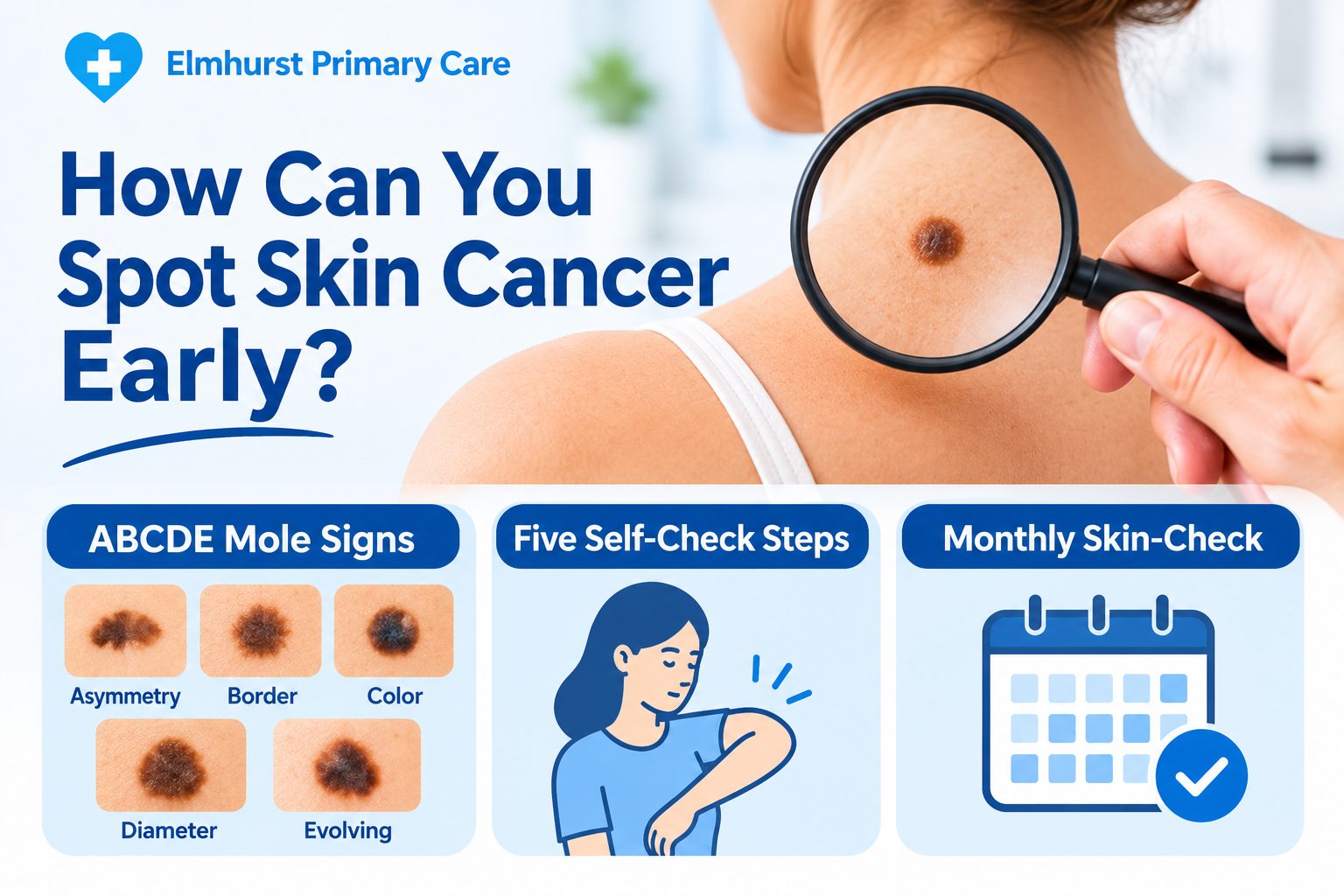
Table of contents
- 1. The Three Main Types of Skin Cancer
- 2. The ABCDE Rule for Moles
- 3. Why Early Detection Matters
- 4. Who Is at Higher Risk
- 5. A Five-Step Skin Self-Check
- 6. A Sample Monthly Skin-Check Log
- 7. Prevention and Sun Safety
- 8. When to See a Doctor, Red Flags and Booking
- Conclusion
- Frequently Asked Questions
- See a Doctor in Elmhurst or Chinatown
Skin is the body's largest organ, and it is also the place where cancer is easiest to see. Skin cancer is the most common cancer in the United States, and most types grow slowly and are highly treatable when found early. The challenge is that early skin cancers are often painless, so many people only notice them by accident. A few minutes of looking, once a month, can change that.
This guide explains the three main skin cancer types, the ABCDE rule for checking moles, who is at higher risk, a five-step self-check, a sample monthly log, how a clinician examines your skin and when a spot needs prompt attention. It is general education, not personal medical advice, and it cannot diagnose a spot. City Prime Care provides primary care in Elmhurst, and you can find the clinic on Google: City Prime Care on Google. See also the clinic's lifestyle counseling page for sun, sleep and habit support.
In this article:
- 1. The three main types of skin cancer (table)
- 2. The ABCDE rule for moles (table)
- 3. Why early detection matters (graph)
- 4. Who is at higher risk
- 5. A five-step skin self-check
- 6. A sample monthly skin-check log (table)
- 7. Prevention and sun safety
- 8. When to see a doctor, red flags and booking
1. The Three Main Types of Skin Cancer
Not every skin cancer looks like a dark mole. The three common types differ in appearance, speed of growth and seriousness. Melanoma is less common than the other two but is more likely to spread if it is not treated early.
| Type | What it often looks like | Where it appears | How serious |
|---|---|---|---|
| 1. Basal cell carcinoma | A pearly or waxy bump, a flat flesh-colored scar-like patch, or a sore that bleeds and does not heal | Face, ears, neck and other sun-exposed areas | Most common; grows slowly and rarely spreads, but can damage nearby tissue |
| 2. Squamous cell carcinoma | A firm red nodule, or a scaly, crusted patch that may bleed | Face, lips, ears, hands and other sun-exposed areas | Second most common; can spread if neglected |
| 3. Melanoma | A new dark spot, or a mole that changes in shape, color or size | Back and legs most often, but anywhere, including under nails and on the soles | Least common but most dangerous; best outcomes come from early removal |
| 4. Precancerous patches (actinic keratosis) | Rough, dry, scaly patches that feel like sandpaper | Scalp, face, ears, backs of hands | Not cancer yet, but some can turn into squamous cell cancer |
The American Academy of Dermatology offers photo examples on aad.org and the American Cancer Society explains each type at cancer.org.
2. The ABCDE Rule for Moles
Dermatologists use the ABCDE rule to decide which moles deserve a closer look. A mole does not need to meet every letter to be worth checking. Any one change is enough reason to ask a clinician.
| Letter | What to look for | Healthy mole usually | Concerning spot may be |
|---|---|---|---|
| 1. A: Asymmetry | Compare one half to the other | Both halves match | One half looks different from the other |
| 2. B: Border | Look at the edge | Smooth, even edge | Ragged, notched, blurred or uneven edge |
| 3. C: Color | Look at the shades | One even color | Several shades of brown, black, tan, red, white or blue |
| 4. D: Diameter | Measure across | Smaller than about 6 mm (a pencil eraser) | Larger than 6 mm, though melanomas can be smaller |
| 5. E: Evolving | Compare with past photos | Looks the same over months | Changes in size, shape, color, height, or starts to itch, crust or bleed |
Another useful clue is the "ugly duckling" sign: a mole that looks different from all the others on your body deserves attention even if it does not fit the ABCDE letters neatly.
3. Why Early Detection Matters
The graph below is an illustrative guide, not exact statistics. It shows the general pattern reported by cancer organizations: the earlier melanoma is found, the higher the chance that treatment removes it completely. Each block represents roughly the relative chance of long-term cure.
| Stage when found | Relative chance of cure (graph) | What it means |
|---|---|---|
| 1. Localized (only in the skin) | ██████████ Very high | Often cured by a minor procedure to remove the spot |
| 2. Regional (nearby lymph nodes) | ███████░░░ Lower | Needs wider surgery and sometimes further treatment |
| 3. Distant (spread to other organs) | ███░░░░░░░ Much lower | Needs specialist cancer treatment |
This is why skin checks are described as a preventive habit, similar to the screenings in our preventive care checklist by age.
4. Who Is at Higher Risk
Anyone can develop skin cancer, including people with darker skin, but risk is higher for people who:
- Have fair skin, light hair or eyes, or freckle and burn easily
- Have had several blistering sunburns, especially in childhood
- Used tanning beds, which raise melanoma risk
- Have many moles (more than about 50) or unusual-looking moles
- Have a personal or family history of skin cancer or melanoma
- Have a weakened immune system, for example after an organ transplant or on certain medicines
- Spend a lot of time outdoors for work or sport, including in New York summers and at the beach
- Notice a sore that does not heal, whatever their skin tone
In people with darker skin, melanoma more often appears on the palms, soles, under the nails or in the mouth, where sun exposure is not the main cause, so it is easier to miss. Check those areas too.
5. A Five-Step Skin Self-Check
Once a month, in good light and in front of a full-length mirror:
- 1. Check your face, scalp and ears: Use a hand mirror and part your hair with a comb or hair dryer to see the scalp.
- 2. Check your trunk and arms: Look at the chest, stomach, underarms, both sides of arms and hands, including between the fingers and under the nails.
- 3. Check your back and buttocks: Use a hand mirror, or ask a partner to look at areas you cannot see.
- 4. Check your legs and feet: Look at the fronts, backs and sides of the legs, the soles, between the toes and under the toenails.
- 5. Compare and record: Note any new, changed or itchy spots and take a dated close-up photo with a coin or ruler beside it for size.
Wounds and spots that behave differently from a normal bruise or scrape are worth noting. For persistent itchy or scaly patches that may be something else, see our guide on itchy rashes.
6. A Sample Monthly Skin-Check Log
The log below is an illustrative example of how to track spots over three months. Photographs taken in the same light make comparisons much easier than memory.
| Month | Spot and location | Size and look | Change since last month | Action |
|---|---|---|---|---|
| 1. January | Mole on left shoulder blade | 4 mm, round, even brown | First record | Photograph and keep watching |
| 2. February | Mole on left shoulder blade | 4 mm, same | No change | Keep watching |
| 3. March | Mole on left shoulder blade | 6 mm, one edge now uneven, darker patch | Grew and changed color | Book a visit this week |
| 4. March | Rough patch on right ear | Scaly, 5 mm, bleeds when scratched | New | Book a visit; do not pick at it |
Bring your photos to the appointment. They help the clinician see how fast a spot is changing.
7. Prevention and Sun Safety
| Habit | Why it helps | Practical tip |
|---|---|---|
| 1. Broad-spectrum sunscreen | Blocks UVA and UVB rays | Use SPF 30 or higher; apply a generous amount and reapply about every two hours and after swimming or sweating |
| 2. Seek shade at midday | UV is strongest in the middle of the day | Plan outdoor activity earlier or later when you can |
| 3. Cover up | Clothing is reliable protection | Wear a wide-brim hat, sunglasses with UV protection and lightweight long sleeves |
| 4. Avoid tanning beds | They raise melanoma risk | There is no safe tan from a bed; consider a self-tanner instead |
| 5. Check the medicines you take | Some medicines make skin more sun-sensitive | Ask your clinician or pharmacist; see our guide on managing many medicines |
| 6. Keep a yearly skin exam | Finds spots you cannot see | Raise it at your yearly physical; see the annual physical guide |
Sun safety also matters on cloudy days and in winter, since UV rays pass through clouds. The Centers for Disease Control and Prevention has sun safety tips at cdc.gov.
8. When to See a Doctor, Red Flags and Booking
A primary care clinician can examine a spot, decide whether it looks harmless or needs a biopsy, and refer you to a dermatologist when needed. See our guide on when your primary care doctor sends you to a specialist to understand how referrals and insurance steps work, and whether insurance pays for preventive care.
| Situation | Action |
|---|---|
| A mole that is asymmetric, has an uneven border, several colors, is growing or is changing | Book a visit soon; do not wait for the next yearly exam |
| A sore that does not heal in about four weeks, or bleeds repeatedly | Book a visit |
| A dark streak under a fingernail or toenail that you did not cause by injury | Book a visit promptly |
| A new lump on the skin that is firm, growing or tender | Book a visit promptly |
| A spot that has bled heavily, or an infected-looking wound with spreading redness, fever or pus | Go to urgent care; see urgent care vs the ER |
| You have many moles, a family history or past skin cancer | Ask for a full-body skin exam and a screening schedule |
| You want to book an exam | Use the appointment page and choose Primary Care |
Conclusion
Skin cancer is common, but it is also among the most treatable cancers when it is caught early. A monthly look, photographs for comparison and a prompt visit for anything new or changing are simple habits that make a real difference. Most spots turn out to be harmless, and checking them gives you certainty.
Contact Us: To ask about a skin concern or to schedule an exam, reach City Prime Care through our Contact Us page, or find the clinic on Google: City Prime Care on Google. This article is for general information and does not replace personal medical advice. In an emergency, call 911.
Frequently Asked Questions
See a Doctor in Elmhurst or Chinatown
Have a question about your own health? Book a visit at our Elmhurst, Queens clinic or our Chinatown, Manhattan clinic, or explore our primary care services.
Related articles
Healthcare
What Are the Warning Signs of Pneumonia, and Who Needs Care Fast? Reading the Symptom Clues, the Five Risk Groups and the Sample Recovery Timeline
Pneumonia is a lung infection that can be mild or serious. Learn how it differs from a cold or the flu, the warning signs, the five higher-risk groups, how severity is judged and what recovery usually looks like.
Healthcare
How Do You Know If a Head Injury Is a Concussion? Reading the Symptom Checklist, the Five Danger Signs and the Sample Return-to-Activity Plan
A concussion does not need a knockout and often shows nothing on a scan. Learn the symptom checklist, the five danger signs that need the ER, how recovery usually goes and a step-by-step return-to-activity plan.
Healthcare
How Can You Recognize a Stroke in Time? Reading the BE-FAST Warning Signs, the Five Emergency Steps and the Sample Hospital Timeline
Stroke care is a race against time. Learn the BE-FAST warning signs, the five emergency steps, what happens at the hospital, why a TIA is a warning and which risk factors you can control.





