
HealthcareBy City Prime Care Team
Is This Just a Headache? How to Tell Tension Headaches, Migraines and Warning-Sign Headaches Apart
Not every headache is the same. Compare tension headaches, migraines and cluster headaches, learn common triggers, home-care steps, and the warning signs that mean a headache needs urgent attention.
Medically reviewed by City Prime Care Administrator9 min read
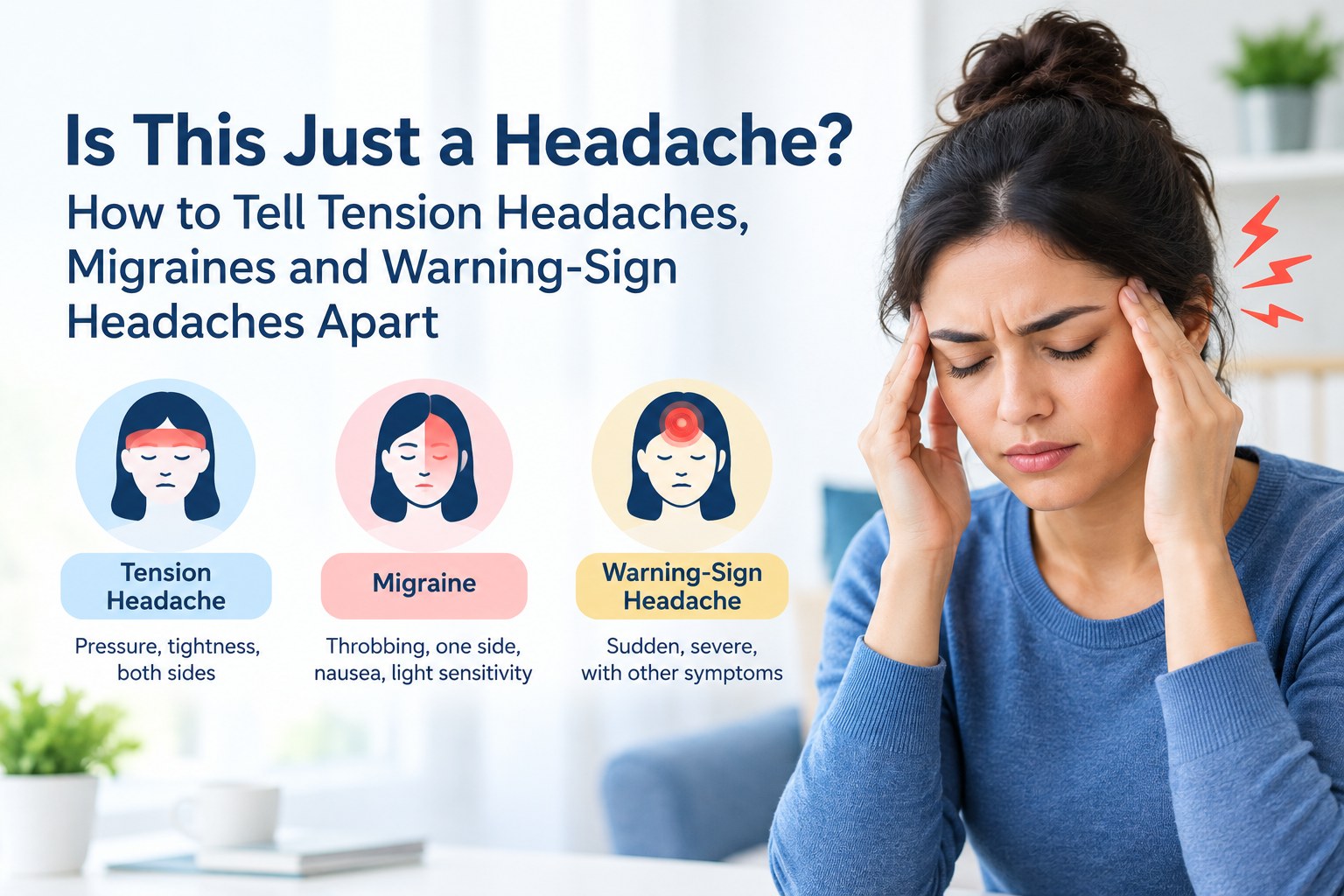
Table of contents
- 1. The Main Types of Headache
- 2. Tension Headache vs Migraine vs Cluster: A Comparison
- 3. Common Headache Triggers
- 4. A Simple Self-Care Plan
- 5. Medication Overuse: A Hidden Trap
- 6. Red Flags: When a Headache Is an Emergency
- 7. How a Clinician Evaluates Headaches
- 8. Prevention and Tracking
- Conclusion
- Frequently Asked Questions
- See a Doctor in Elmhurst or Chinatown
Almost everyone has had a headache. For most people it is a nuisance that fades after rest, fluids, and time. For others, it is a pounding, light-sensitive pain that cancels the day. And in rare cases, a headache is the first sign of something that needs urgent care. Knowing which is which can save you worry, time, and sometimes a trip you did not need to make.
This guide compares the most common headache types, lists frequent triggers, offers a simple self-care plan, and spells out the red flags that should never be ignored. If you are unsure where to go for care, our article on when to visit urgent care instead of waiting for your doctor can help you decide.
In this article:
- 1. The main types of headache
- 2. Side-by-side comparison table
- 3. Common triggers (with graph)
- 4. Self-care plan, step by step
- 5. Medication overuse: a hidden trap
- 6. Red flags: when a headache is an emergency
- 7. How a clinician evaluates headaches
- 8. Prevention and tracking
1. The Main Types of Headache
Doctors divide headaches into two broad groups. Primary headaches, such as tension headaches and migraines, are the main problem themselves. Secondary headaches are a symptom of something else, such as infection, injury, high blood pressure, or medication effects. Most headaches people deal with day to day are primary.
The three you will hear about most:
- Tension-type headache: the most common type, usually a dull, band-like pressure on both sides of the head
- Migraine: often a throbbing pain on one side, with nausea and sensitivity to light or sound; some people see visual changes called aura first
- Cluster headache: rare but severe, with intense pain around one eye, tearing, and a stuffy or runny nostril, often at the same time each day during a cluster period
2. Tension Headache vs Migraine vs Cluster: A Comparison
| Feature | Tension headache | Migraine | Cluster headache |
|---|---|---|---|
| 1. Pain quality | Dull, tight, pressing | Throbbing or pulsing | Sharp, burning, stabbing |
| 2. Location | Both sides, forehead or back of head | Often one side | Around or behind one eye |
| 3. Severity | Mild to moderate | Moderate to severe | Very severe |
| 4. Duration | 30 minutes to several hours | 4 to 72 hours if untreated | 15 to 180 minutes |
| 5. Nausea or vomiting | Uncommon | Common | Sometimes |
| 6. Light and sound sensitivity | Occasionally mild | Common and strong | Less common; restlessness is typical |
| 7. Effect on activity | Can usually keep going | Often need to lie down | Often unable to stay still |
For deeper patient-friendly background, see the MedlinePlus headache overview. Remember that this table is a guide. Some people have overlapping features, and only a clinician can sort out a pattern that does not fit neatly.
3. Common Headache Triggers
Triggers are things that make a headache more likely. The graph below shows how often people commonly report different triggers. It is an illustrative guide for self-tracking, not a measured statistic, and your own triggers may differ.
| Trigger | How commonly reported (graph) | Practical tip |
|---|---|---|
| Stress and tension | ██████████ Very common | Short breaks, breathing exercises, walking |
| Poor or irregular sleep | ████████░░ Very common | Keep a steady sleep schedule |
| Skipped meals | ███████░░░ Common | Eat at regular times |
| Dehydration | ██████░░░░ Common | Sip water through the day |
| Screen time and eye strain | █████░░░░░ Common | 20-20-20 rule: every 20 minutes look 20 feet away for 20 seconds |
| Caffeine changes | ████░░░░░░ Moderate | Keep intake steady; avoid sudden cutting |
| Hormonal changes | ████░░░░░░ Moderate | Track your cycle alongside headaches |
| Weather or strong smells | ███░░░░░░░ Occasional | Note patterns in a diary |
Dehydration is an easy trigger to fix. Our guide on dehydration warning signs includes a urine-color chart, and our article on sleep and your health covers sleep habits that help.
4. A Simple Self-Care Plan
At the first sign of an ordinary headache, try this order:
- Pause and drink a glass of water, since mild dehydration is a common contributor.
- Eat something if you have gone several hours without a meal.
- Rest in a quiet, dim room if light or noise makes the pain worse.
- Apply a cool cloth to the forehead or neck, or a warm compress if the muscles feel tight.
- Gently stretch the neck and shoulders and relax your jaw.
- If you use an over-the-counter pain reliever, follow the label and check with a pharmacist or clinician if you have stomach, kidney, liver, or heart conditions or take other medicines.
- Write down the date, time, possible trigger, and what helped, so you can spot patterns.
5. Medication Overuse: A Hidden Trap
Taking pain relievers too often can lead to medication-overuse headache, where the medicine itself keeps the headaches coming back. As a general guide, if you find yourself needing pain relievers on most days of the week, or on more than about two or three days per week, speak with a clinician. Do not stop prescription medicines on your own.
| Situation | What it suggests | Next step |
|---|---|---|
| Headache needing medicine more than 2-3 days a week | Possible overuse or an undertreated headache condition | Book a visit to review your plan |
| Headaches worse in the morning after daily pain-relief use | Possible rebound pattern | Discuss gradual changes with a clinician |
| Medicine no longer working | Pattern may have changed | Get re-evaluated |
6. Red Flags: When a Headache Is an Emergency
Most headaches are harmless, but a few patterns need immediate attention. Call 911 or go to the emergency room if you have any of the following.
| Warning sign | Possible concern | Action |
|---|---|---|
| Sudden, severe headache that reaches peak pain within a minute | Bleeding or a vascular problem | Call 911 |
| Headache with weakness, facial drooping, trouble speaking, or confusion | Possible stroke | Call 911 |
| Headache with fever, stiff neck, and rash or light sensitivity | Possible meningitis | Go to the ER now |
| Headache after a head injury | Possible concussion or bleeding | Seek urgent evaluation |
| Headache with seizure or fainting | Neurological emergency | Call 911 |
| New headache after age 50, or a changing pattern | Needs prompt evaluation | Book a visit soon |
| Headache with very high blood pressure readings | Possible hypertensive emergency | Seek urgent care |
High blood pressure can contribute to headaches in some situations. Our guide to high blood pressure explains what the numbers mean and when to act.
7. How a Clinician Evaluates Headaches
A thorough visit for recurring headaches usually involves:
- A detailed history: when headaches started, how often, how long they last, and what you feel before and during them
- A review of medicines, caffeine, sleep, stress, and family history
- A physical and neurological exam, including blood pressure and eye and nerve checks
- Blood tests or imaging only when the history or exam suggests they are needed
- A treatment plan that may include lifestyle changes, medicines for acute attacks, preventive medicine, or referral to a neurologist
Routine blood tests can sometimes rule out contributing factors such as anemia or thyroid problems. Learn more in our article on common blood tests, or explore primary care and diagnostic testing at City Prime Care.
8. Prevention and Tracking
These habits reduce headaches for many people:
- Keep a headache diary for at least a month
- Sleep and wake at consistent times
- Stay hydrated and eat regular meals
- Move your body most days; gentle aerobic exercise helps many people
- Limit alcohol and keep caffeine steady
- Take screen breaks and check your vision if you have frequent eye strain
- Practice stress-management techniques such as breathing exercises or short walks
Conclusion
Understanding the type, trigger, and pattern of your headaches puts you in control. Treat ordinary headaches with rest, fluids, and routine, but never ignore sudden, severe, or unusual symptoms.
Contact Us: If headaches are becoming more frequent, more severe, or harder to manage, get in touch with City Prime Care through our Contact Us page. This article is for general education and is not a substitute for personal medical advice. In an emergency, call 911.
Frequently Asked Questions
See a Doctor in Elmhurst or Chinatown
Have a question about your own health? Book a visit at our Elmhurst, Queens clinic or our Chinatown, Manhattan clinic, or explore our primary care services.
Related articles
Healthcare
Chest Discomfort Decoded: Heartburn, Muscle Strain, Anxiety or Something Serious?
Chest pain can come from the heart, the stomach, the muscles or even stress. Learn the usual patterns, the warning signs of a heart attack, and why unexplained chest pain should never be ignored.
Healthcare
Why Do You Feel Tired All the Time? Reading the Anemia Signs, the Five Testing Steps and the Sample Iron-Level Recovery
Constant tiredness, pale skin and shortness of breath can point to anemia. Learn the common causes, the blood tests used, a sample iron recovery pattern, five testing steps and when symptoms need urgent attention.
Healthcare
How Do Kidney Stones Cause Sudden Severe Pain? Reading the Warning Signs, the Five Prevention Steps and the Sample Stone-Size Outlook
Kidney stones can cause sudden, intense flank pain and blood in the urine. Learn the warning signs, how size affects passing a stone, five prevention steps, and when pain with fever or vomiting needs urgent care.





