HealthcareBy City Prime Care Team
Why Are Your Ankles and Feet Swollen by Evening, and When Is Leg Swelling Serious? Reading the Swelling Patterns, the Five Relief Steps and the Sample Two-Week Swelling Diary
Swollen ankles after a long day can be harmless, but swelling in one leg, sudden weight gain or breathlessness can signal a clot, heart, kidney or liver problem. Learn the patterns, five relief steps and a two-week diary.
Medically reviewed by Dr. Karl E. Latortue11 min read
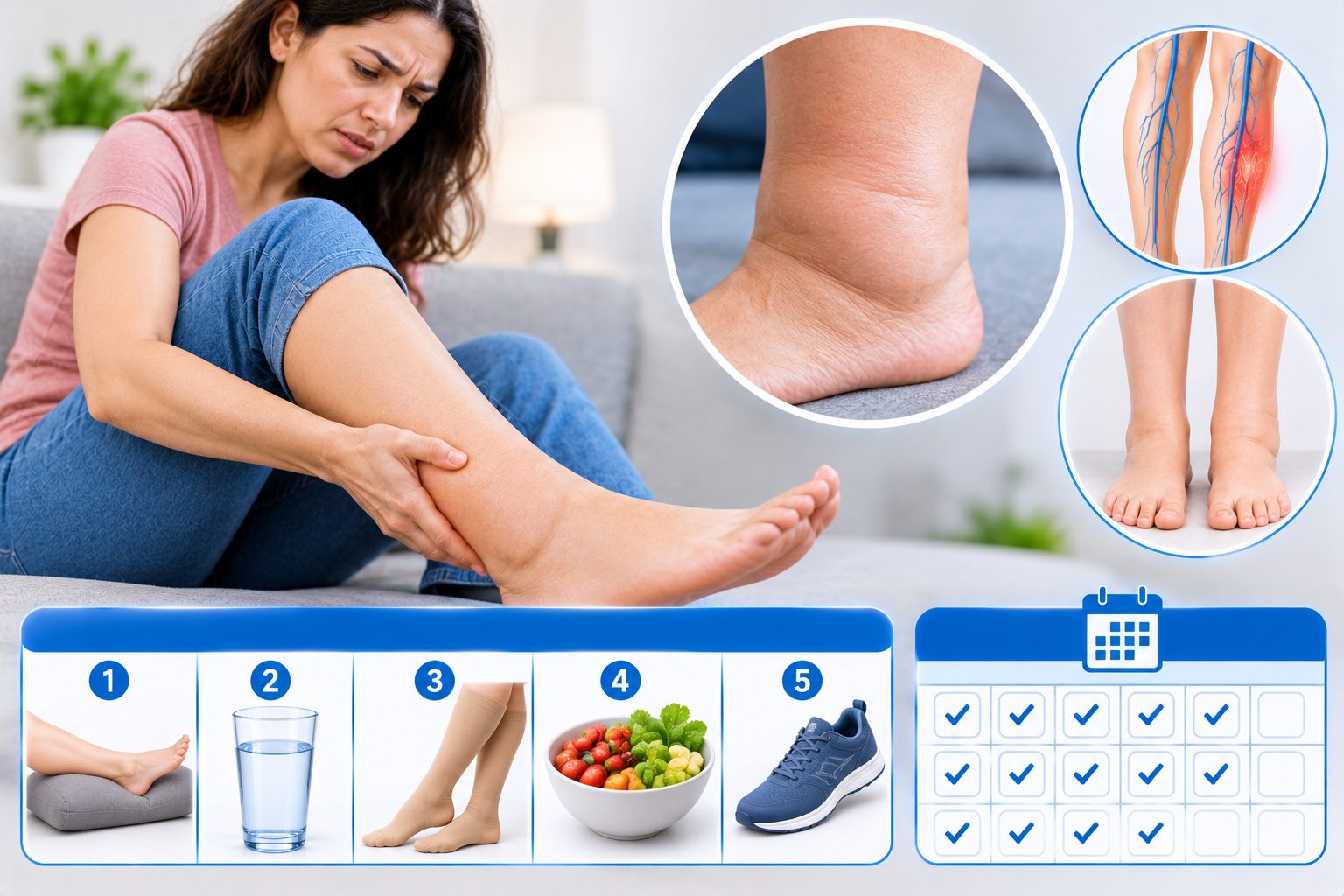
Table of contents
- 1. What Is Leg and Ankle Swelling (Edema)?
- 2. Reading the Swelling Patterns
- 3. Common Causes of Swollen Ankles and Feet
- 4. One-Sided vs Two-Sided Swelling
- 5. What a Clinician May Do
- 6. The Five Relief Steps
- 7. Graph: Illustrative Ankle Swelling Across a Day
- 8. Sample Two-Week Swelling Diary
- 9. Red Flags: When to Get Prompt Care
- 10. Where to Get Care: Elmhurst, Chinatown and Lower Manhattan
- 11. Related Reading From City Prime Care
- 12. Contact Us
- Conclusion
- Frequently Asked Questions
- See a Doctor in Elmhurst or Chinatown
You take off your shoes at the end of the day and the sock marks are deep, your ankles look puffy and your feet feel tight. Swelling in the feet, ankles and lower legs, called edema, is one of the most common reasons adults ask about their health. Often it is caused by long hours of standing or sitting, a salty meal, hot weather or a medicine. Sometimes it is the first visible sign of a vein, heart, kidney, liver or clotting problem that deserves attention.
This guide explains the swelling patterns, how one-sided and two-sided swelling differ, five practical relief steps, a sample two-week swelling diary and the red flags that need same-day care. City Prime Care serves patients in Elmhurst, Queens, Chinatown and Lower Manhattan. This article is general education and not a substitute for personal medical advice.
Quick takeaways:
- Swelling in both legs that builds during the day and improves overnight is often caused by gravity, salt, heat or medicines, but it can also come from vein, heart, kidney or liver disease.
- Swelling in one leg, especially with pain, warmth or redness, can be a blood clot and needs urgent evaluation.
- Swelling with shortness of breath, chest pain, or fast weight gain needs same-day care.
- Leg elevation, movement, less salt and a medicine review help many people, but the cause should be identified first.
1. What Is Leg and Ankle Swelling (Edema)?
Edema means extra fluid trapped in the soft tissues. In the legs, fluid tends to collect because gravity pulls it downward and because the leg veins and muscles must push blood back up to the heart. When pressure inside the veins rises, when the protein in the blood is low, when the kidneys hold on to salt, or when lymph channels are blocked, fluid leaks into the tissue and the ankle puffs up. MedlinePlus describes this process in its guide to edema.
A simple home check is pitting: press a thumb firmly over the shin or ankle for about five seconds. If a dent stays for a few seconds after you let go, it is called pitting edema, and it is worth mentioning to a clinician, especially if it is new.
2. Reading the Swelling Patterns
| Pattern | Typical clues | Common causes |
|---|---|---|
| Both ankles, worse by evening, better after a night's rest | Sock marks, tight shoes, no pain | Long standing or sitting, salty food, heat, mild vein weakness |
| Both legs, with shortness of breath lying flat or on exertion | Needing extra pillows, tiring easily, weight gain | Heart failure or lung disease; needs evaluation |
| Both legs plus puffy eyes or foamy urine | Swelling around the eyes in the morning, foamy urine | Kidney problems; needs urine and blood tests |
| Both legs plus swollen abdomen or yellow eyes | Bloating, easy bruising, itching | Liver disease; needs prompt evaluation |
| One leg only, sudden, painful or warm | Calf tenderness, redness, recent travel, surgery or injury | Deep vein thrombosis (blood clot); see signs of a blood clot in the leg |
| One or both legs, hard, long-standing, skin thickening | Swelling that does not go down overnight | Chronic venous insufficiency or lymphedema |
| Both ankles after starting a new medicine | Swelling begins within weeks of a new prescription | Medicine side effect; tell your clinician, do not stop on your own |
3. Common Causes of Swollen Ankles and Feet
Leg swelling has many possible causes, including:
- Standing or sitting for long periods, air travel, long car rides and hot weather.
- Chronic venous insufficiency, where leg-vein valves weaken and blood pools.
- Medicines such as calcium channel blockers for blood pressure, anti-inflammatory pain relievers, steroids, some diabetes medicines and hormones.
- Heart, kidney or liver problems that cause the body to retain fluid; see our guide to fatty liver disease.
- Pregnancy and hormonal changes before a period.
- Blood clots, skin infection and injuries such as a sprained ankle.
- Low thyroid function and low protein levels from poor nutrition or kidney loss.
4. One-Sided vs Two-Sided Swelling
| Feature | One leg | Both legs |
|---|---|---|
| Most worrying cause | Blood clot, infection, injury | Heart, kidney or liver disease |
| Speed | Often sudden over hours to days | Often gradual over days to weeks |
| Pain or warmth | Common with a clot or infection | Usually painless or mildly aching |
| Urgency | Same-day evaluation | Prompt evaluation; same-day if breathless |
| Useful tests | Leg ultrasound, blood test for clotting | Blood tests, urine test, ECG, sometimes chest X-ray or echocardiogram |
5. What a Clinician May Do
A visit for leg swelling often includes:
- A history of when the swelling started, whether it is one-sided, your medicines, salt intake, recent travel, surgery or illness.
- A physical exam of the legs, skin, pulses, heart, lungs and abdomen, plus weight and blood pressure.
- Blood tests for kidney function, liver function, thyroid, protein and blood count; see how to read your blood test results.
- A urine test to look for protein, which can point to a kidney cause.
- An ECG, chest X-ray, echocardiogram or leg ultrasound when the history or exam suggests a heart, lung or clot problem; see when an injury or cough calls for an X-ray.
- A medicine review and, when needed, referral to cardiology, vascular medicine or nephrology; see when your primary care doctor sends you to a specialist.
6. The Five Relief Steps
For mild swelling in both ankles with no red-flag symptoms:
- Elevate your legs above heart level for 15 to 30 minutes, two to three times a day, lying down with pillows under the calves.
- Move regularly: walk, flex the ankles or do calf raises every hour if you sit or stand for long periods.
- Cut back on salt and processed or restaurant food, since many city meals are high in sodium; ask your clinician what daily limit fits your health.
- Wear comfortable, supportive shoes and consider compression stockings only after a clinician confirms your leg arteries are healthy.
- Review your medicines with a clinician and keep a short swelling diary so patterns become clear.
Do not take water pills (diuretics) that were prescribed for someone else. They can cause dehydration and low potassium, and they can hide the real cause. See our guide to dehydration warning signs for how fluid balance affects the body.
7. Graph: Illustrative Ankle Swelling Across a Day
This is a teaching graph, not patient data. It shows how ankle swelling in a person with mild venous weakness may build during the day, compared with a day that includes leg elevation breaks and walking.
| Time of day | No elevation or movement breaks (illustrative) | With elevation and movement breaks (illustrative) |
|---|---|---|
| Morning | ██ | ██ |
| Midday | █████ | ███ |
| Afternoon | ████████ | ████ |
| Evening | ██████████ | █████ |
| After 30 minutes elevated | █████ | ██ |
8. Sample Two-Week Swelling Diary
| Day | What to record | Why it helps |
|---|---|---|
| Days 1-3 | Morning and evening ankle swelling (none, mild, moderate), sock marks, shoes that feel tight | Shows the daily pattern |
| Days 4-6 | Salt-heavy meals, hours sitting or standing, medicines taken | Links swelling to triggers |
| Days 7-9 | Weight each morning, breathing at night, extra pillows | Flags fluid gain and possible heart or kidney clues |
| Days 10-12 | Effect of elevation, walking breaks and lower salt | Tests which steps help |
| Days 13-14 | Summarize and bring the diary to your appointment | Gives your clinician a clear picture |
9. Red Flags: When to Get Prompt Care
Get urgent or same-day evaluation for:
- Swelling in one leg with pain, warmth, redness or tenderness in the calf, especially after travel, surgery or injury.
- Swelling with shortness of breath, chest pain, a racing heartbeat or difficulty lying flat; call 911 for severe symptoms.
- Rapid weight gain, such as more than about two to three pounds in a day or five pounds in a week, with swelling.
- Swelling with fever, spreading redness or a hot, tender area, which can signal infection.
- Swelling with very little urine, foamy urine or yellowing of the eyes or skin.
- A swollen leg with a pale, cold or numb foot.
10. Where to Get Care: Elmhurst, Chinatown and Lower Manhattan
A suddenly swollen leg or ankle is a common reason people search for urgent care Elmhurst NY, a walk in clinic Elmhurst NY, urgent care 11373, a same day doctor appointment Elmhurst or Same-Day Acute Care in Elmhurst Queens. For long-term swelling, blood pressure, kidney and heart checks, patients choose a primary care doctor Elmhurst NY, a family doctor Elmhurst Queens, Primary Care Doctors in Elmhurst NY or chronic disease management Elmhurst NY.
People comparing options often search for Best Primary Care Clinic in Elmhurst Queens, Best Primary Care Doctor in Elmhurst Queens, Primary Care Near Me Elmhurst Queens, Best Primary Care Clinics in Queens NY, Primary Care Clinics and Doctors in Queens NY and Top Primary Care Clinics in Queens NY. City Prime Care offers Men's and Women's Healthcare in Elmhurst NY, a physical exam clinic Elmhurst NY and preventive care Elmhurst NY, including medicine reviews and blood pressure follow-up.
Downtown, people look for primary care Lower Manhattan, primary care Chinatown NYC, a doctor near Catherine Street NYC, primary care 75 Catherine St, a walk-in clinic Chinatown NYC, a Primary Care Clinic in Chinatown Manhattan or a Healthcare Center in Chinatown Manhattan NY. Citywide searches include primary care doctor NYC, family doctor Manhattan NYC, annual physical exam NYC, same day primary care NYC, preventive care Lower Manhattan and primary care doctor near me. Residents searching for Primary Care Doctors Serving Todt Hill Staten Island are welcome to contact the clinic to ask about care options and travel.
| Area | Common searches | How care can help |
|---|---|---|
| Elmhurst (ZIP 11373) | Urgent care 11373, same day doctor appointment Elmhurst | Same-day exam of a swollen or painful leg |
| Elmhurst, Queens | Family doctor Elmhurst Queens, primary care doctor Elmhurst NY | Blood tests, medicine review and long-term follow-up |
| Queens | Best Primary Care Clinics in Queens NY, Top Primary Care Clinics in Queens NY | Convenient primary care for the whole family |
| Lower Manhattan | Primary care Lower Manhattan, preventive care Lower Manhattan | Follow-up and referral planning close to work |
| Chinatown / Catherine Street | Primary care Chinatown NYC, doctor near Catherine Street NYC, primary care 75 Catherine St | Convenient downtown care |
| Citywide | Primary care doctor NYC, family doctor Manhattan NYC, same day primary care NYC | Same-day or scheduled evaluation |
You can also find the clinic on Google or learn more on the City Prime Care website.
11. Related Reading From City Prime Care
12. Contact Us
Are your ankles puffy, tight or getting worse? Visit our Contact Us page or see our Google listing. If you have one swollen painful leg, trouble breathing or chest pain, seek urgent care right away.
Conclusion
Swollen ankles are common and often manageable with movement, elevation, less salt and a medicine review, but new, one-sided, rapidly worsening or breathless swelling should never be ignored. A short visit, a few simple tests and a clear diary can separate a harmless cause from one that needs treatment.
Frequently Asked Questions
See a Doctor in Elmhurst or Chinatown
Have a question about your own health? Book a visit at our Elmhurst, Queens clinic or our Chinatown, Manhattan clinic, or explore our primary care services.
Related articles
Healthcare
Why Is a Red, Itchy Ring-Shaped Patch Spreading on Your Skin, and Is It Ringworm? Reading the Patch Types, the Five Treatment Steps and the Sample Four-Week Clearing Plan
A red, scaly, ring-shaped itchy patch is often ringworm, a common fungal skin infection that is not caused by a worm. Learn the patch types, look-alike rashes, five treatment steps and a four-week clearing plan.
Healthcare
Why Is Your Hair Thinning or Falling Out in Clumps, and Could a Health Problem Be Behind It? Reading the Hair Loss Patterns, the Five Checkup Steps and the Sample Six-Month Regrowth Timeline
Finding more hair in the shower or brush can be stressful. Learn the common hair loss patterns, which blood tests and health problems matter, five checkup steps and a realistic six-month regrowth timeline.
Healthcare
Why Do Painful Muscle Cramps Wake You at Night, and Are They a Sign of Something Beyond Tired Legs? Reading the Cramp Triggers, the Five Prevention Steps and the Sample Four-Week Stretching Plan
A sudden, knotted calf cramp at 3 a.m. is common and usually harmless, but frequent cramps can point to dehydration, medicines, nerve or circulation problems. Learn the triggers, five prevention steps and a four-week stretching plan.