HealthcareBy City Prime Care Team
Why Does the Back of Your Heel Ache and Feel Stiff After Walking, and Could It Be Achilles Tendinitis? Reading the Pain Zones, the Five Loading Steps and the Sample Ten-Week Rehab Plan
Pain and stiffness above the heel that is worst in the morning or after activity may be Achilles tendinitis. Learn the pain zones, five loading steps, a ten-week rehab plan and the signs of a tendon rupture.
Medically reviewed by Dr. Karl E. Latortue11 min read
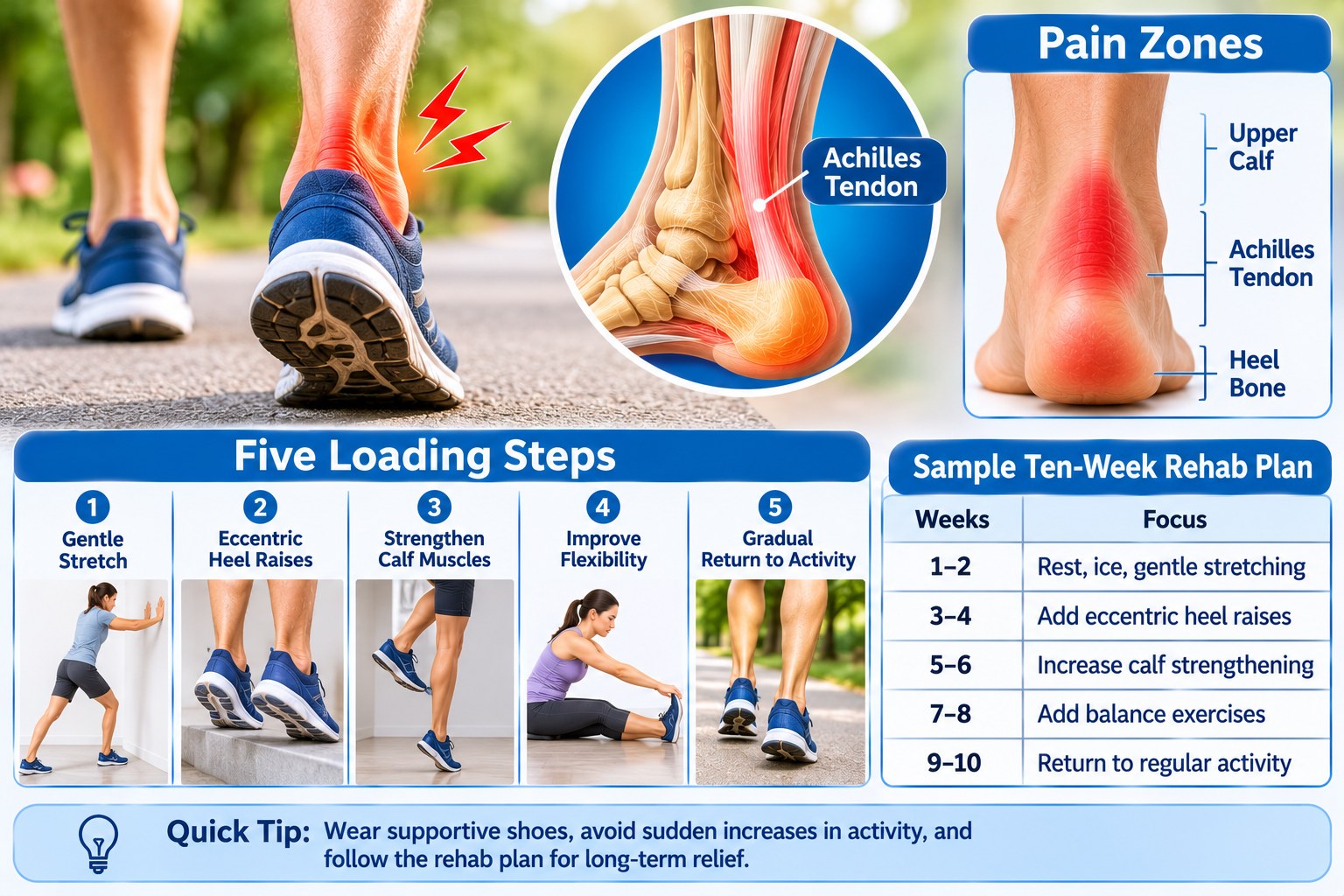
Table of contents
- 1. What Is Achilles Tendinitis?
- 2. Reading the Pain Zones
- 3. Achilles Tendinitis vs Look-Alikes
- 4. Causes and Who Is at Higher Risk
- 5. What a Clinician May Do
- 6. The Five Loading Steps
- 7. Graph: Illustrative Pain Level Over Ten Weeks
- 8. Sample Ten-Week Rehab Plan
- 9. Red Flags: When to Get Prompt Care
- 10. Where to Get Care: Elmhurst, Chinatown and Lower Manhattan
- 11. Contact Us
- Conclusion
- Frequently Asked Questions
- See a Doctor in Elmhurst or Chinatown
Pain and stiffness in the back of your ankle or just above the heel that is worst with the first steps in the morning, eases as you warm up and flares again after a run, a long walk or a day on your feet is the classic story of Achilles tendinitis. The Achilles is the strongest and thickest tendon in the body, linking your calf muscles to your heel bone, and it is overloaded easily when activity ramps up too fast.
This guide explains the pain zones, how Achilles tendinitis differs from plantar fasciitis, a calf strain and a tendon rupture, five loading steps, a sample ten-week rehab plan and the red flags that need urgent attention. City Prime Care serves patients in Elmhurst, Queens and Lower Manhattan. This article is general education and not a substitute for personal medical advice.
Quick takeaways:
- Achilles tendinitis is an overuse injury, usually from a sudden increase in walking, running, jumping or stair climbing, or from tight calves and worn footwear.
- Most cases improve with relative rest, graded calf strengthening and activity changes over weeks to a few months.
- A sudden pop or snap, a gap in the tendon, or inability to rise on your toes can mean a rupture and needs urgent care.
- Calf swelling, warmth and pain after a long trip or surgery can be a blood clot rather than a tendon problem and needs prompt evaluation.
1. What Is Achilles Tendinitis?
Tendinitis means pain and irritation of a tendon, and modern research suggests the problem is often a tendon that struggles with load and becomes thickened and painful rather than simply inflamed. The tendon can hurt in the middle portion, about two to six centimeters above the heel, or where it attaches to the heel bone. The Mayo Clinic describes it on its Achilles tendinitis symptoms and causes page, and the American Academy of Orthopaedic Surgeons provides a patient guide to Achilles tendinitis.
It is common in runners, recreational athletes who play weekend sports, and middle-aged adults, but it also affects people who are not athletic, including those who stand or walk for long hours on hard city sidewalks.
2. Reading the Pain Zones
| Zone | Where it hurts | Typical clues | Common cause |
|---|---|---|---|
| Midportion tendon | Two to six centimeters above the heel bone | Thickened, tender area that moves with the ankle; morning stiffness | Overload after a sudden increase in activity |
| Insertional | Where the tendon meets the heel bone | Pain with uphill walking, tight shoe backs, a bony bump | Tight calves, shoe rubbing, high-impact activity |
| Calf-tendon junction | Lower calf above the tendon | Pain with push-off, tight muscles | Calf strain or tendon-muscle overload |
| Bottom of heel | Underside of the heel, first steps in the morning | Different location from the tendon; see heel pain with the first steps in the morning | Plantar fasciitis, a different problem |
3. Achilles Tendinitis vs Look-Alikes
| Condition | Typical clue | How it differs |
|---|---|---|
| Achilles tendon rupture | Sudden pop or snap, feels like being kicked, cannot push off or stand on tiptoe | Urgent; often a gap or weakness; needs same-day evaluation |
| Calf muscle strain | Sudden pain in the calf belly during exertion | Higher in the muscle, not the tendon |
| Plantar fasciitis | Pain under the heel with first steps | Different structure and location |
| Retrocalcaneal bursitis | Pain and swelling in front of the tendon at the heel | Bursa irritation rather than tendon thickening |
| Deep vein thrombosis (blood clot) | Calf swelling, warmth, tenderness, sometimes after travel or surgery | Needs urgent evaluation; see signs of a blood clot in the leg |
| Arthritis of the ankle or heel | Joint stiffness and swelling | Pain deeper in the joint; see wear and tear or arthritis |
4. Causes and Who Is at Higher Risk
Achilles tendinitis is more likely if you:
- Suddenly increase running, walking, hill work, jumping or stair climbing.
- Have tight calf muscles, flat feet or a high arch, or wear worn or unsupportive shoes.
- Are between about 30 and 50 years old and play weekend sports.
- Have taken fluoroquinolone antibiotics, which carry a warning about tendon injury, or have had repeated corticosteroid exposure; tell your clinician about every medicine you take.
- Have inflammatory arthritis, psoriasis, high cholesterol, obesity or diabetes; see our guide to how to read your blood test results.
- Train on hard surfaces or in cold weather without warming up.
5. What a Clinician May Do
A typical visit includes:
- A history of activity changes, past injuries and medicines, especially recent antibiotics or steroids.
- A physical exam checking tenderness, thickening, ankle movement and calf strength, plus the Thompson test, in which squeezing the calf should make the foot point down if the tendon is intact.
- An X-ray when a bone problem is suspected or after injury; see when an injury calls for an X-ray.
- Ultrasound or MRI when the diagnosis is unclear, symptoms are stubborn or a tear is suspected.
- A rehab plan, activity guidance and, when needed, referral to physical therapy or a sports or orthopedic specialist; see when your primary care doctor sends you to a specialist.
6. The Five Loading Steps
For typical Achilles tendinitis in a healthy adult with no sign of rupture:
- Reduce, do not stop everything: cut back running, jumping and hills to a level that does not leave pain above about 3 out of 10 the next morning, and switch to cycling or swimming for fitness.
- Support the heel for comfort in the short term with a small heel lift or cushioned shoes, and avoid walking barefoot on hard floors.
- Start gradual calf loading: slow, controlled heel raises, first with both legs, then progress to single-leg and eventually with extra weight or on a step, as a clinician or physical therapist guides.
- Add calf and hip strengthening and gentle stretching, and warm up before activity, increasing weekly volume by no more than about ten percent.
- Return to running in stages, and see a clinician if pain is not improving after about six weeks, if swelling is increasing or if the tendon feels weak.
Short courses of pain medicine or ice can ease symptoms for some people, but they do not rebuild the tendon. Ask your clinician before using anti-inflammatory medicines if you have stomach, kidney or heart problems. Avoid corticosteroid injections near the Achilles, because they raise the risk of tendon rupture.
7. Graph: Illustrative Pain Level Over Ten Weeks
This is a teaching graph, not patient data. It shows how morning pain may fall gradually with graded loading, compared with complete rest followed by a sudden return to activity, where pain often rebounds.
| Week | Pain with graded loading (illustrative) | Pain with rest then sudden return (illustrative) |
|---|---|---|
| Week 0 | ██████████ | ██████████ |
| Week 2 | ████████ | ████ |
| Week 4 | ██████ | █████████ |
| Week 6 | ████ | ████████ |
| Week 8 | ██ | █████ |
| Week 10 | █ | ██████ |
8. Sample Ten-Week Rehab Plan
| Weeks | Goal | Sample actions | Check |
|---|---|---|---|
| Weeks 1-2 | Calm the tendon | Cut back impact, heel lift if helpful, gentle ankle movement, isometric calf holds | Is morning pain at or below about 3 out of 10? |
| Weeks 3-4 | Start strengthening | Slow double-leg heel raises, 3 sets as tolerated, daily walking on flat ground | Pain settles within 24 hours of exercise? |
| Weeks 5-6 | Build strength | Single-leg heel raises, step-edge raises as advised, hip and core work | Is the tendon less tender and thick? |
| Weeks 7-8 | Add load and speed | Light jogging intervals if pain is low, calf strength with added weight | No sharp pain or swelling the next day? |
| Weeks 9-10 | Return to activity | Gradual running or sport, 10 percent weekly increases, proper shoes | If stuck, see a clinician for imaging or specialist care |
9. Red Flags: When to Get Prompt Care
Get urgent or same-day evaluation for:
- A sudden pop or snap in the back of the ankle with immediate weakness or inability to stand on tiptoe.
- A visible gap, bruising or marked swelling along the tendon.
- Calf swelling, warmth, redness or pain, especially after a long trip, surgery or injury, which can signal a blood clot.
- Fever, spreading redness or a hot, swollen tendon area, which can signal infection.
- Pain that does not improve after about six weeks of sensible care, or that wakes you at night.
- Recent fluoroquinolone antibiotic use with new tendon pain; tell your clinician right away.
10. Where to Get Care: Elmhurst, Chinatown and Lower Manhattan
A suddenly painful ankle, a possible tendon rupture or a swollen calf is a common reason people search for urgent care Elmhurst NY, a walk in clinic Elmhurst NY, urgent care 11373, a same day doctor appointment Elmhurst or Same-Day Acute Care in Elmhurst Queens. For rehab planning, referrals and long-term joint and weight care, patients choose a primary care doctor Elmhurst NY, a family doctor Elmhurst Queens, Primary Care Doctors in Elmhurst NY or chronic disease management Elmhurst NY.
People comparing options often search for Best Primary Care Clinic in Elmhurst Queens, Best Primary Care Doctor in Elmhurst Queens, Primary Care Near Me Elmhurst Queens, Best Primary Care Clinics in Queens NY, Primary Care Clinics and Doctors in Queens NY and Top Primary Care Clinics in Queens NY. City Prime Care offers Men's and Women's Healthcare in Elmhurst NY, a physical exam clinic Elmhurst NY and preventive care Elmhurst NY, including sports and activity guidance.
Downtown, people look for primary care Lower Manhattan, primary care Chinatown NYC, a doctor near Catherine Street NYC, primary care 75 Catherine St, a walk-in clinic Chinatown NYC, a Primary Care Clinic in Chinatown Manhattan or a Healthcare Center in Chinatown Manhattan NY. Citywide searches include primary care doctor NYC, family doctor Manhattan NYC, annual physical exam NYC, same day primary care NYC, preventive care Lower Manhattan and primary care doctor near me. Residents searching for Primary Care Doctors Serving Todt Hill Staten Island are welcome to contact the clinic to ask about care options and travel.
| Area | Common searches | How care can help |
|---|---|---|
| Elmhurst (ZIP 11373) | Urgent care 11373, same day doctor appointment Elmhurst | Quick exam and imaging decisions for a sudden injury |
| Elmhurst, Queens | Family doctor Elmhurst Queens, primary care doctor Elmhurst NY | Rehab plan, medicine review and referrals |
| Queens | Best Primary Care Clinics in Queens NY, Top Primary Care Clinics in Queens NY | Easy-to-reach primary care for the family |
| Lower Manhattan | Primary care Lower Manhattan, preventive care Lower Manhattan | Convenient follow-up and referral planning |
| Chinatown / Catherine Street | Primary care Chinatown NYC, doctor near Catherine Street NYC, primary care 75 Catherine St | Convenient downtown care |
| Citywide | Primary care doctor NYC, family doctor Manhattan NYC, same day primary care NYC | Same-day or scheduled evaluation |
You can also find the clinic on Google.
11. Contact Us
Is heel or calf pain limiting your steps or workouts? Visit our Contact Us page or see our Google listing. If you heard a pop and cannot push off your foot, or you have a swollen, painful calf, seek care the same day.
Conclusion
Achilles tendinitis is common, treatable and usually responds to patient, graded loading and smarter activity habits. A sudden pop, weakness, calf swelling or pain that does not improve after about six weeks deserve a clinician's evaluation.
Frequently Asked Questions
See a Doctor in Elmhurst or Chinatown
Have a question about your own health? Book a visit at our Elmhurst, Queens clinic or our Chinatown, Manhattan clinic, or explore our primary care services.
Related articles
Healthcare
Why Are Your Ankles and Feet Swollen by Evening, and When Is Leg Swelling Serious? Reading the Swelling Patterns, the Five Relief Steps and the Sample Two-Week Swelling Diary
Swollen ankles after a long day can be harmless, but swelling in one leg, sudden weight gain or breathlessness can signal a clot, heart, kidney or liver problem. Learn the patterns, five relief steps and a two-week diary.
Healthcare
Why Is a Red, Itchy Ring-Shaped Patch Spreading on Your Skin, and Is It Ringworm? Reading the Patch Types, the Five Treatment Steps and the Sample Four-Week Clearing Plan
A red, scaly, ring-shaped itchy patch is often ringworm, a common fungal skin infection that is not caused by a worm. Learn the patch types, look-alike rashes, five treatment steps and a four-week clearing plan.
Healthcare
Why Is Your Hair Thinning or Falling Out in Clumps, and Could a Health Problem Be Behind It? Reading the Hair Loss Patterns, the Five Checkup Steps and the Sample Six-Month Regrowth Timeline
Finding more hair in the shower or brush can be stressful. Learn the common hair loss patterns, which blood tests and health problems matter, five checkup steps and a realistic six-month regrowth timeline.