HealthcareBy City Prime Care Team
Why Does Your Heel Hurt With the First Steps in the Morning? Reading the Plantar Fasciitis Pattern, the Five Stretch Steps and the Sample Eight-Week Plan
Sharp heel pain with the first steps of the day is a hallmark of plantar fasciitis. Learn the pain pattern, five stretch steps, footwear tips and a sample eight-week recovery plan.
Medically reviewed by Dr. Karl E. Latortue9 min read
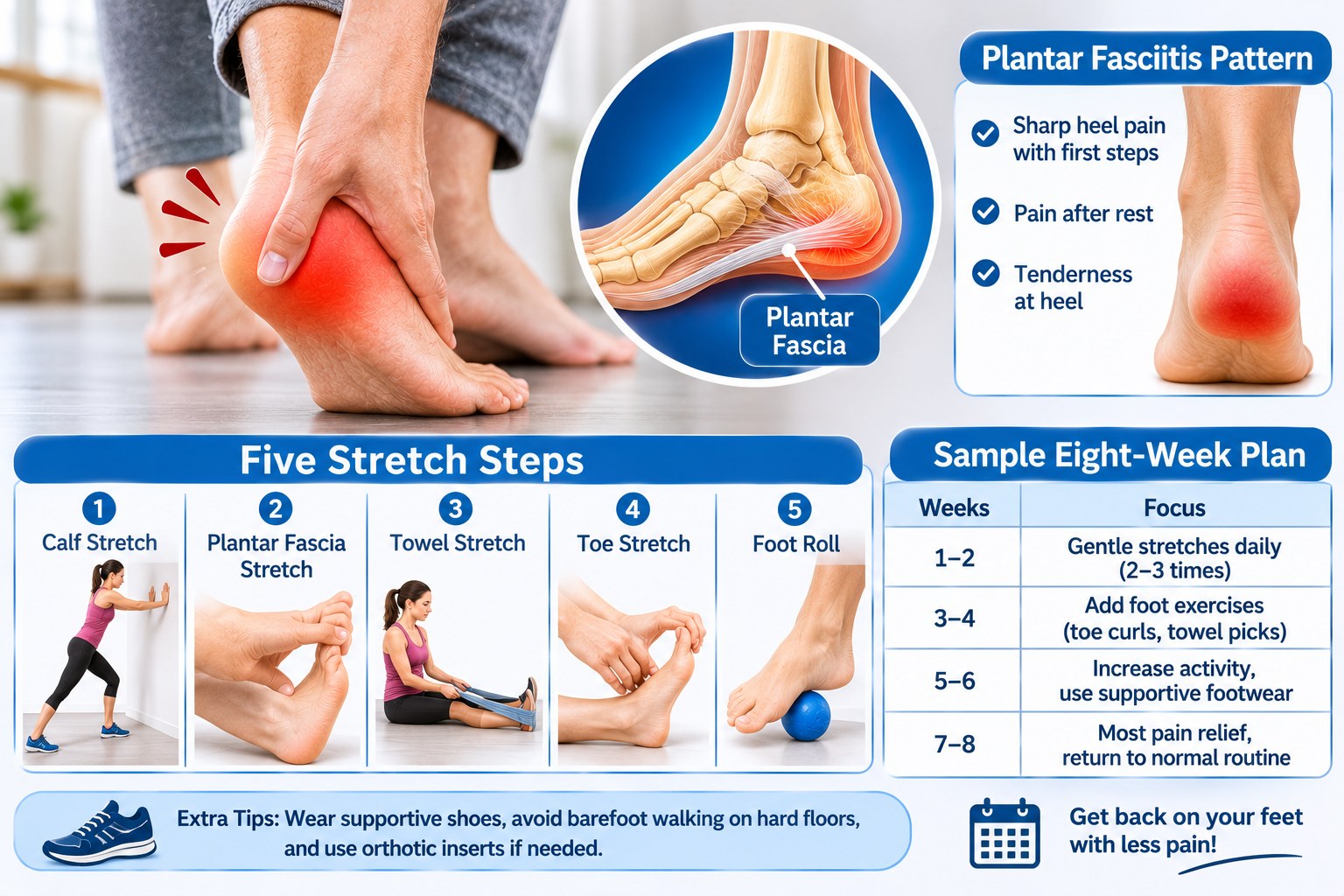
Table of contents
- 1. The Plantar Fasciitis Pain Pattern
- 2. Heel Pain: Other Possible Causes
- 3. Who Is More Likely to Get It
- 4. Five Stretch and Care Steps
- 5. When to See a Clinician
- 6. Treatment Options Compared
- 7. Sample Eight-Week Recovery Plan With a Pain Graph
- 8. Contact Us and Find Us Online
- Conclusion
- Frequently Asked Questions
- See a Doctor in Elmhurst or Chinatown
If the first steps out of bed send a stabbing pain through your heel, you are not alone. Plantar fasciitis, irritation of the thick band of tissue along the bottom of the foot, is one of the most common causes of heel pain. The pain often eases after you warm up, only to return after long periods of standing or after sitting.
This guide explains the typical pain pattern, who is more likely to get it, five stretch steps, footwear tips and a sample eight-week plan. It is general education only. Sudden severe pain after an injury or heel pain with fever or swelling needs a clinician's evaluation.
| At a Glance | Key Point |
|---|---|
| What it is | Irritation or small tears in the plantar fascia, the band under the foot |
| Classic sign | Stabbing heel pain with the first steps in the morning or after sitting |
| Common causes | Overuse, tight calves, high-impact exercise, worn shoes, standing for long hours |
| Recovery | Often improves over weeks to months with stretching, rest and good footwear |
| See a clinician if | Pain lasts more than a few weeks or follows an injury |
1. The Plantar Fasciitis Pain Pattern
The pain is usually felt on the underside of the heel, near the front of the heel bone, and sometimes along the arch. It tends to follow a recognizable daily rhythm.
| Time of Day | What Many People Notice |
|---|---|
| First steps in the morning | Sharp, stabbing heel pain |
| After a few minutes of walking | Pain eases as the tissue loosens up |
| After long standing or exercise | Pain builds and may return in the evening |
| After sitting for a while | Pain returns for the first few steps |
MedlinePlus offers a plain-language overview of plantar fasciitis, and the American Academy of Orthopaedic Surgeons covers causes and treatment on OrthoInfo.
2. Heel Pain: Other Possible Causes
| Condition | Typical Clue |
|---|---|
| Plantar fasciitis | Morning first-step pain, under the heel |
| Achilles tendon problem | Pain at the back of the heel and above it |
| Stress fracture | Pain that builds with activity and hurts to press on the bone |
| Nerve entrapment | Burning or tingling in the heel or arch |
| Sprain or fracture after injury | Sudden pain, swelling and trouble bearing weight |
If you hurt your foot in a fall or twist, read our guide on sprain versus fracture and when you need an X-ray.
3. Who Is More Likely to Get It
Factors that raise the risk include:
- Age between about 40 and 60.
- Running, dancing or other high-impact activity, especially after a sudden jump in training.
- Jobs that keep you on your feet on hard floors for many hours.
- Tight calf muscles or Achilles tendons, flat feet or very high arches.
- Higher body weight, which adds load to the foot.
Extra body weight is one of the few changeable risks. See our guide on losing weight safely with your doctor's support.
4. Five Stretch and Care Steps
These steps are commonly suggested for mild to moderate plantar fasciitis. Stop any movement that sharply increases pain:
- Calf stretch: stand facing a wall, one foot back with the heel down, and lean forward. Hold 30 seconds, repeat 3 times per leg.
- Plantar fascia stretch: sitting, cross the foot over the opposite knee and gently pull the toes back. Hold 10 seconds, repeat 10 times, especially before getting up in the morning.
- Rolling: roll the arch gently over a frozen water bottle or a massage ball for a few minutes.
- Supportive footwear: choose shoes with good arch support and cushioning, and avoid walking barefoot on hard floors.
- Activity changes: cut back on impact for a while, and return gradually.
Over-the-counter pain relief may help short term if it is safe for you. Check the label and ask your clinician or pharmacist.
5. When to See a Clinician
See a clinician if:
- Heel pain lasts more than a few weeks despite home care.
- The pain started after a fall, twist or other injury.
- The heel is swollen, red, hot or you have a fever.
- You have numbness, tingling or cannot put weight on the foot.
- You have diabetes or poor circulation and notice any foot pain or sores.
Treatment may include physical therapy, night splints, heel inserts or orthotics, injections and, rarely, procedures. Our guide on when your primary care doctor sends you to a specialist explains referrals.
6. Treatment Options Compared
| Option | What It Involves | Used For |
|---|---|---|
| Stretching and strengthening | Calf and plantar fascia stretches, foot exercises | First-line care for almost everyone |
| Footwear changes and inserts | Arch support, cushioned heel, replacing worn shoes | Reducing strain on the fascia |
| Night splint | Holds the foot gently flexed while you sleep | Persistent morning pain |
| Physical therapy | Guided exercises and manual techniques | Pain lasting beyond several weeks |
| Injections or other procedures | Considered by a specialist | Stubborn pain after other measures |
7. Sample Eight-Week Recovery Plan With a Pain Graph
This illustrative plan shows a typical path for mild to moderate plantar fasciitis. It is a teaching example, and recovery can take longer. The squares show example pain levels, not a guarantee.
| Weeks | Focus | Typical Pain (Example Graph) |
|---|---|---|
| 1 to 2 | Stretch before getting up, supportive shoes, reduce impact | ■■■■■■■■ |
| 3 to 4 | Add calf stretching 3 times a day and arch rolling | ■■■■■■ |
| 5 to 6 | Add foot-strengthening exercises, short walks | ■■■■ |
| 7 to 8 | Return gradually to regular activity | ■■ |
| After week 8 | Keep stretching, replace worn shoes; see a clinician if not improved | ■ |
8. Contact Us and Find Us Online
If heel pain is not improving, keeps returning or follows an injury, our team can examine your foot and plan the next step. For non-emergency questions, Contact Us or find City Prime Care on Google: City Prime Care on Google.
Conclusion
Plantar fasciitis is common, uncomfortable and usually manageable. Stretch daily, wear supportive shoes, ease back into activity and get checked if pain persists or follows an injury. This article is for general education and does not replace medical advice.
Frequently Asked Questions
See a Doctor in Elmhurst or Chinatown
Have a question about your own health? Book a visit at our Elmhurst, Queens clinic or our Chinatown, Manhattan clinic, or explore our primary care services.
Related articles
Healthcare
Is Your Leg Pain Sciatica or Something Else? Reading the Nerve Pain Pattern, the Five Red Flags and the Sample Six-Week Recovery Plan
Sciatica sends pain from the lower back or buttock down one leg. Learn the symptom pattern, five red flags that need urgent care, treatment options and a sample six-week recovery plan.
Healthcare
Why Does Your Shoulder Ache When You Lift Your Arm, and Could It Be a Rotator Cuff Injury? Reading the Pain Pattern, the Five Rehab Steps and the Sample Strengthening Plan
Shoulder pain that worsens when you reach overhead or lie on your side may be a rotator cuff problem. Learn the causes, diagnosis, five rehab steps, treatment options and a sample strengthening plan with a simple graph.
Healthcare
Why Does Your Knee Click, Catch or Give Way After a Twist, and Could It Be a Meniscus Tear? Reading the Knee Clues, the Five Protection Steps and the Sample Recovery Plan
A twisting injury or years of wear can tear the meniscus, the cushion inside the knee, causing pain, swelling, catching and giving way. Learn the knee clues, causes, red flags, treatments, five protection steps and a sample recovery plan with a simple graph.