HealthcareBy City Prime Care Team
Why Does the Outer Side of Your Hip Hurt When You Lie on It or Climb Stairs, and Could It Be Bursitis? Reading the Pain Map, the Five Rehab Steps and the Sample Six-Week Strengthening Plan
Pain on the outer hip that worsens when lying on your side or climbing stairs is often trochanteric bursitis. Learn the pain map, five rehab steps and a six-week plan.
Medically reviewed by Dr. Helen Vasquez9 min read
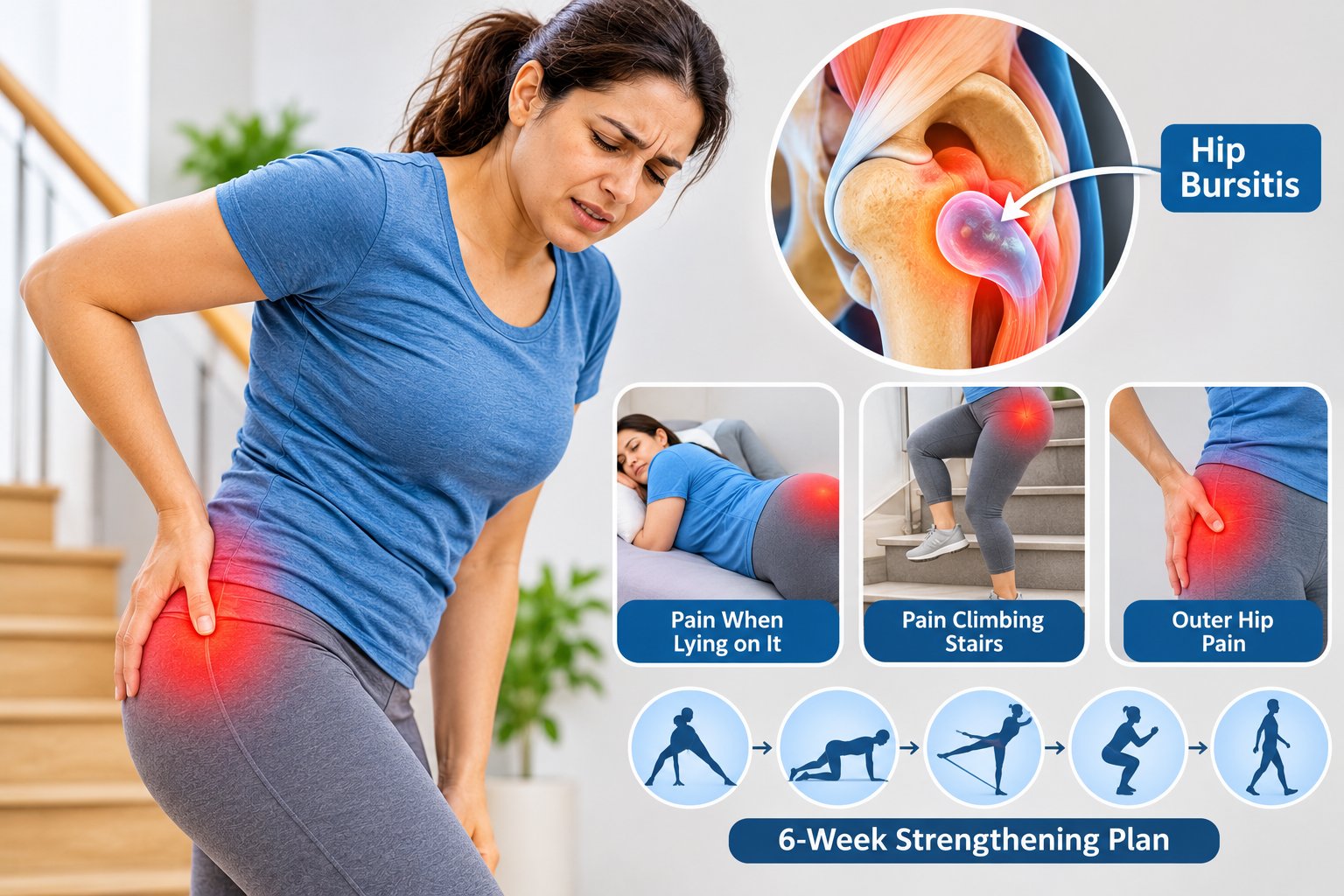
Table of contents
- 1. What Is Hip Bursitis?
- 2. Reading the Pain Map
- 3. What a Clinician May Do
- 4. The Five Rehab Steps
- 5. Graph: Illustrative Pain and Strength Over Six Weeks
- 6. Sample Six-Week Strengthening Plan
- 7. When to See a Doctor
- 8. Where to Get Care: Elmhurst, Chinatown and Lower Manhattan
- 9. Contact Us
- Conclusion
- Frequently Asked Questions
- See a Doctor in Elmhurst or Chinatown
If the bony point on the outer side of your hip aches when you roll onto it at night, climb stairs, or stand up after sitting, you are not alone. This pattern is very often caused by trochanteric bursitis, now frequently described more broadly as greater trochanteric pain syndrome, in which the fluid-filled cushion and tendons around the outer hip become irritated. It is more common in middle age and in women, and it often settles with the right mix of rest, positioning and strengthening.
This guide shows how to read the pain map, how hip bursitis differs from joint problems or back-related pain, five rehab steps, and a sample six-week strengthening plan. It also lists the red flags that need prompt care. City Prime Care serves patients in Elmhurst, Queens and Lower Manhattan. This article is general education and not a substitute for personal medical advice.
Quick takeaways:
- Pain on the outer hip, tender to touch and worse when lying on that side, points to bursitis or tendon irritation.
- Most cases improve with activity changes, sleep positioning and targeted hip-strengthening exercises.
- Fever, a hot red swollen hip, an inability to bear weight, or pain after a fall needs prompt evaluation.
- Groin pain is more often a true hip joint problem, and back pain with leg symptoms may be a nerve issue such as sciatica.
1. What Is Hip Bursitis?
A bursa is a small fluid-filled sac that reduces friction between bone and soft tissue. Around the outer hip, the trochanteric bursa sits between the bony prominence of the thigh bone and the tendons and tissue running over it. When the area is overloaded or compressed, it can become irritated and painful. Overlapping tendon problems of the gluteal muscles are also common. See the MedlinePlus overview of bursitis for a general explanation.
Common contributors include repetitive activity such as running or stair climbing, sleeping on one side, weak hip muscles, leg-length differences, long periods of standing, and sometimes arthritis or back problems. Our guide to normal wear and tear versus arthritis can help you compare.
2. Reading the Pain Map
| Where it hurts | Typical triggers | What it often suggests |
|---|---|---|
| Outer point of the hip | Lying on that side, stairs, standing after sitting | Trochanteric bursitis or gluteal tendon irritation |
| Groin or inner thigh | Walking, rotating the hip | Hip joint problem such as arthritis; needs evaluation |
| Buttock with pain down the leg | Sitting, bending, coughing | Possible nerve involvement; see sciatica |
| Hip with fever, redness and warmth | Constant pain, feeling unwell | Possible infection; seek care promptly |
| Hip pain after a fall | Cannot bear weight | Possible fracture; urgent evaluation |
3. What a Clinician May Do
A visit usually includes:
- A history of your pain, sleep position, activity, and any recent falls or injuries.
- A hands-on exam, pressing on the outer hip and testing single-leg standing, hip strength and motion.
- A check of the back and hip joint to separate bursitis from nerve or joint causes.
- An X-ray or ultrasound only when the diagnosis is unclear, symptoms are severe, or the pain does not improve.
- A plan that may include exercises, short-term pain relief, referral to physical therapy or, in selected cases, an injection.
4. The Five Rehab Steps
For typical outer hip pain, once serious causes are excluded, many clinicians recommend:
- Reduce irritation: limit repetitive stair climbing, long hills and prolonged standing for a short period, and avoid crossing your legs or sitting low.
- Adjust sleep position: sleep on the unaffected side with a pillow between your knees, or on your back; a foam topper can ease pressure.
- Use short-term relief as advised: cold or warm packs for comfort, and anti-inflammatory medicine only if safe for your stomach, kidneys and blood pressure.
- Start gentle glute strengthening, such as bridges, side-lying leg lifts and clamshells, guided by a clinician or physical therapist.
- Build back gradually with walking and low-impact exercise, and work on posture and weight-bearing habits.
5. Graph: Illustrative Pain and Strength Over Six Weeks
This is a teaching graph, not patient data. It shows how pain often drops as hip strength builds.
| Week | Pain level (illustrative) | Hip strength (illustrative) |
|---|---|---|
| Week 1 | ██████████ | ██ |
| Week 2 | ████████ | ███ |
| Week 3 | ██████ | ████ |
| Week 4 | ████ | ██████ |
| Week 5 | ███ | ███████ |
| Week 6 | ██ | ████████ |
6. Sample Six-Week Strengthening Plan
| Weeks | Goal | Sample activities | Check |
|---|---|---|---|
| 1-2 | Calm the area | Sleep with pillow, avoid triggers, short easy walks, gentle bridges | Pain at night improving? |
| 3-4 | Build strength | Side-lying leg lifts, clamshells, mini squats | Can you stand on one leg for 20 seconds? |
| 5-6 | Return to activity | Longer walks, step-ups, gradual return to exercise | Stairs comfortable? |
| After week 6 | Maintain | Keep strength routine twice a week | Book review if pain persists |
7. When to See a Doctor
Get checked promptly if you have:
- Fever, chills, a red, hot or swollen hip, or feeling generally unwell.
- Severe pain after a fall, an inability to bear weight, or a deformed hip.
- Pain that is not improving after several weeks of sensible self-care.
- Numbness, leg weakness, or changes in bladder or bowel control.
- Night pain that is constant, unexplained weight loss, or a history of cancer.
For related reading, see when your primary care doctor sends you to a specialist and our guide on protecting your bones as you age.
8. Where to Get Care: Elmhurst, Chinatown and Lower Manhattan
Patients with hip pain often start by searching for urgent care Elmhurst NY, a walk in clinic Elmhurst NY, or urgent care 11373 for a quick exam, or by booking a same day doctor appointment Elmhurst. For ongoing guidance, many choose a primary care doctor Elmhurst NY or a family doctor Elmhurst Queens. Downtown, residents and workers search for primary care Lower Manhattan, primary care Chinatown NYC, a doctor near Catherine Street NYC, primary care 75 Catherine St, or a walk-in clinic Chinatown NYC.
| Area | Common searches | How care can help |
|---|---|---|
| Elmhurst (ZIP 11373) | Urgent care 11373, same day doctor appointment Elmhurst | Exam for new hip pain and injury |
| Elmhurst, Queens | Family doctor Elmhurst Queens, primary care doctor Elmhurst NY | Rehab planning, referrals and chronic disease management Elmhurst NY |
| Lower Manhattan | Primary care Lower Manhattan, preventive care Lower Manhattan | Bone and joint health review |
| Chinatown / Catherine Street | Primary care Chinatown NYC, doctor near Catherine Street NYC, primary care 75 Catherine St | Convenient downtown care |
| Citywide | Primary care doctor NYC, family doctor Manhattan NYC, same day primary care NYC | Same-day or scheduled evaluation |
If you want a primary care doctor near me, a physical exam clinic Elmhurst NY, preventive care Elmhurst NY, or an annual physical exam NYC, use that visit to discuss joint pain, activity levels and bone health. You can also find us on Google.
9. Contact Us
Need help with hip pain or want to book a visit? Visit our Contact Us page or open our Google listing.
Conclusion
Outer hip pain is common and usually improves with smart sleep positioning, load management and strengthening. Seek a medical review for red flags or pain that persists, so that joint, nerve and other causes are not missed.
Frequently Asked Questions
See a Doctor in Elmhurst or Chinatown
Have a question about your own health? Book a visit at our Elmhurst, Queens clinic or our Chinatown, Manhattan clinic, or explore our primary care services.
Related articles
Healthcare
Why Does the Outside of Your Elbow Hurt When You Grip or Lift, and Is It Tennis Elbow? Reading the Pain Pattern, the Five Rehab Steps and the Sample Return-to-Activity Plan
Pain on the outer elbow when you grip, lift or turn a doorknob is often tennis elbow, an overuse tendon problem that usually improves with the right care. Learn the pain pattern, causes, red flags, treatments, five rehab steps and a sample return-to-activity plan with a simple graph.
Healthcare
Why Are Your Ankles and Feet Swollen by Evening, and When Is Leg Swelling Serious? Reading the Swelling Patterns, the Five Relief Steps and the Sample Two-Week Swelling Diary
Swollen ankles after a long day can be harmless, but swelling in one leg, sudden weight gain or breathlessness can signal a clot, heart, kidney or liver problem. Learn the patterns, five relief steps and a two-week diary.
Healthcare
Why Is a Red, Itchy Ring-Shaped Patch Spreading on Your Skin, and Is It Ringworm? Reading the Patch Types, the Five Treatment Steps and the Sample Four-Week Clearing Plan
A red, scaly, ring-shaped itchy patch is often ringworm, a common fungal skin infection that is not caused by a worm. Learn the patch types, look-alike rashes, five treatment steps and a four-week clearing plan.