
HealthcareBy City Prime Care Team
When Does an Injury or Cough Call for an X-Ray? Reading the Body-Area Guide, the Five Preparation Steps and the Sample Visit Timeline
Not sure if your injury or cough needs an X-ray? Learn what X-rays show, how much radiation is involved, when to go to the ER instead and how to prepare for your visit.
Medically reviewed by City Prime Care Administrator9 min read
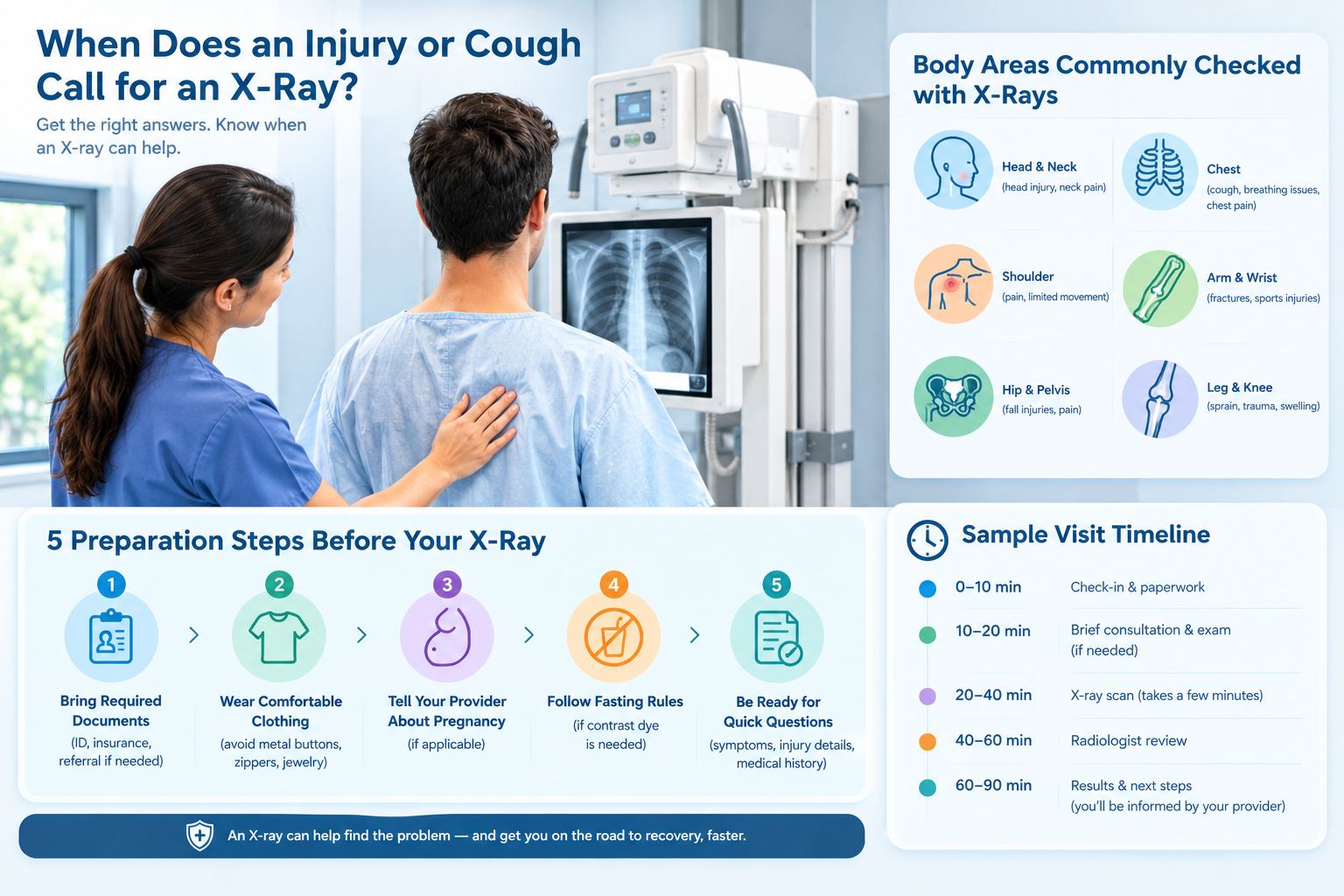
Table of contents
- 1. Why X-Rays Are Still a First-Line Test
- 2. What an X-Ray Can and Cannot Show
- 3. Common Reasons for an X-Ray by Body Area
- 4. When to Go to the ER Instead
- 5. How Much Radiation Is Involved
- 6. Five Steps to Prepare
- 7. What Happens During the Visit
- 8. Getting Your Results
- 9. A Sample X-Ray Visit Timeline
- 10. Questions to Ask Before You Go
- Conclusion
- Frequently Asked Questions
- See a Doctor in Elmhurst or Chinatown
Pain after a fall, a cough that will not clear, or a swollen ankle that will not bear weight all raise the same question: is something broken, or is it just a bad sprain or infection? An X-ray is often the fastest way to find out. It is quick, painless and widely available, and it shows bones and many lung problems clearly.
This guide explains when an X-ray is useful, what it can and cannot show, how much radiation is involved, how to prepare and what a typical visit looks like. It draws on patient information from RadiologyInfo.org, which is run by radiology societies, and on MedlinePlus. Availability of on-site imaging can differ, so ask City Prime Care whether your X-ray is done at the Elmhurst clinic or arranged by referral. This is general education, not personal medical advice. You can also find the clinic on Google.
In this article:
- 1. Why X-rays are still a first-line test
- 2. What an X-ray can and cannot show (table)
- 3. Common reasons by body area (table)
- 4. When to go to the ER instead
- 5. How much radiation is involved (graph)
- 6. Five steps to prepare
- 7. What happens during the visit
- 8. Getting your results (table)
- 9. A sample X-ray visit timeline
- 10. Questions to ask before you go
1. Why X-Rays Are Still a First-Line Test
X-rays use a small, controlled amount of radiation to make a picture of the inside of the body. Dense tissue such as bone absorbs more radiation and shows up white, while air in the lungs shows up dark. That contrast is why X-rays remain the usual first test for suspected fractures, chest infections and many joint problems.
An X-ray is only one tool. Your clinician decides whether you need one after asking about your symptoms and examining you. Our guide to the services of the Elmhurst primary care clinic shows how imaging fits with exams, labs and referrals.
2. What an X-Ray Can and Cannot Show
| X-ray shows well | X-ray shows less well | Often needs another test |
|---|---|---|
| Broken bones and dislocations | Ligament and tendon tears | MRI for soft tissue injury |
| Pneumonia and fluid in the lungs | Small lung nodules | CT scan for detail |
| Joint arthritis changes | Early or tiny stress fractures | Repeat X-ray or MRI |
| Some swallowed or embedded objects | Disc problems in the spine | MRI or specialist review |
| Bone alignment after a fracture | Internal organ injury | Ultrasound or CT |
3. Common Reasons for an X-Ray by Body Area
| Body area | Typical reasons | Often paired with |
|---|---|---|
| Hand, wrist, arm | Fall on an outstretched hand, swelling, deformity | Splint or cast, follow-up with a bone specialist if broken |
| Ankle, foot, toe | Twisting injury, cannot bear weight, pain over bone | Brace, boot or crutches; rest and elevation |
| Knee, hip, leg | Fall, joint pain, limping, long-term arthritis | Physical therapy or specialist referral |
| Chest | Cough, fever, chest tightness, shortness of breath | Lab tests, breathing check, antibiotics if bacterial pneumonia |
| Spine and neck | Pain after an injury, persistent back pain | Exam for nerve symptoms; MRI if needed |
| Ribs | Pain on breathing after a blow or fall | Pain control and breathing exercises |
For breathing problems that keep returning, see our guide on keeping asthma under control through every season in Queens.
4. When to Go to the ER Instead
Some problems should not wait for a clinic visit. Call 911 or go to the nearest emergency room for:
- Chest pain or pressure, or severe trouble breathing
- A bone pushing through the skin, or a limb that looks badly out of shape
- Heavy bleeding that does not stop with pressure
- A head, neck or back injury with confusion, weakness, numbness or loss of consciousness
- A serious fall, car crash or other major trauma
For heart attack warning signs, see the American Heart Association.
5. How Much Radiation Is Involved
Radiation amounts are measured in millisieverts (mSv). For comparison, people in the United States receive about 3 mSv a year from natural background sources such as soil, air and cosmic rays. The figures below are approximate, taken from RadiologyInfo.org, and each block is about 0.5 mSv.
| Source | Approximate dose (graph) | Roughly equals |
|---|---|---|
| X-ray of hand, wrist or foot | less than 0.01 mSv | A few hours of background radiation |
| Chest X-ray | █ 0.1 mSv | About 10 days of background radiation |
| Mammogram | █ 0.4 mSv | About 7 weeks of background radiation |
| Natural background, one year | ██████ 3 mSv | One year |
| CT scan of the chest | ██████████████ 7 mSv | About 2 years |
A single X-ray adds very little to your lifetime exposure, and your clinician orders one only when the benefit outweighs the small risk. See RadiologyInfo.org on X-ray safety.
6. Five Steps to Prepare
Preparing takes a few minutes:
- Tell the clinic about the injury or symptoms when you book, so the right images are planned.
- Bring your photo ID, insurance card and any earlier images or reports.
- Wear loose clothing without metal, or be ready to change into a gown.
- Remove jewelry, belts, hearing aids and anything metal near the area.
- Tell the staff if you are or might be pregnant, and about any implants or devices.
7. What Happens During the Visit
A typical visit follows this order:
- Check in and describe your symptoms; a clinician examines you first.
- Move to the X-ray room and position the injured or affected area.
- Hold still, and sometimes hold your breath, for each image.
- Several views may be taken from different angles.
- Wait for the images to be reviewed, and discuss next steps before you leave.
8. Getting Your Results
| Stage | What happens | What to ask |
|---|---|---|
| Preliminary review | The treating clinician looks at the images | Is anything urgent, such as a fracture? |
| Radiologist report | A radiologist writes the formal report | When will the final report be ready? |
| Follow-up | Treatment, repeat X-ray or another test | Do I need a specialist or a referral? |
| Record keeping | Images and report stored in your chart | Can I get a copy for another doctor? |
Referrals for MRI, CT or specialist care can be arranged through referral services.
9. A Sample X-Ray Visit Timeline
| Step | What happens | Usual time (varies) |
|---|---|---|
| Check-in | ID, insurance and symptom history | Short |
| Clinician exam | Examination and decision about imaging | Short |
| X-ray images | Positioning and imaging | Minutes |
| Review | Images checked; plan explained | Varies |
| Treatment or referral | Splint, medicine, referral or repeat imaging | Varies |
| Follow-up | Recheck, final report, specialist visit | Days to weeks |
10. Questions to Ask Before You Go
Before you go, it helps to ask:
- Is the X-ray done on site at the Elmhurst clinic, or by referral?
- Do I need a doctor's order, and can I book same-day?
- What does my insurance cover, and what might I owe?
- Will a radiologist read the images, and when will I hear back?
- Book through the appointment page, and see how insurance and preventive billing works.
Conclusion
An X-ray is a quick, low-dose way to look at bones and lungs. Know when it helps, when a bigger problem needs the emergency room, and prepare so your visit goes smoothly.
Contact Us: To ask about X-ray availability, referrals or an appointment, reach City Prime Care through our Contact Us page, or find us on Google. This article is for general information and does not replace personal medical advice. In an emergency, call 911.
Frequently Asked Questions
See a Doctor in Elmhurst or Chinatown
Have a question about your own health? Book a visit at our Elmhurst, Queens clinic or our Chinatown, Manhattan clinic, or explore our primary care services.
Related articles
Healthcare
What Are the Warning Signs of Pneumonia, and Who Needs Care Fast? Reading the Symptom Clues, the Five Risk Groups and the Sample Recovery Timeline
Pneumonia is a lung infection that can be mild or serious. Learn how it differs from a cold or the flu, the warning signs, the five higher-risk groups, how severity is judged and what recovery usually looks like.
Healthcare
How Do You Know If a Head Injury Is a Concussion? Reading the Symptom Checklist, the Five Danger Signs and the Sample Return-to-Activity Plan
A concussion does not need a knockout and often shows nothing on a scan. Learn the symptom checklist, the five danger signs that need the ER, how recovery usually goes and a step-by-step return-to-activity plan.
Healthcare
How Can You Recognize a Stroke in Time? Reading the BE-FAST Warning Signs, the Five Emergency Steps and the Sample Hospital Timeline
Stroke care is a race against time. Learn the BE-FAST warning signs, the five emergency steps, what happens at the hospital, why a TIA is a warning and which risk factors you can control.





