
HealthcareBy City Prime Care Team
What Should You Expect From a Full Checkup at the Elmhurst Clinic? Reading the Lab Panels, the Four Test Groups and the Sample Visit Day
Wondering exactly which tests a full checkup in Elmhurst includes? See the four lab groups, the age-based screenings, how to prepare, what to bring, and a sample visit day at the 75th Street clinic.
Medically reviewed by City Prime Care Administrator9 min read
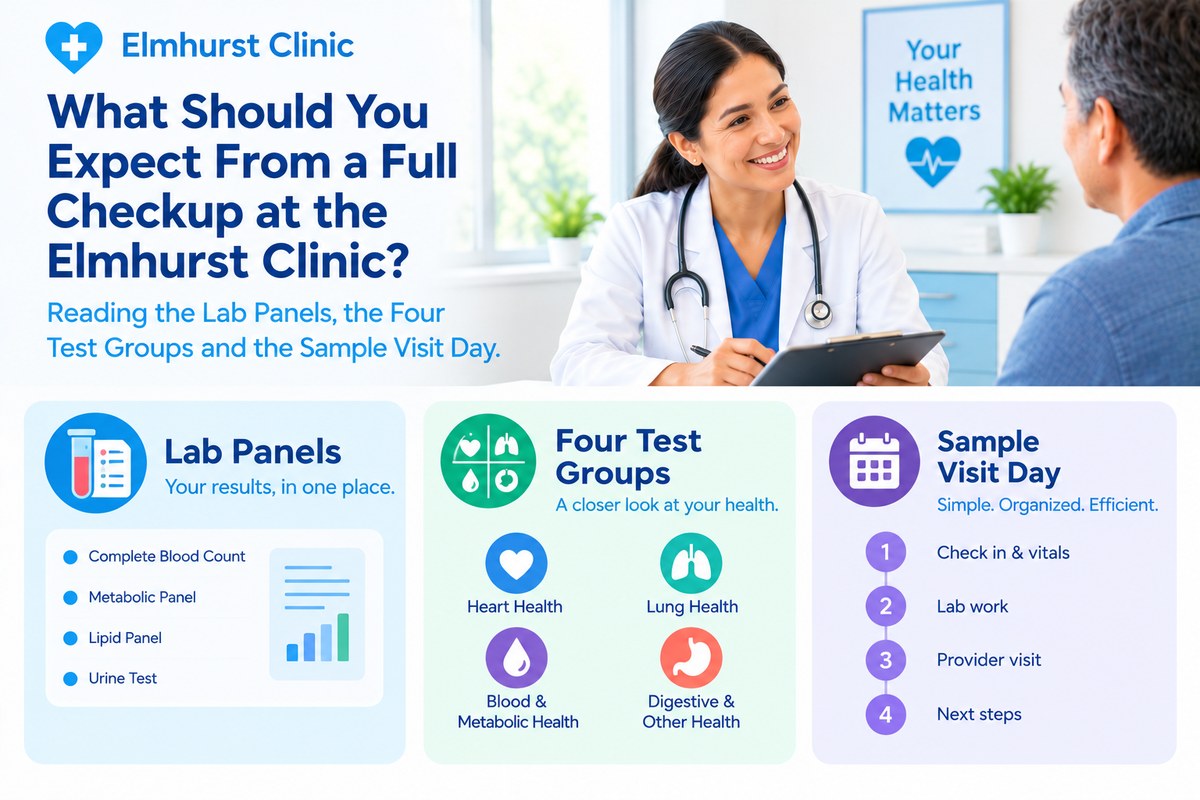
Table of contents
People who search for a full body checkup in Queens usually want one thing: to know exactly what will be done. Which tests? How long? What should I do before I arrive? The honest answer, which the City Prime Care comprehensive health assessments page gives too, is that it depends on you. Tests are matched to your age, sex, family history, and personal risk instead of ordering everything available.
This guide walks through what to expect from a comprehensive health assessment at the clinic at 41-02 75th St, Elmhurst: the four groups of lab tests and screenings the clinic describes, how age changes the picture, how to prepare, what to bring, how insurance works, and a sample visit day. If you want the big-picture explanation of the service first, read our article on what a comprehensive health assessment covers.
In this article:
- 1. The Elmhurst clinic at a glance
- 2. The four test groups (table)
- 3. Age-based screenings (table and graph)
- 4. Fasting and preparation
- 5. What to bring (checklist)
- 6. A sample visit day (graph)
- 7. Insurance and cost
- 8. After the visit: results and next steps
1. The Elmhurst Clinic at a Glance
| Detail | What the clinic lists |
|---|---|
| Address | 41-02 75th St, Elmhurst, NY 11373, a short walk from the 74 St-Broadway station |
| Hours | Monday to Friday, 9:00 AM to 6:00 PM |
| Phone | (929) 491-4592 |
| Languages | English and Spanish at Elmhurst |
| Service | Comprehensive Health Assessments, offered at both the Elmhurst and Chinatown clinics |
| Booking | Online through the appointment page, or by phone |
For a tour of the clinic itself, see our article on what to expect at the Elmhurst clinic and the clinic's Elmhurst page.
2. The Four Test Groups
The clinic says it follows guidance from groups such as the U.S. Preventive Services Task Force, which match screening to age, sex, family history, and personal risk. The result, it says, is a focused set of labs that tells you something useful, with fewer needle sticks and fewer false alarms. The four groups below cover what most adults are offered.
| Test group | What it checks | Why it may be ordered |
|---|---|---|
| 1. Blood count and metabolic panel | A complete blood count (CBC) measures red cells, white cells, and platelets; a comprehensive metabolic panel adds kidney function, liver enzymes, electrolytes such as sodium and potassium, and glucose | Can point toward anemia, infection, or clotting problems before symptoms; shows how major organs work and whether a medicine affects them |
| 2. Cholesterol and blood sugar (A1c) | A lipid panel reports total cholesterol, LDL, HDL, and triglycerides; A1c reflects average blood sugar over about three months | Heart risk is estimated with blood pressure, age, and smoking history; A1c helps spot prediabetes |
| 3. Thyroid and vitamin levels | A TSH test checks thyroid function; vitamin D and B12 may be added | Ordered for fatigue, weight change, hair thinning, feeling cold, or a family history; routine vitamin testing for everyone is not recommended |
| 4. Age-based cancer screenings | Your provider reviews which screenings are due | Pap smears and stool kits can be handled in the clinic; mammograms, colonoscopies, and CT scans are arranged by referral |
Learn what these labs mean in plain language in our guides on common blood tests, cholesterol, and diabetes and A1c.
3. Age-Based Screenings
The clinic's page lists general starting points for average-risk adults. Your provider adjusts them to your history. The graph below shows the typical starting age for several screenings; each block is about five years of age.
| Screening | Typical starting age (graph) | Notes from the clinic's page |
|---|---|---|
| Cervical screening | ████ 21 | From 21 to 65 |
| Diabetes screening | ███████ 35 | Recommended for overweight adults 35 to 70, and earlier with other risk factors |
| Mammogram | ████████ 40 | Every two years from 40 |
| Colorectal screening | █████████ 45 | Generally begins at 45 |
| Lung screening | ██████████ 50 | Adults 50 to 80 with a heavy smoking history may qualify for yearly screening |
| Prostate testing discussion | ███████████ 55 | Men 55 to 69 can discuss testing |
See our annual physical checkup guide for the full age-by-age table, and the U.S. Preventive Services Task Force recommendations for the national guidance behind it.
4. Fasting and Preparation
The clinic's page gives these preparation tips:
- When you book, the front desk confirms whether fasting labs are planned and sends any forms you can complete ahead of time.
- If your visit includes a fasting glucose or lipid panel, skip food and drinks other than water for 8 to 12 hours; water is encouraged, and a morning appointment makes the fast easier.
- Keep taking regular medicines unless told otherwise. If you have diabetes or use insulin, call the clinic first for safe instructions.
- Allow more time than a typical sick visit, wear short sleeves or layers for the blood draw and blood pressure cuff, and arrive about ten minutes early.
- Bring home readings if you track blood pressure, sleep, or glucose, since trends over several weeks often say more than one reading in the exam room.
5. What to Bring
Gather these before you leave home:
- Photo ID and your insurance card
- A list of medicines and supplements with doses, or the bottles
- Recent lab results or specialist letters from other offices
- Your vaccination record, if you have one
- Any employer or school forms that need completing
- A short list of questions or symptoms to discuss
- Details of your family history, such as heart disease, diabetes, or cancer in parents and siblings
New patients can also read the clinic's new patients page and patient forms.
6. A Sample Visit Day
The graph below is an illustrative example of how a visit day might feel from arrival to departure. It is not a promise about timing, and the clinic says to allow more time than a typical sick visit.
| Stage | Relative time (graph) | What happens |
|---|---|---|
| Arrival and check-in | ██░░░░░░░░ | ID, insurance, forms; arrive about ten minutes early |
| Vitals | ██░░░░░░░░ | Blood pressure, pulse, breathing rate, temperature, oxygen level |
| History conversation | █████░░░░░ | Illnesses, surgeries, allergies, medicines, family history, lifestyle |
| Full physical exam | █████░░░░░ | Head-to-toe exam, with findings explained |
| Blood and urine collection, EKG if needed | ███░░░░░░░ | Samples go to a licensed laboratory; the EKG takes a few minutes |
| Wrap-up | ██░░░░░░░░ | Next steps and how results will reach you |
7. Insurance and Cost
The clinic says it accepts most major insurance plans, including Medicaid and Medicare, so call to confirm your plan. It notes that under the Affordable Care Act many plans cover a yearly preventive visit and recommended screenings with no copay in network, but coverage for a comprehensive health assessment still varies. Some labs, or care for a problem found during the visit, may be billed as diagnostic, which can mean a copay or deductible.
| Step | What to do |
|---|---|
| 1 | Call the clinic with your plan name and member ID |
| 2 | Ask the front desk to check your benefits before the visit, which the clinic says it can do |
| 3 | Ask your insurer how a comprehensive assessment and the planned labs are billed |
| 4 | If you have no insurance, ask about self-pay options and check eligibility on NY State of Health |
Our guide to whether preventive care is covered by insurance explains the billing rules in more detail. See the clinic's insurance page for plans it lists.
8. After the Visit: Results and Next Steps
The clinic says results usually return within a few days, and your provider explains each number: what is normal, what is borderline, and what needs action. You leave with a written plan with follow-up tests, screening dates, lifestyle goals, and referrals. Mammograms, colonoscopies, and CT scans are arranged by referral through the clinic's referral services.
Possible next steps:
- Repeat or follow-up labs if something was borderline
- A referral for a screening done at an outside imaging center or specialist
- A move into chronic disease management if a condition such as high blood pressure or diabetes is found
- Lifestyle support through lifestyle counseling
- Yearly follow-up through preventive care
To understand your report, read understanding your diagnostic testing results.
Conclusion
A full checkup in Elmhurst should feel like a plan, not a pile of tests: a focused set of labs, a thorough exam, clear explanations, and a written next step. Prepare a little, bring the right papers, and ask every question you have.
Contact Us: To ask about booking, fasting, coverage, or which tests suit you, reach City Prime Care through our Contact Us page or the appointment page. This article is for general information and does not replace personal medical advice. In an emergency, call 911.
Frequently Asked Questions
See a Doctor in Elmhurst or Chinatown
Have a question about your own health? Book a visit at our Elmhurst, Queens clinic or our Chinatown, Manhattan clinic, or explore our primary care services.
Related articles
Healthcare
Will Insurance Pay for Preventive Care? Reading the Coverage Rules, the Five Billing Checks and the Sample Cost Scenarios
Many plans cover preventive visits and screenings at no copay, but billing can change when a problem is found. Learn the coverage rules, five checks to run before your visit, and sample scenarios showing how a visit may be billed.
Healthcare
Which Screenings Should Elmhurst Adults Not Skip? Reading the Screening Priorities, the Three Age Bands and the Sample Referral Path
Some screenings catch serious problems early, yet many adults skip them. See the screenings that matter in each age band, how in-clinic and referral screenings differ, and a sample referral path from order to results.
Healthcare
What Does a Comprehensive Health Assessment Actually Cover? Reading the Five Parts, the Difference From a Checkup and the Sample Results Timeline
A comprehensive health assessment is one unhurried visit that combines your history, a full exam, lab work, a heart check and a written plan. See its five parts, how it differs from a sick visit or yearly screening, and a sample results timeline.





