HealthcareBy City Prime Care Team
Is Your Lower Left Belly Pain Diverticulitis? Reading the Flare Symptoms, the Five Diet Steps and the Sample Recovery Plan
Lower left belly pain with fever and changes in bowel habits can signal diverticulitis. Learn the symptoms, risk factors, five diet steps, red flags and a sample recovery plan with a simple graph.
Medically reviewed by Dr. Helen Vasquez10 min read
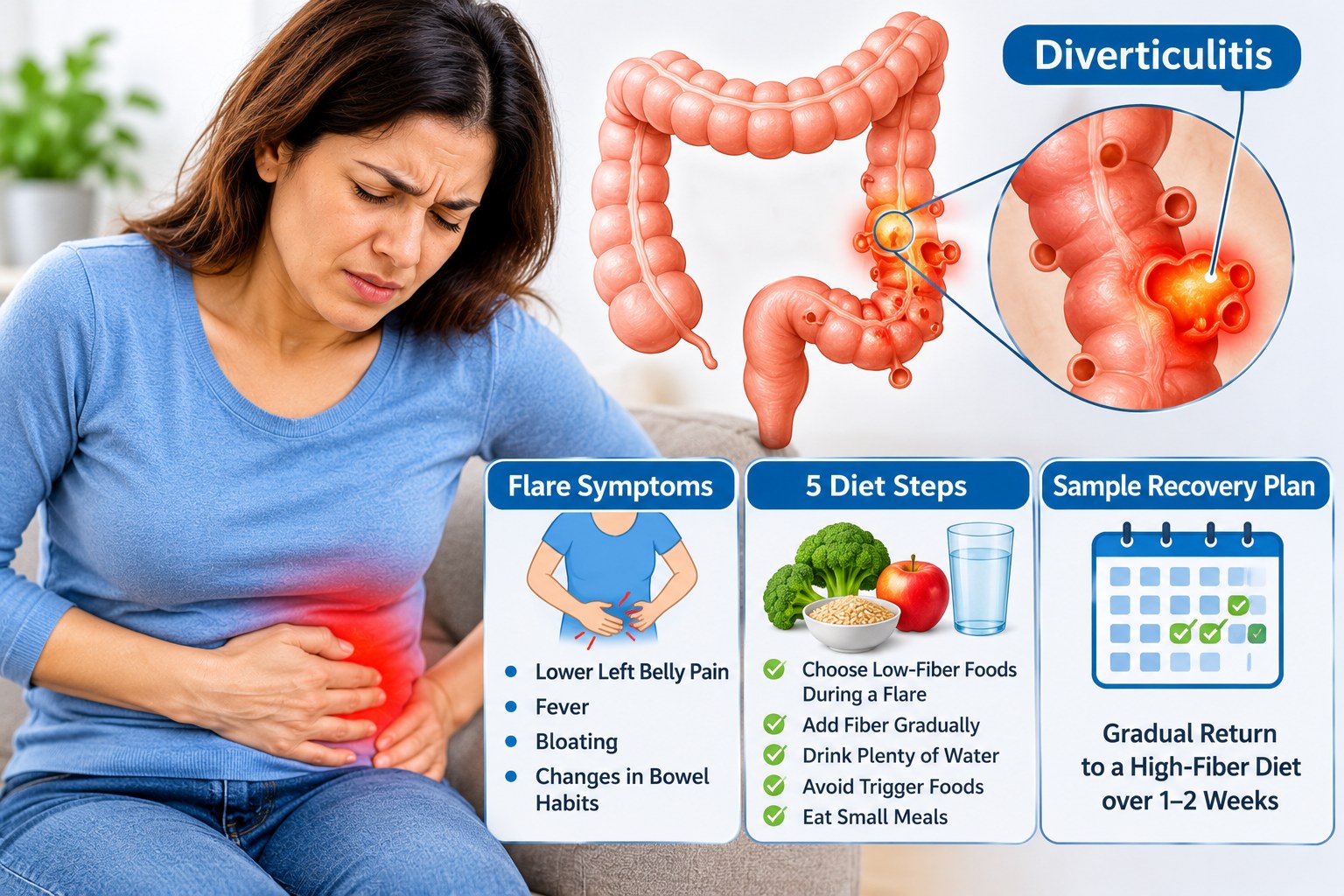
Table of contents
- 1. Diverticulosis vs Diverticulitis
- 2. Symptoms of a Flare
- 3. Could It Be Something Else?
- 4. Five Risk Factors
- 5. How Diverticulitis Is Diagnosed
- 6. Treatment and the Five Diet Steps
- 7. Emergency Signs
- 8. Sample Recovery Plan
- 9. Preventing Another Flare: Fiber and Habits
- 10. Contact Us and Find Us Online
- Conclusion
- Frequently Asked Questions
- See a Doctor in Elmhurst or Chinatown
Many adults develop small pouches called diverticula in the wall of the large intestine, a condition called diverticulosis. It becomes more common with age and usually causes no symptoms. Diverticulitis happens when one or more of those pouches becomes inflamed or infected. The classic result is steady pain in the lower left side of the belly, often with fever, nausea and a change in bowel habits. Most flares are mild and can be treated at home, but some become serious.
This guide explains the symptoms, how diverticulitis differs from other belly pain, the risk factors, how it is diagnosed, the five diet steps during a flare, emergency signs, a sample recovery plan and ways to lower the chance of another attack. It is general education only. Severe constant pain, a hard belly, high fever, repeated vomiting or blood in the stool needs urgent care.
| At a Glance | Key Point |
|---|---|
| What it is | Inflammation or infection of small pouches in the colon wall |
| Typical symptoms | Lower left belly pain, fever, nausea, bloating, constipation or diarrhea |
| Diagnosis | Exam, blood and urine tests and often a CT scan |
| Treatment | Rest, fluids, a stepwise diet and antibiotics when the clinician advises |
| Prevention | Fiber-rich diet, fluids, exercise, no smoking and a healthy weight |
1. Diverticulosis vs Diverticulitis
Diverticulosis means the pouches are present. Diverticulitis means they are inflamed or infected. Most people with diverticulosis never have a flare. For trusted background, see the NIDDK page on diverticulosis and diverticulitis and the MedlinePlus entry on diverticulosis and diverticulitis.
2. Symptoms of a Flare
| Symptom | What It Suggests |
|---|---|
| Steady lower left belly pain lasting days | Typical of diverticulitis; in some people the pain is on the right side |
| Fever and chills | The body is fighting infection or inflammation |
| Nausea or vomiting | Gut irritation; repeated vomiting is a warning sign |
| Constipation or diarrhea | Bowel habits often change during a flare |
| Bloating and tenderness | The inflamed area is sore to touch |
| Blood in the stool | Needs prompt evaluation; call or be seen the same day |
3. Could It Be Something Else?
Belly pain has many causes, so a careful exam matters. The table gives general differences.
| Condition | Common Clue |
|---|---|
| Diverticulitis | Lower left pain, fever, tender spot |
| Stomach flu | Vomiting and diarrhea with cramps; see our guide on upset stomach, vomiting and diarrhea |
| Kidney stone | Severe wave-like flank pain that spreads to the groin; see how kidney stones cause sudden severe pain |
| Urinary tract infection | Burning with urination and urgency; see our guide to UTI symptoms and treatment |
| Acid reflux | Burning upper belly or chest after meals; see what causes acid reflux |
4. Five Risk Factors
Flares are more likely with:
- Older age, especially after 40 to 50.
- A low-fiber diet and low fluid intake.
- Overweight or obesity. See our guide on losing weight safely with your doctor's support.
- Smoking and low physical activity. See quitting smoking or vaping with a doctor's help.
- Regular use of nonsteroidal anti-inflammatory pain relievers or steroids, so review medicines with your clinician.
5. How Diverticulitis Is Diagnosed
Your clinician will ask about pain, fever and bowel habits, examine the belly and may order blood tests for signs of infection, a urine test and, when the diagnosis is uncertain or the flare is severe, a CT scan. Because belly pain can come from many organs, imaging helps rule out other problems. To make sense of lab reports, see how to read your blood test results without panic.
After a first serious flare, your clinician may recommend a colonoscopy several weeks after recovery to look at the colon and rule out other causes.
6. Treatment and the Five Diet Steps
Mild, uncomplicated flares are often treated at home with rest, fluids and close follow-up. Whether you need antibiotics depends on how sick you are, your other conditions and what the exam shows, so follow your clinician's advice. Hospital care with IV fluids and antibiotics is used for severe cases, and surgery or drainage is reserved for complications such as abscess, perforation or repeated severe attacks.
A typical stepwise diet during a flare, guided by your clinician:
- Start with clear liquids such as water, broth, clear juice without pulp and gelatin for the first day or two while pain is strongest.
- Move to low-fiber foods such as white rice, eggs, plain yogurt, refined pasta and well-cooked vegetables without skins as pain eases.
- Drink plenty of fluids throughout the day unless told otherwise.
- Return to a high-fiber diet gradually after the flare settles, adding fiber over days to weeks to avoid gas and cramps.
- Use acetaminophen for pain if your clinician agrees, and avoid anti-inflammatory pain relievers unless advised.
7. Emergency Signs
Go to the emergency room or call 911 for:
- Severe, constant or rapidly worsening belly pain, or a hard, rigid belly.
- High fever, shaking chills or a fast heartbeat.
- Repeated vomiting or being unable to keep fluids down.
- Heavy rectal bleeding or fainting.
- Pain with a history of weakened immunity or recent steroid use.
Not sure whether a visit belongs in an urgent care or the emergency room? Read when a problem calls for the emergency room instead of urgent care in Queens.
8. Sample Recovery Plan
This teaching example shows how a mild flare treated at home may progress. Your plan may differ, and you should follow your clinician's instructions. The squares show example pain level.
| Day | Diet and Care | Example Pain |
|---|---|---|
| Day 1 | Clear liquids, rest, fluids; visit for evaluation | ■■■■■■ |
| Day 2 to 3 | Clear liquids, then low-fiber foods if pain is easing | ■■■■■ |
| Day 4 to 7 | Low-fiber diet; finish any prescribed medicine | ■■■ |
| Week 2 | Slowly add fruits, vegetables and whole grains | ■■ |
| Week 6 to 8 | Follow-up visit; discuss colonoscopy and prevention | ■ |
If pain is not improving after 2 to 3 days, or fever rises, call your clinician or go to urgent care.
9. Preventing Another Flare: Fiber and Habits
Once you have recovered, a fiber-rich diet, steady fluids and regular activity are the main ways to lower the chance of another flare. Many adults aim for roughly 25 to 35 grams of fiber a day, and increasing gradually avoids bloating. Current evidence does not show that nuts, seeds and popcorn trigger flares, but ask your clinician about your own diet. The table shows approximate fiber amounts.
| Food | Serving | Approx. Fiber |
|---|---|---|
| Lentils, cooked | 1 cup | About 15 g |
| Black beans, cooked | 1 cup | About 15 g |
| Raspberries | 1 cup | About 8 g |
| Broccoli, cooked | 1 cup | About 5 g |
| Pear with skin | 1 medium | About 5 to 6 g |
| Oatmeal, cooked | 1 cup | About 4 g |
| Whole-wheat bread | 1 slice | About 2 g |
10. Contact Us and Find Us Online
If you have lower belly pain, have had a flare before or want a prevention plan, our team can examine you, order tests and guide treatment and follow-up. For non-emergency questions, Contact Us, book a visit, or find City Prime Care on Google: City Prime Care on Google. For severe pain, a hard belly or heavy bleeding, call 911 or go to the emergency room.
Conclusion
Diverticulitis is common and often manageable with early evaluation, fluids and a stepwise diet, but severe pain, fever and vomiting need prompt care. After recovery, a fiber-rich diet, fluids, exercise and not smoking lower the chance of another flare. This article is for general education and does not replace medical advice.
Frequently Asked Questions
See a Doctor in Elmhurst or Chinatown
Have a question about your own health? Book a visit at our Elmhurst, Queens clinic or our Chinatown, Manhattan clinic, or explore our primary care services.
Related articles
Healthcare
Why Are Your Ankles and Feet Swollen by Evening, and When Is Leg Swelling Serious? Reading the Swelling Patterns, the Five Relief Steps and the Sample Two-Week Swelling Diary
Swollen ankles after a long day can be harmless, but swelling in one leg, sudden weight gain or breathlessness can signal a clot, heart, kidney or liver problem. Learn the patterns, five relief steps and a two-week diary.
Healthcare
Why Is a Red, Itchy Ring-Shaped Patch Spreading on Your Skin, and Is It Ringworm? Reading the Patch Types, the Five Treatment Steps and the Sample Four-Week Clearing Plan
A red, scaly, ring-shaped itchy patch is often ringworm, a common fungal skin infection that is not caused by a worm. Learn the patch types, look-alike rashes, five treatment steps and a four-week clearing plan.
Healthcare
Why Is Your Hair Thinning or Falling Out in Clumps, and Could a Health Problem Be Behind It? Reading the Hair Loss Patterns, the Five Checkup Steps and the Sample Six-Month Regrowth Timeline
Finding more hair in the shower or brush can be stressful. Learn the common hair loss patterns, which blood tests and health problems matter, five checkup steps and a realistic six-month regrowth timeline.