
HealthcareBy City Prime Care Team
Croup in Young Children in Queens, NY: How the Barking Cough Develops and What to Expect
A seal-like barking cough and noisy breathing at night are the signs of croup in young children. Learn how croup develops, how severity is judged, five home-care steps, a sample five-day timeline and when to get urgent care.
Medically reviewed by Dr. Helen Vasquez11 min read
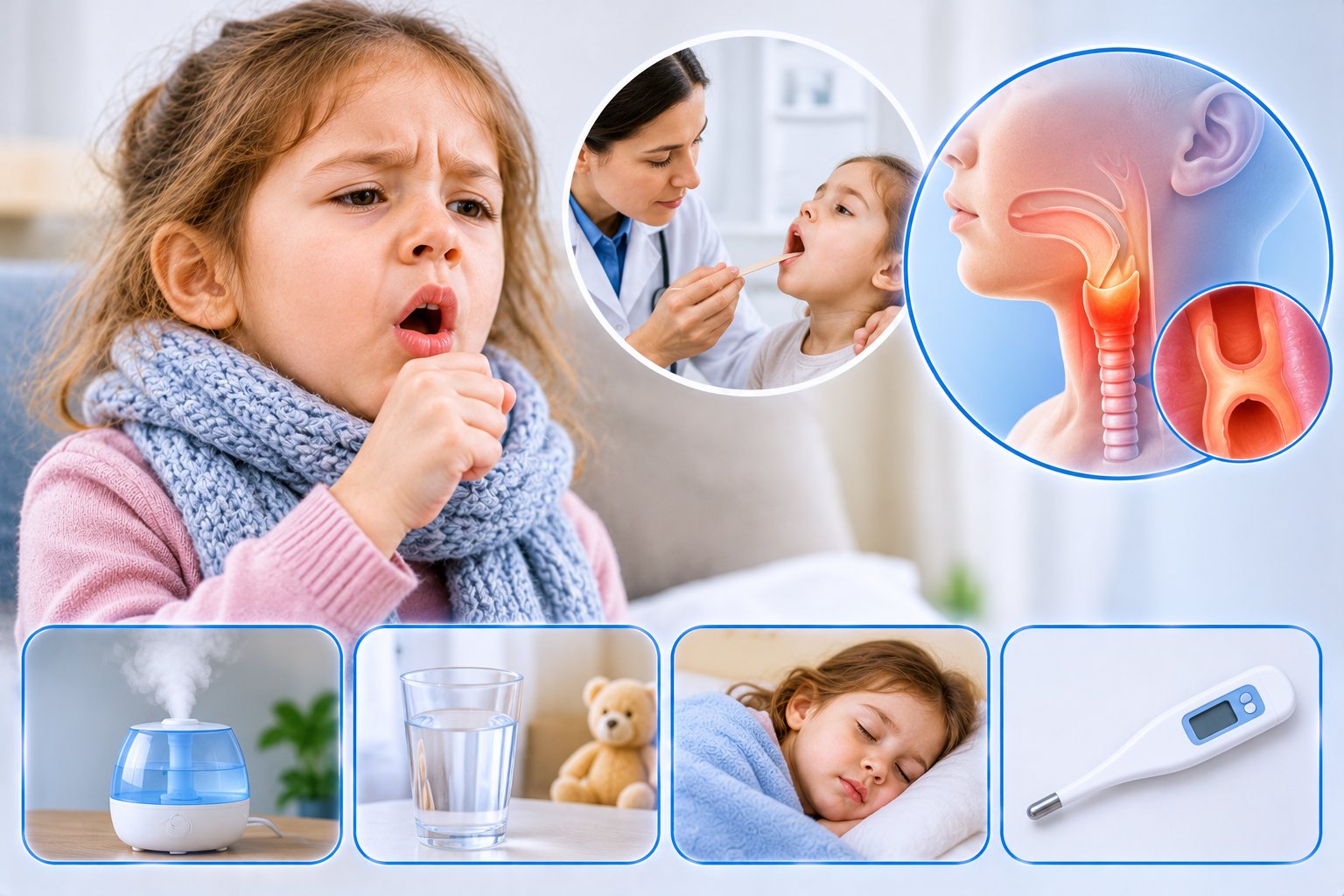
Table of contents
- 1. What Is Croup?
- 2. Judging Severity: Mild, Moderate and Severe
- 3. Croup vs Look-Alike Problems
- 4. Causes and Who Is at Higher Risk
- 5. How a Clinician Diagnoses Croup
- 6. The Five Home-Care Steps
- 7. Treatment Options at a Glance
- 8. Graph: Illustrative Cough Severity Across Five Days
- 9. Sample Five-Day Care Timeline
- 10. Red Flags: When to Get Urgent Care
- 11. Where to Get Care: Elmhurst, Chinatown and Lower Manhattan
- 12. Related Reading From City Prime Care
- 13. Contact Us
- Conclusion
- Frequently Asked Questions
- See a Doctor in Elmhurst or Chinatown
Your toddler goes to bed with a runny nose and wakes in the middle of the night with a harsh, barking cough that sounds like a seal. The voice is hoarse, and there is a noisy, high-pitched sound when breathing in. It is frightening for any parent, but this is the classic picture of croup, a common viral illness of young children. Most cases are mild and settle in a few days, though some need medical treatment, and a few need emergency care.
This guide explains what croup is, how severity is judged, five home-care steps, a sample five-day timeline and the red flags that need urgent care. City Prime Care serves patients in Elmhurst, Queens, Chinatown and Lower Manhattan. This article is general education and not a substitute for personal medical advice. The American Academy of Pediatrics also explains croup on its HealthyChildren croup page.
Quick takeaways:
- Croup is a viral infection that swells the voice box and windpipe, causing a barking cough, hoarse voice and sometimes noisy breathing called stridor.
- It most often affects children from about 6 months to 3 years old and is typically worse at night, usually peaking on the second or third night.
- Staying calm, comfort measures and fluids help mild cases, while a single dose of a steroid medicine from a clinician can reduce swelling in moderate cases.
- Stridor at rest, a pulling-in of the chest or neck with breathing, blue lips, drooling or unusual sleepiness is an emergency.
1. What Is Croup?
Croup, or laryngotracheitis, is swelling of the larynx (voice box) and trachea (windpipe) that is usually caused by a virus, most often parainfluenza. In young children the airway below the vocal cords is narrow, so even a small amount of swelling changes the voice and makes breathing noisy.
Croup is most common in fall and winter. It often begins like a cold, with a runny nose and mild fever, before the barking cough appears. It spreads through coughs, sneezes and contaminated surfaces.
2. Judging Severity: Mild, Moderate and Severe
| Level | What you may notice | Typical approach |
|---|---|---|
| Mild | Occasional barking cough, hoarse voice, no noisy breathing at rest, child plays and drinks normally | Comfort care at home, watch closely at night |
| Moderate | Frequent barking cough, stridor at rest, mild pulling in at the ribs or neck, some distress | Prompt medical visit; a steroid dose may be given |
| Severe | Loud stridor at rest, marked chest or neck retractions, agitation or sleepiness, trouble speaking or feeding | Emergency care; treatment with nebulized medicines and monitoring |
| Impending airway blockage | Blue or gray lips, very tired or limp, quiet breathing despite distress | Call 911 immediately |
Crying can make stridor louder, so look at how your child breathes when calm. Stridor that remains when the child is at rest is a warning sign.
3. Croup vs Look-Alike Problems
| Condition | Typical clue | How it differs from croup |
|---|---|---|
| Common cold | Runny nose, mild cough | No barking cough or stridor |
| Epiglottitis | High fever, severe throat pain, drooling, child sits leaning forward | Rare and life-threatening; no barking cough and the child looks very ill |
| Foreign object in the airway | Sudden choking or coughing while eating or playing | Sudden onset without a cold or fever |
| Asthma or wheezing | Whistling sounds when breathing out | Wheeze is on exhalation, not stridor on inhalation |
| Pneumonia | Fever, fast breathing, cough with chest sounds | Lower-airway illness; see warning signs of pneumonia |
| Allergic reaction | Hives, facial swelling, sudden breathing trouble after exposure | Often with a trigger and rash; see bug bites and bee stings |
4. Causes and Who Is at Higher Risk
Croup is linked to:
- Viruses, most commonly parainfluenza, and also RSV, influenza, adenovirus and others.
- Age between about 6 months and 3 years, when airways are small; croup is less common after age 6.
- Cold weather months when respiratory viruses circulate.
- Daycare or crowded homes where children share germs.
- A history of previous croup episodes or a narrow airway.
- Being around cigarette smoke, which irritates the airways.
- Premature birth or underlying airway or heart conditions, which can make croup more serious.
Staying up to date on childhood vaccines protects against some serious airway infections; see our adult vaccines guide for family vaccine planning and how to tell a childhood illness that needs a doctor.
5. How a Clinician Diagnoses Croup
A visit usually includes:
- A history of the cold symptoms, how the cough began, fever, feeding, drinking and any choking episode.
- Watching your child's breathing at rest, counting the breathing rate and checking for stridor, chest retractions, color and alertness.
- Listening to the chest and checking oxygen levels with a small sensor on the finger or toe.
- Usually no X-ray is needed; an X-ray may be used if the diagnosis is unclear, though see when an injury or cough calls for an X-ray.
- A treatment plan, which may include a single dose of a steroid medicine, observation and clear advice on warning signs; see when your primary care doctor sends you to a specialist if hospital care is needed.
Call ahead for an urgent visit if your child has stridor at rest. If breathing looks difficult, call 911 rather than driving.
6. The Five Home-Care Steps
For mild croup, once a clinician agrees home care is safe:
- Stay calm and comfort your child: crying and fear make breathing harder, so hold your child upright, cuddle and speak softly.
- Try cool or humid air: sitting in a steamy bathroom for a few minutes or stepping outside into cool night air may feel soothing, though evidence is limited; avoid hot steam and hot water that can cause burns.
- Offer fluids often: small sips of water, breast milk, formula or diluted juice prevent dehydration; see dehydration warning signs.
- Ease fever or discomfort: use acetaminophen or ibuprofen if appropriate for age and weight as the label or your clinician advises; avoid cough and cold medicines in young children.
- Watch through the night: sleep near your child, keep the head slightly raised, and check breathing, color and alertness. Use the red flags below to decide when to go to the emergency room.
Honey can soothe a cough in children over one year of age, but it should never be given to babies younger than 12 months.
7. Treatment Options at a Glance
| Option | Best for | Notes |
|---|---|---|
| Comfort care, fluids and rest | Mild croup | Most children recover without medicine |
| Single dose of a steroid (such as dexamethasone) | Mild to moderate croup | Prescribed by a clinician; reduces airway swelling and often helps within hours |
| Nebulized epinephrine | Moderate to severe croup with stridor at rest | Given in a clinic or hospital; child is observed afterward |
| Oxygen and monitoring | Severe croup | Hospital treatment |
| Antibiotics | Rare bacterial complications | Not used for viral croup |
| Cool-mist humidifier | Comfort in the bedroom | Clean it daily; benefit is uncertain but some families find it soothing |
8. Graph: Illustrative Cough Severity Across Five Days
This is a teaching graph, not patient data. It shows how croup symptoms often start with a cold, peak on the second or third night and then fade. Real courses vary from child to child.
| Day | Barking cough and noisy breathing (illustrative) |
|---|---|
| Day 1 (cold symptoms) | ██ |
| Day 2 (night) | █████████ |
| Day 3 (night) | ██████████ |
| Day 4 | █████ |
| Day 5 | ███ |
| Day 7 | █ |
9. Sample Five-Day Care Timeline
| When | Goal | Sample actions | Check |
|---|---|---|---|
| Day 1 | Watch and prepare | Rest, fluids, note the cough, keep the home smoke-free | Does the child breathe quietly while calm? |
| Day 2 (first bad night) | Calm and assess | Comfort, cool night air, call a clinician or get a visit if stridor at rest | Any pulling in at the ribs or neck? |
| Day 3 | Treat as advised | Steroid dose if prescribed, fluids, close night-time watch | Is the child drinking and playful when awake? |
| Days 4-5 | Recovery | Continue fluids, rest and monitoring | Is the cough softer and breathing quiet? |
| After recovery | Prevent spread | Wash hands, keep the child home while fever or severe cough lasts | Are other children at home now showing symptoms? |
10. Red Flags: When to Get Urgent Care
Call 911 or go to the emergency room for:
- Stridor that continues when the child is calm or asleep.
- Pulling in of the skin between the ribs, at the base of the throat or under the breastbone with each breath.
- Blue, gray or very pale lips or face.
- Drooling, being unable to swallow or sitting rigidly forward with a high fever.
- Unusual sleepiness, limpness, confusion or extreme agitation.
- Fast breathing, difficulty speaking or feeding.
- Symptoms in a baby younger than 6 months, or croup that is not improving after three to five days, or keeps coming back.
11. Where to Get Care: Elmhurst, Chinatown and Lower Manhattan
A barking cough at night is a common reason families search for urgent care Elmhurst NY, a walk in clinic Elmhurst NY, urgent care 11373, a same day doctor appointment Elmhurst or Same-Day Acute Care in Elmhurst Queens. For well-child visits, vaccine records and follow-up after an illness, families choose a primary care doctor Elmhurst NY, a family doctor Elmhurst Queens, Primary Care Doctors in Elmhurst NY or chronic disease management Elmhurst NY for children with asthma or recurring airway issues.
People comparing options often search for Best Primary Care Clinic in Elmhurst Queens, Best Primary Care Doctor in Elmhurst Queens, Primary Care Near Me Elmhurst Queens, Best Primary Care Clinics in Queens NY, Primary Care Clinics and Doctors in Queens NY and Top Primary Care Clinics in Queens NY. City Prime Care offers Men's and Women's Healthcare in Elmhurst NY, a physical exam clinic Elmhurst NY and preventive care Elmhurst NY, including evaluation of children's respiratory illnesses and referrals.
Downtown, people look for primary care Lower Manhattan, primary care Chinatown NYC, a doctor near Catherine Street NYC, primary care 75 Catherine St, a walk-in clinic Chinatown NYC, a Primary Care Clinic in Chinatown Manhattan or a Healthcare Center in Chinatown Manhattan NY. Citywide searches include primary care doctor NYC, family doctor Manhattan NYC, annual physical exam NYC, same day primary care NYC, preventive care Lower Manhattan and primary care doctor near me. Residents searching for Primary Care Doctors Serving Todt Hill Staten Island are welcome to contact the clinic to ask about care options and travel.
| Area | Common searches | How care can help |
|---|---|---|
| Elmhurst (ZIP 11373) | Urgent care 11373, same day doctor appointment Elmhurst | Prompt breathing check and treatment decisions |
| Elmhurst, Queens | Family doctor Elmhurst Queens, primary care doctor Elmhurst NY | Follow-up, vaccine review and recurring croup plans |
| Queens | Best Primary Care Clinics in Queens NY, Top Primary Care Clinics in Queens NY | Easy-to-reach primary care for the family |
| Lower Manhattan | Primary care Lower Manhattan, preventive care Lower Manhattan | Convenient visits near work |
| Chinatown / Catherine Street | Primary care Chinatown NYC, doctor near Catherine Street NYC, primary care 75 Catherine St | Convenient downtown care |
| Citywide | Primary care doctor NYC, family doctor Manhattan NYC, same day primary care NYC | Same-day or scheduled evaluation |
You can also find the clinic on Google or learn more on the City Prime Care website.
12. Related Reading From City Prime Care
13. Contact Us
Is your child waking with a barking cough or noisy breathing? Visit our Contact Us page or see our Google listing. If your child has stridor at rest, blue lips, drooling or is struggling to breathe, call 911 or go to the nearest emergency room.
Conclusion
Croup is frightening to hear but is usually mild and settles within about three to five days with calm, fluids and comfort care. A clinician can give a steroid dose when needed. Know the warning signs, especially stridor at rest and retractions, and do not wait to seek emergency help if your child is struggling to breathe.
Frequently Asked Questions
See a Doctor in Elmhurst or Chinatown
Have a question about your own health? Book a visit at our Elmhurst, Queens clinic or our Chinatown, Manhattan clinic, or explore our primary care services.
Related articles
Healthcare
Chickenpox in Adults and Children in Elmhurst, NY: How the Rash Develops and What to Expect
Itchy red spots that turn into blisters and then crusts are the classic sign of chickenpox. Learn how the rash develops, how long you are contagious, five care steps, a ten-day timeline and when to see a doctor.
Healthcare
Tonsillitis in Queens, NY: How Swollen Tonsils Are Evaluated and What to Expect From Treatment
Red, swollen tonsils with a painful throat and fever are the hallmarks of tonsillitis. Learn how viral and bacterial cases differ, how strep is tested, five care steps and when tonsil surgery is considered.
Healthcare
Easy Bruising in Elmhurst, NY: Why Bruises Appear Easily and What to Expect From a Checkup
Finding large bruises without remembering a bump can be unsettling. Learn the common causes of easy bruising, how bruise colors change, which blood tests may be used, five care steps and when to see a doctor.