HealthcareBy City Prime Care Team
Could Your Headache and Nausea at Home Be Carbon Monoxide Poisoning? Reading the Exposure Symptoms, the Five Home-Safety Steps and the Sample Exposure-Level Chart
Carbon monoxide is invisible and odorless, and early poisoning feels like the flu without a fever. Learn the symptoms, five home-safety steps, what to do when an alarm sounds and a sample exposure chart.
Medically reviewed by Dr. Helen Vasquez10 min read
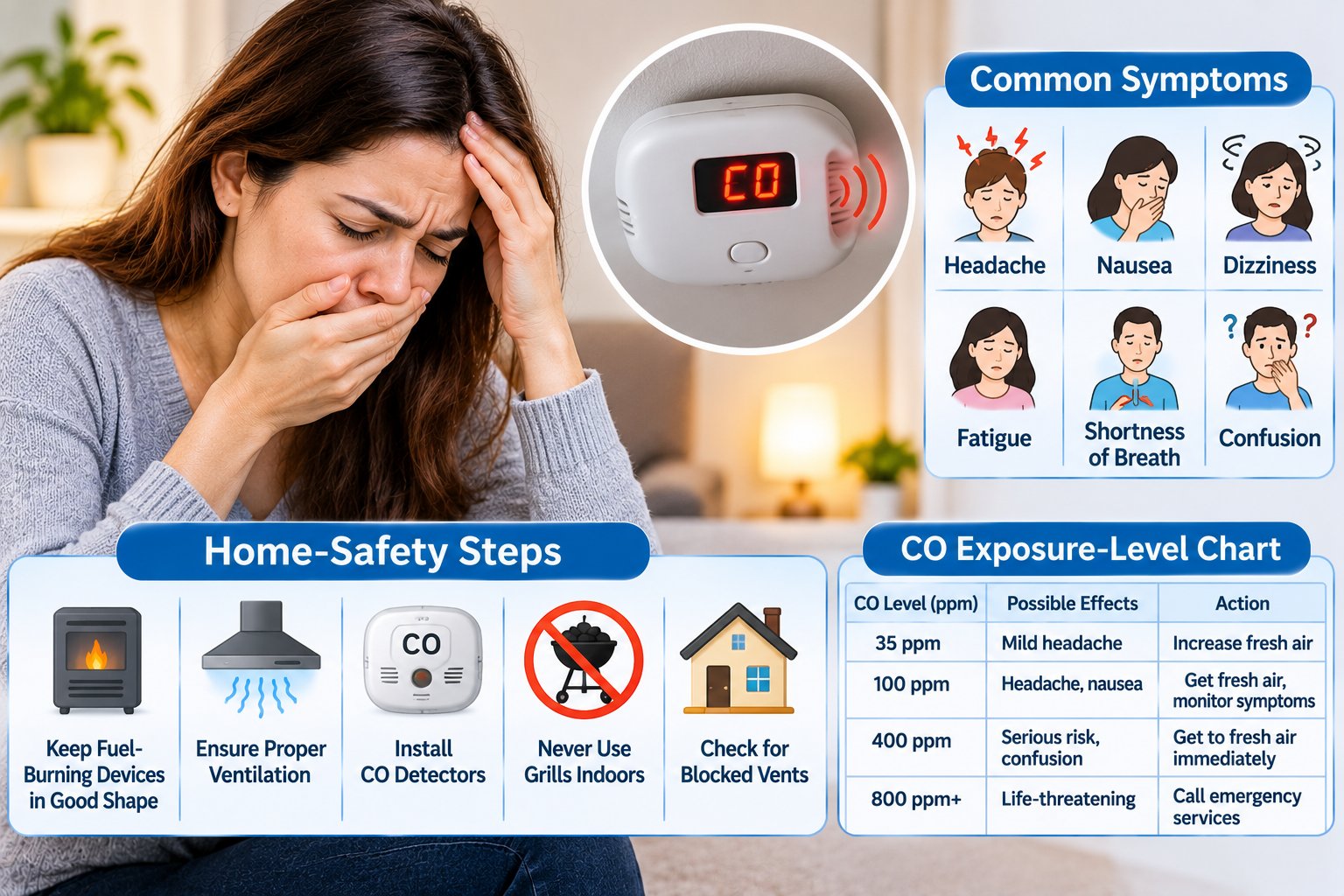
Table of contents
- 1. What Is Carbon Monoxide and Where Does It Come From?
- 2. Symptoms From Mild to Severe
- 3. Five Clues It May Be CO and Not the Flu
- 4. Five Home-Safety Steps
- 5. What to Do If an Alarm Sounds or You Suspect CO
- 6. Who Is at Higher Risk?
- 7. How Doctors Diagnose and Treat CO Poisoning
- 8. Sample Exposure-Level Chart
- 9. Winter Home Checklist
- 10. Contact Us and Find Us Online
- Conclusion
- Frequently Asked Questions
- See a Doctor in Elmhurst or Chinatown
Carbon monoxide, or CO, is a colorless, odorless gas produced whenever fuel burns without enough air. Furnaces, gas stoves and ovens, water heaters, fireplaces, portable generators, charcoal grills and running cars can all make it. Winter is the highest-risk season, because homes are sealed tight, heaters run all day and people bring grills or generators too close to the house. You cannot see or smell the gas, which is why early poisoning is so easily mistaken for the flu.
This guide explains where CO comes from, symptoms from mild to severe, five clues that point to CO rather than a virus, the five home-safety steps, what to do when an alarm sounds, who is at higher risk and a sample exposure-level chart. It is general education only. If anyone has confusion, chest pain, fainting or seizure, or several people and pets are sick at once, leave the building and call 911.
| At a Glance | Key Point |
|---|---|
| What it is | An invisible, odorless gas from burning fuel that blocks oxygen delivery in the blood |
| Early symptoms | Headache, dizziness, nausea, tiredness, often without fever |
| Serious symptoms | Confusion, chest pain, vomiting, fainting, seizure |
| First step | Get everyone out into fresh air and call 911 |
| Best prevention | Working CO alarms on every level and near sleeping areas, plus yearly appliance checks |
1. What Is Carbon Monoxide and Where Does It Come From?
When you breathe CO, it attaches to hemoglobin in red blood cells far more tightly than oxygen does. The blood then carries less oxygen to the brain and heart, even though you are breathing normally. For reliable background, see the CDC page on carbon monoxide and the MedlinePlus entry on carbon monoxide poisoning.
| Source | How CO Builds Up | Safer Habit |
|---|---|---|
| Furnace or boiler | Blocked flue, cracked heat exchanger or poor ventilation | Annual professional inspection before heating season |
| Gas stove or oven | Used for heating or with a poorly adjusted burner | Never use a stove or oven to heat the home |
| Portable generator | Run in a garage, basement or near a window | Run outdoors, well away from doors, windows and vents |
| Charcoal or gas grill | Used indoors, on a balcony or in a garage | Use only outdoors in open air |
| Car or truck | Engine idling in an attached garage, even with the door open | Back out before warming up the car |
| Fireplace or wood stove | Blocked or dirty chimney | Yearly chimney inspection and cleaning |
2. Symptoms From Mild to Severe
| Level | Common Symptoms | What to Do |
|---|---|---|
| Mild | Dull headache, dizziness, nausea, tiredness, mild shortness of breath | Get into fresh air; if CO is possible, call 911 or emergency services and do not wait |
| Moderate | Pounding headache, confusion, vomiting, blurred vision, chest pain, fast heartbeat | Leave the building and call 911 |
| Severe | Fainting, seizure, loss of consciousness, trouble waking | Call 911; this is a life-threatening emergency |
Sleeping people and people who have been drinking may not notice symptoms before they become severe, which is why working alarms matter so much.
3. Five Clues It May Be CO and Not the Flu
A virus and CO can feel alike. These clues point toward CO:
- There is no fever, even though you feel achy and unwell.
- More than one person in the home is sick at the same time.
- Pets are sluggish or sick, or houseplants look unusually poor.
- Symptoms improve when you leave the house and return when you come back.
- Symptoms are worse when the heater, stove, generator or garage car has been running.
Compare patterns in our guide to flu vs cold vs COVID-19 in Queens. When in doubt about CO, treat it as an emergency first and a virus second.
4. Five Home-Safety Steps
A few habits remove most of the risk:
- Install CO alarms on every level of the home and outside every sleeping area, as the manufacturer directs, and test them monthly.
- Replace alarms at the end of their rated life, commonly 5 to 10 years, and replace batteries on schedule.
- Have furnaces, boilers, water heaters, stoves and chimneys inspected every year by a qualified technician.
- Never run a generator, grill, camp stove or charcoal burner indoors, in a garage or close to windows, doors and vents.
- Never idle a car in an attached garage, and keep outdoor vents for dryers and furnaces clear of snow.
5. What to Do If an Alarm Sounds or You Suspect CO
Act right away, even if everyone feels fine:
- Get everyone, including pets, out into fresh air immediately.
- Call 911 from outside, and do not go back in until emergency responders say it is safe.
- Do not stop to open windows or find the source; leaving is the priority.
- Tell responders about every symptom and when they began.
- Be checked by a medical team even if you feel better after leaving, because symptoms can lag behind exposure.
Not sure whether symptoms call for the emergency room or a clinic visit? Read when a problem calls for the emergency room instead of urgent care in Queens. Suspected CO poisoning belongs in an emergency setting.
6. Who Is at Higher Risk?
| Group | Why Risk Is Higher |
|---|---|
| Infants and young children | Smaller bodies and faster breathing take in CO quickly |
| Older adults | Heart and brain are more sensitive to low oxygen |
| Pregnant people | The fetus is vulnerable to low oxygen |
| People with heart disease or anemia | Less oxygen-carrying reserve |
| People with lung conditions such as asthma or COPD | Breathing symptoms can worsen quickly; see our guide to asthma control through every season in Queens |
| Sleeping or intoxicated people | Warning symptoms may go unnoticed |
7. How Doctors Diagnose and Treat CO Poisoning
Diagnosis starts with the story and a blood test that measures carboxyhemoglobin, the form of hemoglobin bound to CO. A standard finger pulse oximeter can read normal in CO poisoning, so it cannot rule it out. Treatment is breathing 100 percent oxygen through a mask until the level falls, and some people with severe poisoning receive hyperbaric oxygen treatment.
Some people develop delayed problems days to weeks later, such as trouble concentrating, memory changes, mood changes or headaches, so follow-up after treatment matters. A primary care visit can help review ongoing symptoms; see when your primary care doctor sends you to a specialist.
8. Sample Exposure-Level Chart
This teaching chart uses commonly cited approximate effects of CO at different concentrations in parts per million (ppm). Real effects depend on the person and the time of exposure, so treat any alarm as an emergency. The squares show example severity.
| CO Level (approx.) | Typical Effect Over Time | Example Severity |
|---|---|---|
| Under 9 ppm | Typical outdoor or indoor background; no symptoms | ■ |
| About 35 ppm | Possible headache or dizziness after several hours | ■■ |
| About 100 to 200 ppm | Headache, dizziness, nausea within a few hours | ■■■■ |
| About 400 ppm | Severe headache within 1 to 2 hours; can be life-threatening in about 3 hours | ■■■■■■ |
| About 800 ppm or more | Dizziness, nausea and convulsions within about 45 minutes; unconsciousness within about 2 hours | ■■■■■■■■ |
9. Winter Home Checklist
| Task | How Often |
|---|---|
| Test CO alarms | Monthly |
| Replace alarm batteries | At least twice a year, or as directed |
| Service furnace, boiler and water heater | Yearly, before heating season |
| Inspect and clean chimney or flue | Yearly |
| Check outdoor vents for snow and ice | After each storm |
| Review generator and grill rules with the household | Before each winter |
10. Contact Us and Find Us Online
If you have had CO exposure, are recovering after an emergency visit, or have lingering headaches or trouble concentrating, our team can review your symptoms and guide next steps. For non-emergency questions, Contact Us, book a visit, or find City Prime Care on Google: City Prime Care on Google. If an alarm is sounding or anyone is confused or faint, call 911 first.
Conclusion
Carbon monoxide is dangerous because you cannot detect it without an alarm. Keep working alarms on every level, service fuel-burning appliances yearly, keep generators and grills outdoors and leave the building and call 911 if you suspect exposure. This article is for general education and does not replace medical advice.
Frequently Asked Questions
See a Doctor in Elmhurst or Chinatown
Have a question about your own health? Book a visit at our Elmhurst, Queens clinic or our Chinatown, Manhattan clinic, or explore our primary care services.
Related articles
Healthcare
Why Are Your Ankles and Feet Swollen by Evening, and When Is Leg Swelling Serious? Reading the Swelling Patterns, the Five Relief Steps and the Sample Two-Week Swelling Diary
Swollen ankles after a long day can be harmless, but swelling in one leg, sudden weight gain or breathlessness can signal a clot, heart, kidney or liver problem. Learn the patterns, five relief steps and a two-week diary.
Healthcare
Why Is a Red, Itchy Ring-Shaped Patch Spreading on Your Skin, and Is It Ringworm? Reading the Patch Types, the Five Treatment Steps and the Sample Four-Week Clearing Plan
A red, scaly, ring-shaped itchy patch is often ringworm, a common fungal skin infection that is not caused by a worm. Learn the patch types, look-alike rashes, five treatment steps and a four-week clearing plan.
Healthcare
Why Is Your Hair Thinning or Falling Out in Clumps, and Could a Health Problem Be Behind It? Reading the Hair Loss Patterns, the Five Checkup Steps and the Sample Six-Month Regrowth Timeline
Finding more hair in the shower or brush can be stressful. Learn the common hair loss patterns, which blood tests and health problems matter, five checkup steps and a realistic six-month regrowth timeline.