HealthcareBy City Prime Care Team
Is That Bulge in Your Groin or Belly a Hernia, and When Does It Need Surgery? Reading the Hernia Types, the Five Warning Signs and the Sample Repair Timeline
A bulge that appears when you cough or lift may be a hernia. Learn the main types, risk factors, five warning signs of an emergency, treatment choices and a sample repair recovery timeline with a simple graph.
Medically reviewed by Dr. Karl E. Latortue10 min read
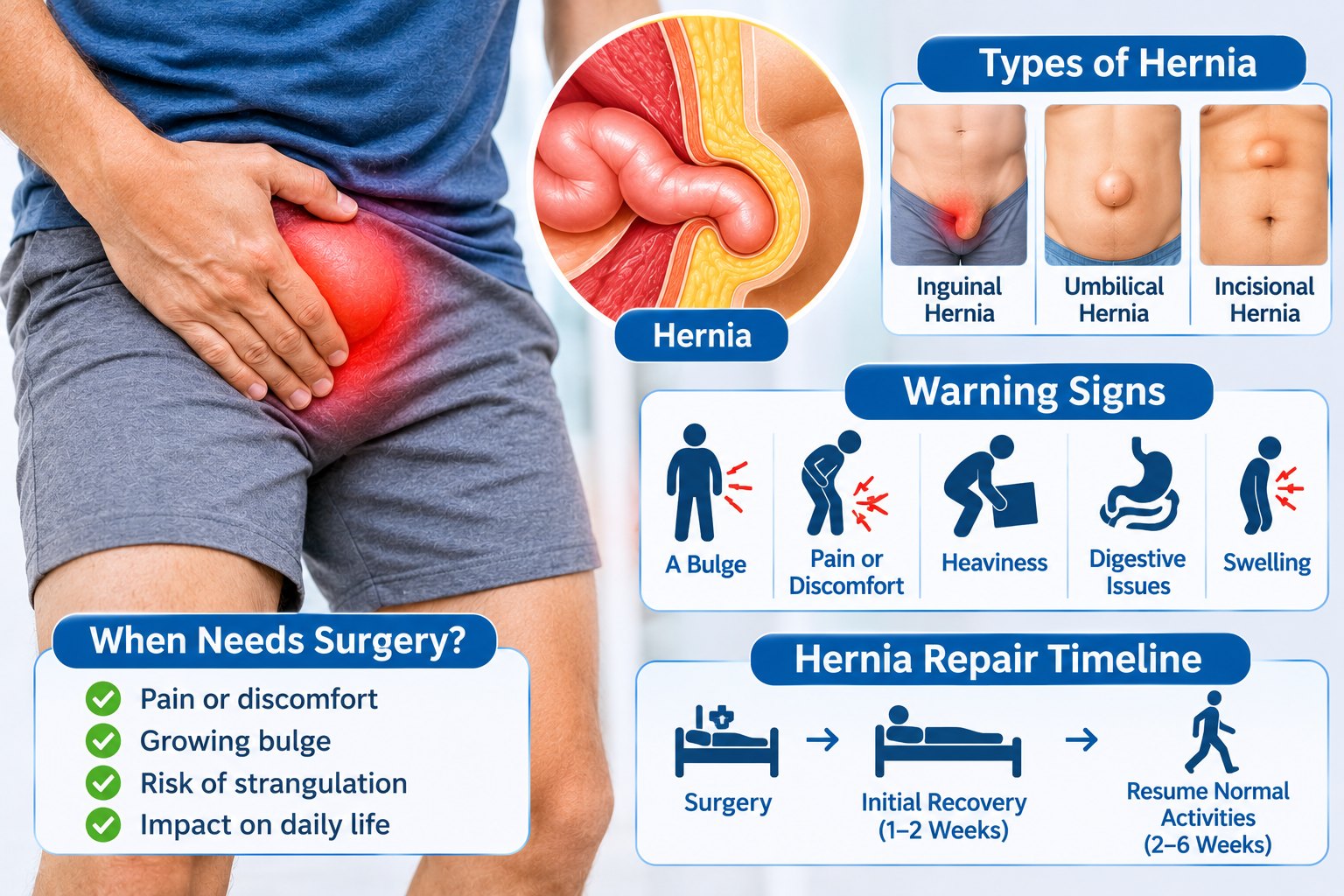
Table of contents
- 1. What Is a Hernia?
- 2. Common Types of Hernia
- 3. Symptoms and How to Notice Them
- 4. Who Is at Higher Risk?
- 5. Five Warning Signs of an Emergency
- 6. How a Hernia Is Diagnosed
- 7. Treatment Options
- 8. Sample Repair Recovery Timeline
- 9. Five Ways to Lower Your Risk
- 10. Contact Us and Find Us Online
- Conclusion
- Frequently Asked Questions
- See a Doctor in Elmhurst or Chinatown
A hernia happens when an organ or fatty tissue pushes through a weak spot in the muscle or connective tissue that normally holds it in place. The most familiar sign is a soft bulge in the groin, belly button or an old surgical scar that may appear when you stand, cough or lift something and shrink when you lie down. Hernias are common, and many are not emergencies, but some can trap tissue and cut off its blood supply, which needs urgent surgery.
This guide explains the main hernia types, the symptoms, the risk factors, the five warning signs that point to an emergency, how hernias are diagnosed and treated, a sample repair recovery timeline and ways to lower your risk. It is general education only. A hernia that suddenly becomes very painful, firm or dark, or cannot be pushed back, with nausea or vomiting, needs emergency care. Call 911.
| At a Glance | Key Point |
|---|---|
| What it is | Tissue or an organ pushing through a weak spot in the abdominal wall or diaphragm |
| Common signs | A bulge that grows with standing, coughing or lifting; aching or heaviness |
| Emergency signs | Sudden severe pain, firm or discolored bulge, vomiting, no gas or stool |
| Treatment | Watchful waiting for some, surgical repair for many |
| Prevention | Healthy weight, proper lifting, fiber, no smoking and treating a chronic cough |
1. What Is a Hernia?
The abdominal wall is layered muscle and tissue that holds the intestines and other organs inside. Strain, aging, surgery or birth differences can leave a weak spot, and pressure from inside the belly pushes tissue through it. A hernia does not heal on its own and usually grows slowly over time. For trusted background, see MedlinePlus on hernia and hiatal hernia.
2. Common Types of Hernia
| Type | Where It Appears | Who Is Affected Most |
|---|---|---|
| Inguinal | Groin, where the thigh meets the lower belly | The most common type; far more common in men |
| Femoral | Upper thigh, just below the groin | More common in women; a higher chance of trapping tissue |
| Umbilical | Around the belly button | Infants, and adults with obesity, pregnancy or fluid in the belly |
| Incisional | Through a scar from past abdominal surgery | People who have had belly surgery |
| Hiatal | Upper stomach pushes through the diaphragm into the chest | Older adults; often causes heartburn |
A hiatal hernia can cause reflux symptoms rather than a visible bulge. See our guide on what causes acid reflux and when heartburn is more than heartburn.
3. Symptoms and How to Notice Them
Common signs include:
- A soft bulge in the groin, belly button or scar that appears with standing, coughing, laughing or lifting.
- A dull ache, pulling or heaviness at the spot, often worse at the end of the day.
- A bulge that shrinks or disappears when you lie down.
- Burning, acid taste or chest discomfort in the case of a hiatal hernia.
- In men, discomfort or swelling that extends into the scrotum with an inguinal hernia.
Some small hernias cause no symptoms and are found during an exam. Because other conditions can cause groin or belly lumps, an in-person exam is the right next step.
4. Who Is at Higher Risk?
| Risk Factor | Why It Matters |
|---|---|
| Heavy lifting or repeated straining | Raises pressure inside the belly |
| Chronic cough or smoking | Coughing strains the abdominal wall; see when a cough is more than a cold and quitting smoking or vaping with a doctor's help |
| Constipation and straining | Repeated pushing weakens the wall |
| Overweight or obesity | Extra pressure on the belly; see losing weight safely with your doctor's support |
| Straining to urinate | An enlarged prostate can cause strain; see your urine stream and the prostate |
| Pregnancy, age, prior surgery or family history | Natural or surgical weakness in the wall |
5. Five Warning Signs of an Emergency
A trapped, or strangulated, hernia can cut off blood supply and needs urgent care. Call 911 or go to the emergency room for:
- Sudden, severe or rapidly worsening pain at the hernia.
- A bulge that becomes firm, tender and cannot be gently pushed back in.
- Redness, purple or dark skin over the bulge.
- Nausea, repeated vomiting or a swollen, bloated belly.
- Being unable to pass gas or stool, or fever with a painful bulge.
If you are unsure where to go, read when a problem calls for the emergency room instead of urgent care in Queens.
6. How a Hernia Is Diagnosed
Diagnosis is usually by exam. Your clinician will look and feel the area while you stand and cough or strain. Ultrasound or CT scanning is used when the diagnosis is uncertain, the hernia is hidden or complications are suspected. A hiatal hernia is typically found with imaging or an upper endoscopy. If you need a surgical opinion, see when your primary care doctor sends you to a specialist.
7. Treatment Options
| Option | When It Is Used | Notes |
|---|---|---|
| Watchful waiting | Small inguinal or umbilical hernias with few or no symptoms, depending on the clinician's advice | Watch for growth, pain or any warning sign |
| Lifestyle changes | All types, alongside other care | Treat cough and constipation, avoid heavy straining and lose excess weight |
| Support belt or truss | Short-term comfort while awaiting surgery, if advised | Does not repair the hernia |
| Open surgical repair | Many symptomatic hernias | Often uses a mesh patch to reinforce the wall |
| Laparoscopic or robotic repair | Many hernias, depending on type and surgeon | Small incisions and often quicker return to normal activity |
| Medicines and diet | Hiatal hernia with reflux | Acid-reducing medicine and meal changes; surgery for severe cases |
8. Sample Repair Recovery Timeline
This teaching example shows a typical recovery after an uncomplicated outpatient repair. Your surgeon's instructions come first, and recovery varies by type, size and technique. The squares show example activity level.
| When | What Often Happens | Example Activity Level |
|---|---|---|
| Day 0 | Home the same day; rest and pain control | ■ |
| Days 1 to 3 | Short walks; swelling and bruising are common | ■■ |
| Week 1 | Light daily activity; desk work for some people | ■■■ |
| Weeks 2 to 3 | More walking and light exercise as comfort allows | ■■■■ |
| Weeks 4 to 6 | Gradual return to lifting and sports as the surgeon approves | ■■■■■■ |
Call the surgeon for fever, spreading redness, increasing pain, drainage, a new bulge or trouble passing urine or stool.
9. Five Ways to Lower Your Risk
You cannot prevent every hernia, but these habits help:
- Lift with your legs, keep the load close to your body, and avoid holding your breath when you strain.
- Maintain a healthy weight and stay active with core and leg strengthening.
- Eat fiber and drink fluids to prevent constipation and straining.
- Do not smoke, and get a lasting cough checked.
- Follow your surgeon's activity advice closely after any abdominal operation.
10. Contact Us and Find Us Online
If you notice a bulge, groin or belly aching that gets worse when you lift or cough, or you want advice before or after a repair, our team can examine you and guide next steps. For non-emergency questions, Contact Us, book a visit, or find City Prime Care on Google: City Prime Care on Google. For sudden severe pain, a firm or dark bulge or vomiting, call 911 or go to the emergency room.
Conclusion
Most hernias grow slowly and can be planned for, but a sudden painful, firm bulge with vomiting is an emergency. Get any new bulge examined, know the five warning signs and follow lifting and recovery advice carefully. This article is for general education and does not replace medical advice.
Frequently Asked Questions
See a Doctor in Elmhurst or Chinatown
Have a question about your own health? Book a visit at our Elmhurst, Queens clinic or our Chinatown, Manhattan clinic, or explore our primary care services.
Related articles
Healthcare
Why Are Your Ankles and Feet Swollen by Evening, and When Is Leg Swelling Serious? Reading the Swelling Patterns, the Five Relief Steps and the Sample Two-Week Swelling Diary
Swollen ankles after a long day can be harmless, but swelling in one leg, sudden weight gain or breathlessness can signal a clot, heart, kidney or liver problem. Learn the patterns, five relief steps and a two-week diary.
Healthcare
Why Is a Red, Itchy Ring-Shaped Patch Spreading on Your Skin, and Is It Ringworm? Reading the Patch Types, the Five Treatment Steps and the Sample Four-Week Clearing Plan
A red, scaly, ring-shaped itchy patch is often ringworm, a common fungal skin infection that is not caused by a worm. Learn the patch types, look-alike rashes, five treatment steps and a four-week clearing plan.
Healthcare
Why Is Your Hair Thinning or Falling Out in Clumps, and Could a Health Problem Be Behind It? Reading the Hair Loss Patterns, the Five Checkup Steps and the Sample Six-Month Regrowth Timeline
Finding more hair in the shower or brush can be stressful. Learn the common hair loss patterns, which blood tests and health problems matter, five checkup steps and a realistic six-month regrowth timeline.