HealthcareBy City Prime Care Team
Are Those Thick, Scaly Skin Patches Psoriasis? Reading the Plaque Types, the Five Trigger Points and the Sample Flare Tracker
Red, raised, silvery-scaled patches may be psoriasis, a long-term immune condition rather than an infection. Learn the types, triggers, treatment ladder, five trigger points and a sample flare tracker with a simple graph.
Medically reviewed by Dr. Helen Vasquez10 min read
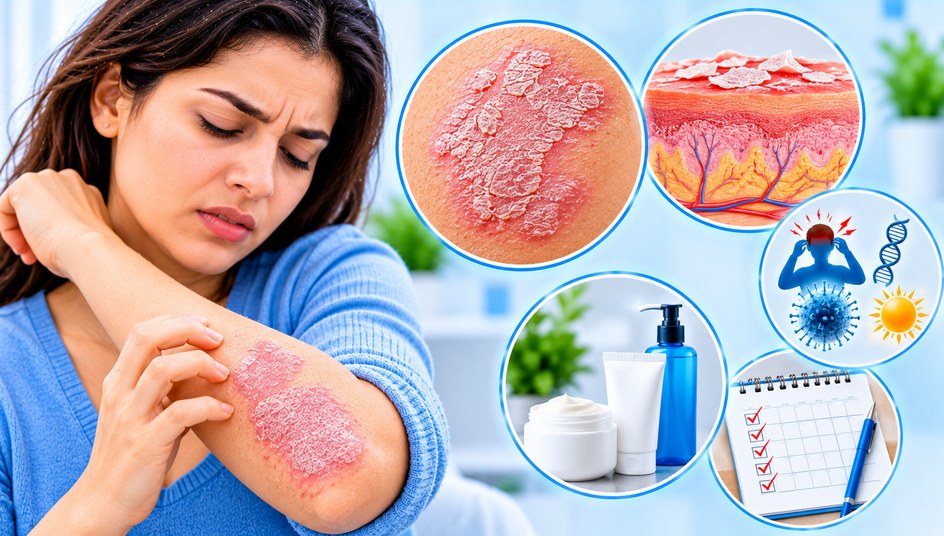
Table of contents
- 1. What Is Psoriasis?
- 2. Common Types of Psoriasis
- 3. Symptoms to Notice
- 4. Psoriasis, Eczema or a Fungal Rash?
- 5. Five Trigger Points
- 6. Five Warning Signs That Need Prompt Care
- 7. How Psoriasis Is Diagnosed
- 8. Treatment Options
- 9. Sample Flare Tracker
- 10. Daily Skin Care and Living Well
- 11. Primary, Urgent and Preventive Care in Elmhurst and Lower Manhattan
- 12. Contact Us and Find Us Online
- Conclusion
- Frequently Asked Questions
- See a Doctor in Elmhurst or Chinatown
Psoriasis is a long-term condition in which the immune system tells skin cells to grow far too fast. Instead of renewing in about a month, skin cells pile up in just a few days, forming thick, red, raised patches covered with silvery-white scale. The patches can itch, burn or crack, and they often appear on the elbows, knees, scalp and lower back. Psoriasis is not an infection, and it is not contagious.
It affects millions of Americans and often runs in families. The condition tends to come and go in flares, and it is linked to joint problems, heart disease risk and low mood. This guide explains the main types, symptoms, triggers, how psoriasis differs from eczema and fungal rashes, the five warning signs that need prompt care, treatment options, a sample flare tracker and daily skin care. It is general education only. Widespread red, peeling skin with fever or chills needs urgent care.
| At a Glance | Key Point |
|---|---|
| What it is | An immune-driven skin condition that speeds up skin cell growth |
| Common signs | Red, raised patches with silvery scale, dryness, itching or burning |
| Common triggers | Stress, infections, skin injury, cold dry weather, smoking, alcohol and some medicines |
| Treatment | Moisturizers, topical medicines, light therapy and prescription systemic or biologic drugs |
| Linked conditions | Psoriatic arthritis, heart disease, diabetes and depression |
1. What Is Psoriasis?
Psoriasis happens when overactive immune cells send signals that cause skin cells to multiply too quickly and form plaques. Genes play a role, and flares are set off by triggers. It can start at any age but often appears between ages 15 and 35 or later in midlife. For trusted background, see the NIAMS guide to psoriasis, the American Academy of Dermatology page on psoriasis and MedlinePlus on psoriasis.
2. Common Types of Psoriasis
| Type | What It Looks Like | Notes |
|---|---|---|
| Plaque | Raised red patches with silvery scale on elbows, knees, scalp and back | The most common type, affecting most people with psoriasis |
| Guttate | Small, drop-shaped red spots across the trunk and limbs | Often follows a strep throat infection, especially in children and young adults |
| Inverse | Smooth, red, shiny patches in skin folds such as the armpits and groin | Worsened by sweat and friction; can be mistaken for a fungal rash |
| Pustular | White, pus-filled blisters on red skin, often on the hands and feet | Widespread forms can cause fever and need urgent care |
| Erythrodermic | Widespread red, peeling skin that looks like a burn | A medical emergency |
| Nail psoriasis | Pitting, ridging, crumbling or lifting of the nails | Can occur with or without skin plaques |
3. Symptoms to Notice
Common signs of psoriasis include:
- Red or pink patches covered with silvery-white scale.
- Dry, cracked skin that may bleed.
- Itching, burning or soreness in the patches.
- Thick, pitted or ridged nails.
- Stiff, swollen or painful joints, which can signal psoriatic arthritis.
Symptoms vary from person to person and tend to cycle between flares and quieter periods.
4. Psoriasis, Eczema or a Fungal Rash?
| Feature | Psoriasis | Eczema | Fungal Rash (Ringworm) |
|---|---|---|---|
| Look | Thick, well-defined plaques with silvery scale | Dry, red, intensely itchy, poorly defined patches | Ring-shaped patch with a clearer center and scaly edge |
| Common places | Elbows, knees, scalp, lower back | Inner elbows, behind knees, face, hands | Anywhere; feet, groin and body folds |
| Main symptom | Scaling, sometimes itch or burn | Severe itch | Itch and a spreading ring |
| Contagious? | No | No | Yes |
Because these look alike, a skin exam is the best way to get a correct diagnosis. Any new, changing or non-healing spot should also be checked; see how to spot skin cancer early.
5. Five Trigger Points
Learning your triggers is one of the best ways to reduce flares. Common triggers fall into five groups:
- Stress and poor sleep: emotional stress is a well-known trigger; see when stress, low mood or anxiety need a doctor's help.
- Infections: strep throat can set off guttate psoriasis, and other infections can cause flares.
- Skin injury: cuts, scrapes, sunburn, tattoos and even scratching can trigger new patches.
- Weather and lifestyle: cold, dry air, smoking and heavy alcohol use can worsen psoriasis; see quitting smoking or vaping with a doctor's help.
- Medicines and weight: some drugs, including lithium, certain beta-blockers and antimalarials, can trigger flares, and excess weight can worsen disease; see losing weight safely with your doctor's support.
Never stop a prescribed medicine on your own. Ask your clinician if a medicine could be linked to your flare.
6. Five Warning Signs That Need Prompt Care
See a clinician promptly, or go to the emergency room if severe, for:
- Widespread red, peeling or burning skin, especially with fever, chills or a fast heartbeat.
- Many small pus-filled blisters spreading quickly across the skin.
- Morning joint stiffness, swollen fingers or toes, or joint pain that could be psoriatic arthritis.
- Patches that are painful, weeping, warm and spreading, which can mean infection; see Is that spreading warm red patch cellulitis for related signs.
- Low mood, hopelessness or trouble coping with your skin, or a flare that does not respond to your treatment.
If you are unsure where to go, read when a problem calls for the emergency room instead of urgent care in Queens.
7. How Psoriasis Is Diagnosed
Diagnosis is usually based on how the skin looks and on your history, including family history, recent infections, stress and medicines. Your clinician may examine your nails and scalp and ask about joint pain. A small skin sample (biopsy) is used if the diagnosis is uncertain. There is no single blood test for psoriasis, although tests may be done before starting certain treatments or to check for related conditions. If you need a skin specialist, see when your primary care doctor sends you to a specialist.
8. Treatment Options
| Step | Examples | Best For |
|---|---|---|
| Daily skin care | Thick fragrance-free moisturizers, short lukewarm showers, gentle cleansers | Everyone with psoriasis |
| Topical medicines | Corticosteroid creams, vitamin D creams, calcineurin inhibitors, medicated shampoos | Mild to moderate patches |
| Light therapy | Controlled narrowband UVB treatment in a clinic | Widespread or stubborn plaques |
| Oral or injected medicines | Methotrexate and other systemic drugs, plus targeted biologic medicines | Moderate to severe disease or psoriatic arthritis |
| Joint care | Early treatment to protect joints | Anyone with psoriatic arthritis signs |
Prescription treatments need monitoring, so work with your clinician and do not use leftover steroid creams on large areas of the body for long periods. Psoriatic arthritis can resemble other joint conditions; read normal wear and tear or arthritis.
9. Sample Flare Tracker
Keeping a simple weekly log helps you and your clinician spot triggers and see whether treatment is working. This teaching example shows a four-week log. The squares show example scaling and itch from 0 to 10, with more squares meaning worse symptoms.
| Week | Notes and Possible Trigger | Example Scale and Itch |
|---|---|---|
| Week 1 | Busy at work, short on sleep, cold dry weather | ■■■■■■■ |
| Week 2 | Started prescribed cream and thicker moisturizer twice daily | ■■■■■ |
| Week 3 | Better sleep, shorter showers, fewer new patches | ■■■ |
| Week 4 | Patches thinner and less red; itch mild | ■■ |
If you see no improvement after 4 to 6 weeks of treatment, ask about changing your plan.
10. Daily Skin Care and Living Well
These habits support treatment:
- Moisturize right after bathing and at least once or twice a day.
- Use lukewarm, not hot, water and fragrance-free products.
- Get brief, safe sun exposure only as your clinician advises; sunburn can trigger flares.
- Limit alcohol, avoid smoking and manage stress and sleep.
- Ask about heart health, blood sugar and mood screening, since psoriasis is linked to these conditions; see what you can do about prediabetes.
11. Primary, Urgent and Preventive Care in Elmhurst and Lower Manhattan
A flare that suddenly spreads or becomes painful is a reason to be seen quickly, and many Queens residents search for urgent care Elmhurst NY, a walk in clinic Elmhurst NY or a same day doctor appointment Elmhurst. City Prime Care helps people who are looking for urgent care 11373, a primary care doctor Elmhurst NY, a family doctor Elmhurst Queens or simply a primary care doctor near me. Because psoriasis is a long-term condition, regular follow-up matters, and we also offer a physical exam clinic Elmhurst NY visit, preventive care Elmhurst NY and chronic disease management Elmhurst NY.
Downtown, patients searching for primary care Lower Manhattan, a primary care doctor NYC or primary care Chinatown NYC can find our team near 75 Catherine St. Whether you look for a doctor near Catherine Street NYC, primary care 75 Catherine St, a walk-in clinic Chinatown NYC or a family doctor Manhattan NYC, we can examine new skin patches and coordinate care. Use the same trip to schedule an annual physical exam NYC, same day primary care NYC or preventive care Lower Manhattan to check heart health, blood sugar and mood. See what happens at your first urgent care visit in Elmhurst and which conditions urgent care in Elmhurst can treat.
12. Contact Us and Find Us Online
If you have scaly patches that will not go away, a flare that is getting worse or joint pain along with your skin symptoms, our team can examine you and guide next steps. For non-emergency questions, Contact Us, book a visit, or find City Prime Care on Google: City Prime Care on Google. For widespread peeling red skin with fever or chills, go to the emergency room or call 911.
Conclusion
Psoriasis is a long-term but manageable condition. With a correct diagnosis, steady skin care, trigger awareness and the right treatment, most people can control their flares and protect their joints and overall health. Get new or changing patches examined, and seek urgent care for widespread peeling skin or fever. This article is for general education and does not replace medical advice.
Frequently Asked Questions
See a Doctor in Elmhurst or Chinatown
Have a question about your own health? Book a visit at our Elmhurst, Queens clinic or our Chinatown, Manhattan clinic, or explore our primary care services.
Related articles
Healthcare
Why Are Your Ankles and Feet Swollen by Evening, and When Is Leg Swelling Serious? Reading the Swelling Patterns, the Five Relief Steps and the Sample Two-Week Swelling Diary
Swollen ankles after a long day can be harmless, but swelling in one leg, sudden weight gain or breathlessness can signal a clot, heart, kidney or liver problem. Learn the patterns, five relief steps and a two-week diary.
Healthcare
Why Is a Red, Itchy Ring-Shaped Patch Spreading on Your Skin, and Is It Ringworm? Reading the Patch Types, the Five Treatment Steps and the Sample Four-Week Clearing Plan
A red, scaly, ring-shaped itchy patch is often ringworm, a common fungal skin infection that is not caused by a worm. Learn the patch types, look-alike rashes, five treatment steps and a four-week clearing plan.
Healthcare
Why Is Your Hair Thinning or Falling Out in Clumps, and Could a Health Problem Be Behind It? Reading the Hair Loss Patterns, the Five Checkup Steps and the Sample Six-Month Regrowth Timeline
Finding more hair in the shower or brush can be stressful. Learn the common hair loss patterns, which blood tests and health problems matter, five checkup steps and a realistic six-month regrowth timeline.