
HealthcareBy City Prime Care Team
Why Does Your Finger Catch, Click or Lock in a Bent Position in the Morning, and Is It Trigger Finger? Reading the Locking Stages, the Five Hand-Care Steps and the Sample Eight-Week Recovery Plan
A finger that catches, clicks or locks in a bent position, especially in the morning, may be trigger finger, an irritated tendon sheath at the base of the finger. Learn the locking stages, five hand-care steps and a sample eight-week recovery plan.
Medically reviewed by Dr. Helen Vasquez10 min read
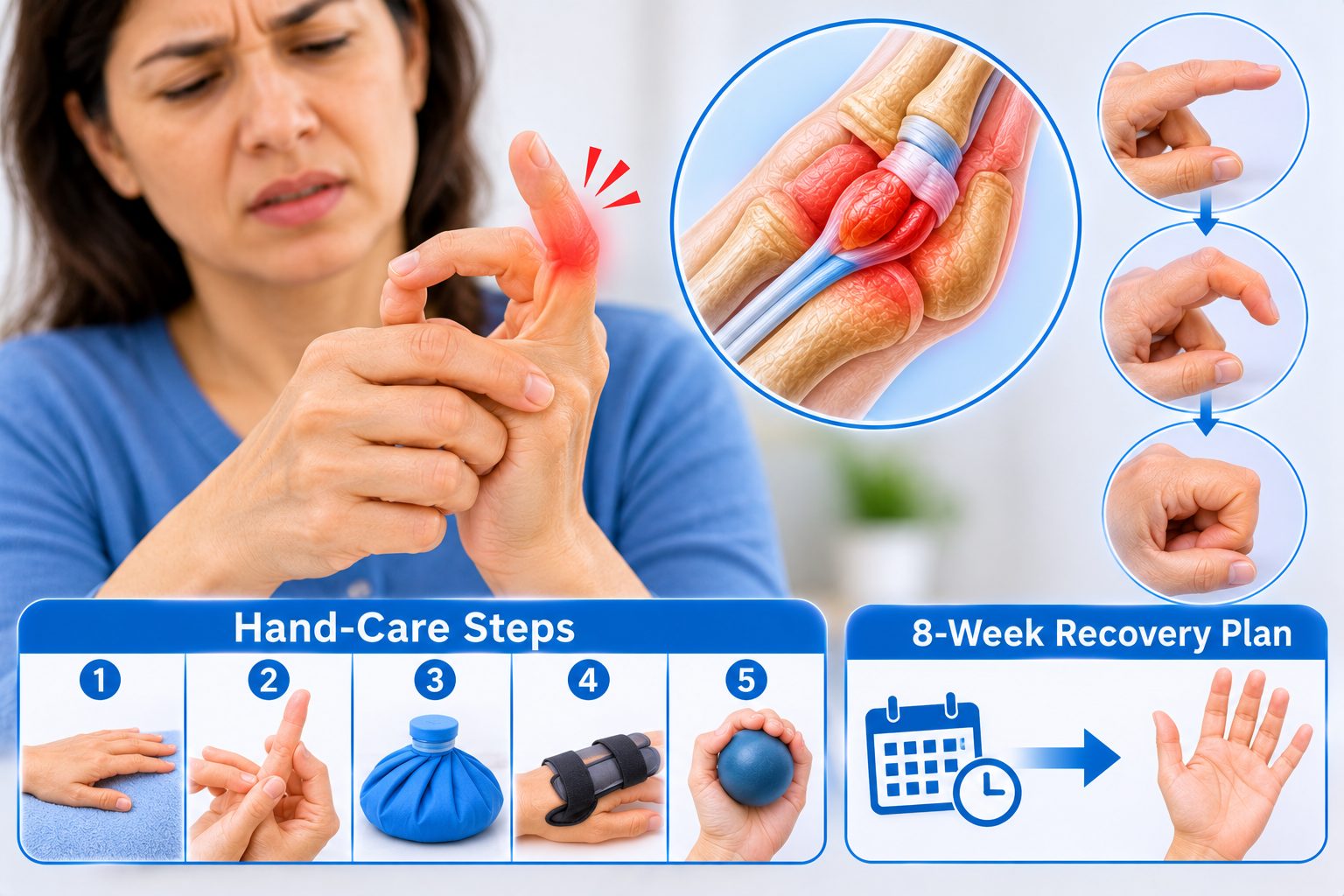
Table of contents
- 1. What Is Trigger Finger?
- 2. Reading the Locking Stages
- 3. Trigger Finger vs Look-Alike Hand Problems
- 4. Who Is at Higher Risk?
- 5. How a Clinician Diagnoses Trigger Finger
- 6. The Five Hand-Care Steps
- 7. Treatment Options at a Glance
- 8. Graph: Illustrative Locking Episodes With Treatment
- 9. Sample Eight-Week Recovery Plan
- 10. Red Flags: When to Get Care Promptly
- 11. Where to Get Care: Elmhurst, Chinatown and Lower Manhattan
- 12. Related Reading From City Prime Care
- 13. Contact Us
- Conclusion
- Frequently Asked Questions
- See a Doctor in Elmhurst or Chinatown
You wake up and one finger is stuck in a bent position. When you straighten it, it snaps open with a click, sometimes with a flash of pain. During the day it loosens, but it catches again when you grip a phone, a steering wheel or a coffee cup. The base of the finger, in the palm, feels tender and you may feel a small bump there. This is the typical story of trigger finger, a very common hand problem that is annoying but treatable, especially when it is caught early.
This guide explains the locking stages, who is at risk, five hand-care steps, a sample eight-week recovery plan and the red flags that need prompt care. City Prime Care serves patients in Elmhurst, Queens, Chinatown and Lower Manhattan. This article is general education and not a substitute for personal medical advice. The American Academy of Orthopaedic Surgeons also explains the condition in its trigger finger guide.
Quick takeaways:
- Trigger finger (stenosing tenosynovitis) happens when the tendon that bends the finger gets irritated and catches as it slides through a tight tunnel at the base of the finger.
- Typical clues are morning stiffness, clicking, catching or locking, and a tender bump in the palm.
- Rest, a night splint and anti-inflammatory measures often help early cases; a steroid injection or a short procedure is used when symptoms persist.
- A finger that stays locked, a hot swollen finger or numbness needs prompt evaluation.
1. What Is Trigger Finger?
Each finger bends because a tendon slides through a series of tunnels, called pulleys, along the finger. At the base of the finger in the palm, the first tunnel (the A1 pulley) can thicken or the tendon can swell. When that happens, the tendon cannot glide smoothly. It catches on the way in and pops free on the way out, like a fishing line catching on a guide.
Any finger or the thumb can be affected, and more than one can be involved. The ring finger and thumb are common. The problem often appears without a clear injury, though repetitive gripping and other health conditions can raise the risk.
2. Reading the Locking Stages
| Stage | What you feel | What you may notice | Typical approach |
|---|---|---|---|
| Stage 1: Pain and tenderness | Soreness at the base of the finger, no real catching yet | Tender bump in the palm, pain with gripping | Rest, activity changes, gentle stretching |
| Stage 2: Catching | Finger catches or clicks but you can straighten it yourself | Morning stiffness, clicking sound | Splint, anti-inflammatory measures, possibly injection |
| Stage 3: Locking | Finger locks and needs the other hand to straighten | Painful pop when released | Injection or procedure if symptoms persist |
| Stage 4: Fixed | Finger stays bent and cannot be straightened | Stiff joint, loss of function | Prompt specialist care |
Treating early, in the first two stages, usually gives better results and lowers the chance of the finger becoming stiff.
3. Trigger Finger vs Look-Alike Hand Problems
| Condition | Typical clue | How it differs from trigger finger |
|---|---|---|
| Carpal tunnel syndrome | Numbness and tingling in the thumb, index, middle and ring fingers, worse at night | Mainly numbness rather than catching; the two conditions can occur together |
| Osteoarthritis of the finger joints | Aching, stiffness and bony enlargement at the joints | Pain is at the joints rather than at the base of the finger in the palm |
| Dupuytren contracture | Thick cords in the palm that pull fingers into a bend | Cords and skin pits in the palm; finger does not snap open |
| Tendon injury or jammed finger | Sudden pain after an injury | Follows an injury; see when an injury calls for an X-ray |
| Ganglion cyst | Soft, round lump on the wrist or finger | A lump without catching or locking |
4. Who Is at Higher Risk?
Trigger finger is more common with:
- Age 40 to 60 and female sex.
- Diabetes, which makes tendon and sheath problems more likely; regular screening is important, see what you can do about prediabetes.
- Rheumatoid arthritis, gout and other inflammatory conditions.
- Repetitive or forceful gripping from work, hobbies, tools, gaming or heavy phone use.
- Carpal tunnel syndrome, which often occurs alongside trigger finger.
- A previous trigger finger in another finger or hand.
People who also have shoulder stiffness or other tendon problems should mention it to their clinician; see frozen shoulder for a related stiffness problem that is more common in diabetes.
5. How a Clinician Diagnoses Trigger Finger
A visit usually includes:
- A history of morning stiffness, catching, locking, pain, hand use at work and other conditions such as diabetes or arthritis.
- A hand exam: pressing on the palm to find the tender nodule, watching the finger bend and straighten, and checking for locking.
- A check for numbness or weakness that suggests a nerve problem.
- Blood tests, such as blood sugar, if diabetes or inflammatory disease is suspected; see how to read your blood test results.
- A decision about splinting, injection or a hand specialist referral; see when your primary care doctor sends you to a specialist.
Imaging is usually not needed for typical trigger finger, but an X-ray or ultrasound may be used if the picture is unclear or there was an injury.
6. The Five Hand-Care Steps
For early or mild trigger finger:
- Rest and modify the grip: avoid repeated forceful gripping, use padded or larger-handled tools and take regular breaks from phone, tools and typing.
- Splint at night: a small splint that keeps the affected finger gently straight while you sleep is often used for several weeks to calm the tendon and prevent morning locking.
- Warm up and stretch gently: warm water soaks and slow finger bending and straightening exercises can ease stiffness, but never force a locked finger.
- Use anti-inflammatory measures as advised: short courses of an over-the-counter anti-inflammatory can help if your clinician agrees they are safe for you; ice after heavy use can relieve soreness.
- Follow up if it is not improving: if catching or locking continues after several weeks, a steroid injection or a hand specialist visit may be the next step.
Do not repeatedly force the finger open, because this can irritate the tendon further.
7. Treatment Options at a Glance
| Option | Best for | Notes |
|---|---|---|
| Activity changes and rest | Stage 1 and 2 | Often combined with other measures |
| Night splint | Catching, morning locking | Usually worn for several weeks |
| Oral or topical anti-inflammatory medicine | Pain and swelling | Check safety with your clinician, especially with stomach, kidney or heart conditions |
| Steroid injection into the tendon sheath | Persistent catching or locking | Often brings relief; may be repeated, and effect can be shorter in people with diabetes |
| Hand therapy | Stiffness after treatment, recurrent problems | Gentle exercises and splinting guidance |
| Release procedure | Stage 3 and 4, or when injections fail | A short outpatient procedure that opens the tight pulley; done by a hand or orthopedic surgeon |
8. Graph: Illustrative Locking Episodes With Treatment
This is a teaching graph, not patient data. It shows how morning locking episodes often decrease over several weeks with splinting and activity changes, or after an injection. Real recovery varies with the person, the finger and the stage.
| Time | Morning locking and catching (illustrative) |
|---|---|
| Week 0 (start) | ██████████ |
| Week 1 | ████████ |
| Week 2 | ██████ |
| Week 4 | ████ |
| Week 6 | ██ |
| Week 8 | █ |
9. Sample Eight-Week Recovery Plan
| When | Goal | Sample actions | Check |
|---|---|---|---|
| Week 0 | Confirm diagnosis | Visit, hand exam, discuss risk factors and blood sugar | Is a plan in place for night splinting? |
| Weeks 1-2 | Calm the tendon | Night splint, less forceful gripping, warm soaks, gentle motion | Less morning locking? |
| Weeks 3-4 | Review progress | Continue splint, stretching, consider anti-inflammatory measures | Is catching less frequent? |
| Weeks 5-6 | Decide next step | Injection or hand referral if still locking | Has locking improved by at least half? |
| Weeks 7-8 | Restore function | Gradual return to grip activities, hand exercises | Is the finger moving smoothly? |
10. Red Flags: When to Get Care Promptly
See a clinician promptly for:
- A finger that stays locked and cannot be straightened, even with the other hand.
- Redness, warmth, swelling, fever or pus around the finger or palm, which may signal an infection of the tendon sheath that needs urgent care.
- Numbness, tingling or weakness in the hand or fingers.
- Severe pain after an injury, a visible deformity or a finger that will not bend.
- Several fingers or both hands locking, especially with joint swelling, which may point to an inflammatory condition.
- Symptoms that keep returning despite treatment.
11. Where to Get Care: Elmhurst, Chinatown and Lower Manhattan
A painful, locking finger is a common reason people search for urgent care Elmhurst NY, a walk in clinic Elmhurst NY, urgent care 11373, a same day doctor appointment Elmhurst or Same-Day Acute Care in Elmhurst Queens. For ongoing hand pain, diabetes checks and long-term follow-up, patients choose a primary care doctor Elmhurst NY, a family doctor Elmhurst Queens, Primary Care Doctors in Elmhurst NY or chronic disease management Elmhurst NY.
People comparing options often search for Best Primary Care Clinic in Elmhurst Queens, Best Primary Care Doctor in Elmhurst Queens, Primary Care Near Me Elmhurst Queens, Best Primary Care Clinics in Queens NY, Primary Care Clinics and Doctors in Queens NY and Top Primary Care Clinics in Queens NY. City Prime Care offers Men's and Women's Healthcare in Elmhurst NY, a physical exam clinic Elmhurst NY and preventive care Elmhurst NY, including musculoskeletal evaluation and referrals.
Downtown, people look for primary care Lower Manhattan, primary care Chinatown NYC, a doctor near Catherine Street NYC, primary care 75 Catherine St, a walk-in clinic Chinatown NYC, a Primary Care Clinic in Chinatown Manhattan or a Healthcare Center in Chinatown Manhattan NY. Citywide searches include primary care doctor NYC, family doctor Manhattan NYC, annual physical exam NYC, same day primary care NYC, preventive care Lower Manhattan and primary care doctor near me. Residents searching for Primary Care Doctors Serving Todt Hill Staten Island are welcome to contact the clinic to ask about care options and travel.
| Area | Common searches | How care can help |
|---|---|---|
| Elmhurst (ZIP 11373) | Urgent care 11373, same day doctor appointment Elmhurst | Prompt hand exam and splint advice |
| Elmhurst, Queens | Family doctor Elmhurst Queens, primary care doctor Elmhurst NY | Diabetes screening and follow-up plan |
| Queens | Best Primary Care Clinics in Queens NY, Top Primary Care Clinics in Queens NY | Easy-to-reach primary care for the family |
| Lower Manhattan | Primary care Lower Manhattan, preventive care Lower Manhattan | Convenient visits near work |
| Chinatown / Catherine Street | Primary care Chinatown NYC, doctor near Catherine Street NYC, primary care 75 Catherine St | Convenient downtown care |
| Citywide | Primary care doctor NYC, family doctor Manhattan NYC, same day primary care NYC | Same-day or scheduled evaluation |
You can also find the clinic on Google or learn more on the City Prime Care website.
12. Related Reading From City Prime Care
These guides on our site cover connected topics:
13. Contact Us
Is a finger catching, clicking or locking and getting in the way of daily life? Visit our Contact Us page or see our Google listing. If the finger is hot, red and swollen or you have fever, seek urgent care.
Conclusion
Trigger finger is common and usually very treatable. Rest, a night splint and gentle stretching help many people in the early stages, and an injection or a short release procedure can help when symptoms persist. See a clinician earlier rather than later, especially if you have diabetes, and seek urgent care if the finger is red, hot and swollen or stuck in a bent position.
Frequently Asked Questions
See a Doctor in Elmhurst or Chinatown
Have a question about your own health? Book a visit at our Elmhurst, Queens clinic or our Chinatown, Manhattan clinic, or explore our primary care services.
Related articles
Healthcare
Chickenpox in Adults and Children in Elmhurst, NY: How the Rash Develops and What to Expect
Itchy red spots that turn into blisters and then crusts are the classic sign of chickenpox. Learn how the rash develops, how long you are contagious, five care steps, a ten-day timeline and when to see a doctor.
Healthcare
Shin Splints in Elmhurst, NY: How Lower Leg Pain Builds and What to Expect From Recovery
Aching pain along the inner edge of the shin during running or walking is often shin splints. Learn how they develop, how they differ from a stress fracture, five recovery steps and a sample six-week return plan.
Healthcare
Tonsillitis in Queens, NY: How Swollen Tonsils Are Evaluated and What to Expect From Treatment
Red, swollen tonsils with a painful throat and fever are the hallmarks of tonsillitis. Learn how viral and bacterial cases differ, how strep is tested, five care steps and when tonsil surgery is considered.