HealthcareBy City Prime Care Team
Why Do Your Hands Go Numb at Night, and Is It Carpal Tunnel? Reading the Finger Symptoms, the Five Treatment Steps and the Sample Workstation Plan
Numbness and tingling in the thumb and first fingers, especially at night, can point to carpal tunnel syndrome. Learn the symptoms, five treatment steps and a sample workstation plan.
Medically reviewed by Dr. Helen Vasquez9 min read
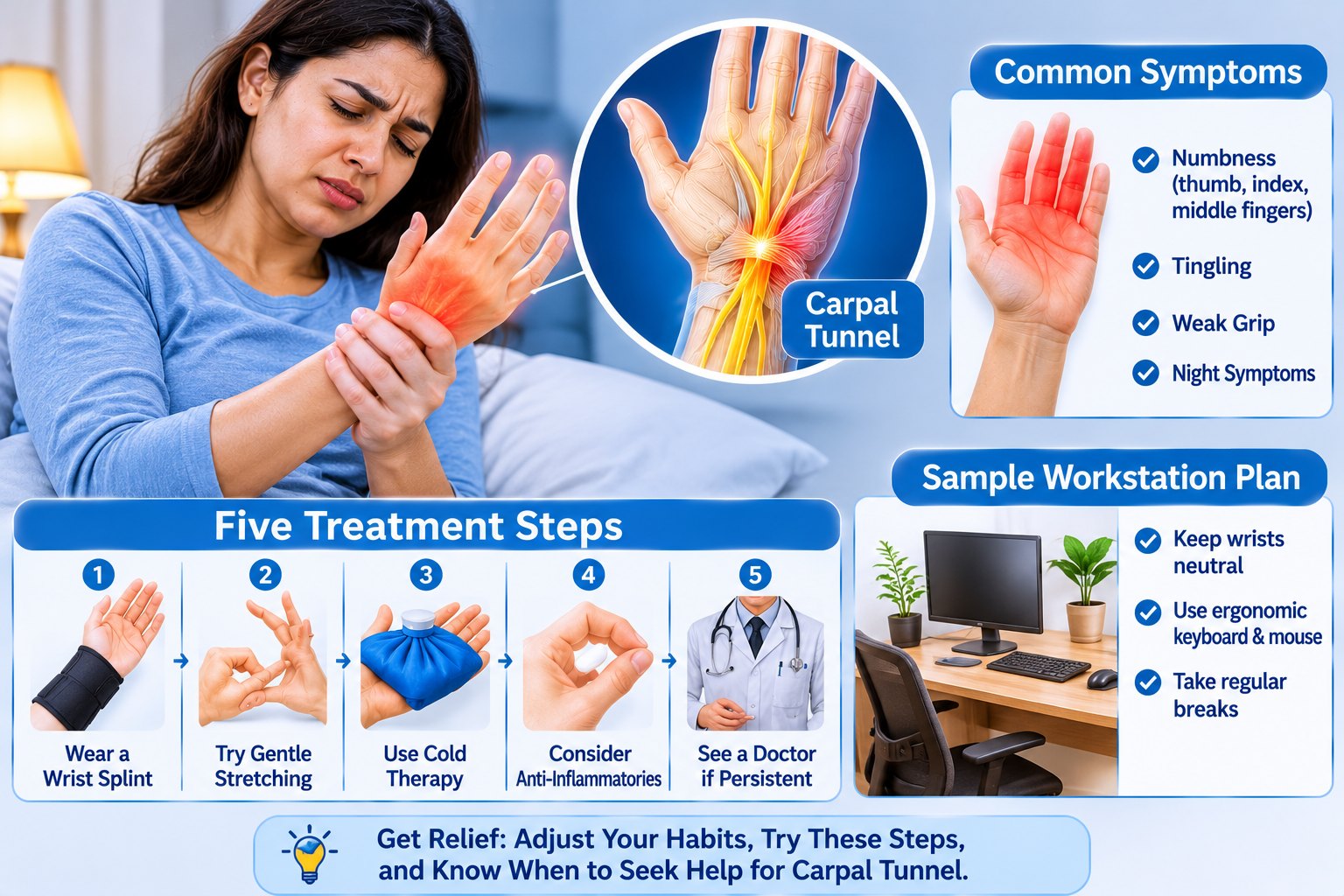
Table of contents
- 1. Symptoms: Which Fingers and When
- 2. Carpal Tunnel Versus Other Causes of Hand Numbness
- 3. Risk Factors
- 4. How Carpal Tunnel Is Diagnosed
- 5. Five Treatment Steps
- 6. Sample Workstation Plan With a Strain Graph
- 7. Sample Four-Week Self-Care Timeline
- 8. Contact Us and Find Us Online
- Conclusion
- Frequently Asked Questions
- See a Doctor in Elmhurst or Chinatown
Waking up at night with a hand that feels asleep, tingly or burning is common. When the thumb, index finger, middle finger and part of the ring finger are involved, carpal tunnel syndrome is a leading suspect. It happens when the median nerve is squeezed as it passes through a narrow passage in the wrist called the carpal tunnel.
This guide explains the typical symptoms, what raises your risk, how the condition is tested, five treatment steps, and a sample workstation plan you can adapt. It is general education only. Worsening weakness or constant numbness should be checked by a clinician.
| At a Glance | Key Point |
|---|---|
| What it is | Pressure on the median nerve at the wrist |
| Classic signs | Tingling, numbness or burning in the thumb, index, middle and half of the ring finger |
| Worse at | Night, when gripping, typing or holding a phone |
| Common tests | Exam maneuvers, sometimes nerve conduction studies |
| First-line care | Night wrist splint, activity changes, then injections or surgery if needed |
1. Symptoms: Which Fingers and When
Symptoms often begin gradually and come and go before becoming more frequent. The little finger is usually spared, which is a useful clue.
| Symptom | What It Usually Looks Like |
|---|---|
| Tingling or pins and needles | Thumb, index, middle and half of the ring finger |
| Numbness | Often wakes people at night; shaking the hand helps |
| Burning or aching | May travel up the forearm |
| Weak grip | Dropping cups or trouble opening jars |
| Clumsiness | Difficulty with buttons or small objects |
The National Institute of Neurological Disorders and Stroke explains the condition on its carpal tunnel syndrome page, and MedlinePlus provides a clear summary of carpal tunnel syndrome.
2. Carpal Tunnel Versus Other Causes of Hand Numbness
| Condition | Typical Clue |
|---|---|
| Carpal tunnel syndrome | Thumb to ring finger, worse at night, little finger spared |
| Ulnar nerve problem (elbow) | Little finger and half of ring finger tingling, often after leaning on the elbow |
| Neck nerve irritation | Neck pain with arm symptoms that change with neck position |
| Diabetes-related nerve damage | Numbness in both hands or feet in a glove-and-stocking pattern |
| Stroke | Sudden one-sided numbness with face droop or speech trouble, which is an emergency |
Joint conditions can look similar. See our guide on normal wear and tear versus arthritis. Sudden numbness with face drooping or speech trouble needs 911.
3. Risk Factors
Several factors can raise the chance of developing carpal tunnel syndrome:
- Repetitive hand and wrist motions or forceful gripping, especially with vibrating tools.
- Wrist anatomy and family history, since some people simply have a narrower tunnel.
- Pregnancy and hormonal changes, which can cause swelling.
- Medical conditions such as diabetes, thyroid disease and rheumatoid arthritis.
- Higher body weight and prior wrist injury or fracture.
Blood sugar matters here. Our guide on losing weight safely with your doctor's support covers one of the changeable risks.
4. How Carpal Tunnel Is Diagnosed
A typical evaluation follows these steps:
- History: which fingers are affected, timing at night, work and hobby activities.
- Physical exam: checking grip strength, sensation and wrist maneuvers that reproduce symptoms.
- Look for other causes: neck, elbow and blood tests for diabetes or thyroid when appropriate.
- Nerve conduction study: measures how well the median nerve carries signals, mainly when the diagnosis is unclear or surgery is considered.
- Referral: to a hand specialist or neurologist if symptoms are severe or not improving.
Our guide on when your primary care doctor sends you to a specialist explains how referrals work.
5. Five Treatment Steps
Treatment generally moves from simple to more involved:
- Wear a neutral wrist splint at night, and during activities that trigger symptoms, as your clinician advises.
- Change the activity: take breaks, vary tasks and keep wrists straight instead of bent.
- Reduce swelling and manage related conditions such as diabetes or thyroid disease.
- Consider a corticosteroid injection or hand therapy if symptoms persist.
- Discuss surgery (carpal tunnel release) for severe, constant or worsening symptoms or muscle weakness.
Do not ignore constant numbness or thumb muscle wasting, because long-term nerve compression can cause lasting damage.
6. Sample Workstation Plan With a Strain Graph
This illustrative plan shows ways to lower wrist strain during desk work. It is a teaching example, so adapt it with your clinician or an ergonomics specialist.
| Setup Choice | Better Option | Wrist Strain (Example Graph) |
|---|---|---|
| Keyboard position | Flat or slightly tilted away, forearms level with desk | ■■ |
| Wrist position | Straight, floating over the keys, not resting on the sharp edge | ■■ |
| Mouse | Fits your hand; consider a vertical mouse | ■■■ |
| Breaks | 30 seconds of stretching every 30 minutes | ■ |
| Common bad habits | Bent wrists, hard edges, gripping the mouse tightly | ■■■■■■■■ |
7. Sample Four-Week Self-Care Timeline
| Week | Focus | Symptom Level (Example Graph) |
|---|---|---|
| Week 1 | Start night splint, adjust workstation | ■■■■■■■ |
| Week 2 | Add short stretch breaks, avoid prolonged gripping | ■■■■■■ |
| Week 3 | Gentle nerve-gliding exercises if advised | ■■■■ |
| Week 4 | Review progress; see a clinician if no improvement | ■■■ |
8. Contact Us and Find Us Online
If hand numbness is waking you at night, weakening your grip or not improving with simple steps, our team can examine you and plan the next step. For non-emergency questions, Contact Us or find City Prime Care on Google: City Prime Care on Google.
Conclusion
Carpal tunnel syndrome is common and treatable, especially when caught early. Pay attention to night-time tingling, protect your wrist, adjust your workstation and get checked if symptoms persist. This article is for general education and does not replace medical advice.
Frequently Asked Questions
See a Doctor in Elmhurst or Chinatown
Have a question about your own health? Book a visit at our Elmhurst, Queens clinic or our Chinatown, Manhattan clinic, or explore our primary care services.
Related articles
Healthcare
Why Is a Red, Itchy Ring-Shaped Patch Spreading on Your Skin, and Is It Ringworm? Reading the Patch Types, the Five Treatment Steps and the Sample Four-Week Clearing Plan
A red, scaly, ring-shaped itchy patch is often ringworm, a common fungal skin infection that is not caused by a worm. Learn the patch types, look-alike rashes, five treatment steps and a four-week clearing plan.
Healthcare
Is That Spreading, Warm Red Patch on Your Skin Cellulitis? Reading the Infection Signs, the Five Treatment Steps and the Sample Recovery Tracker
Cellulitis is a common bacterial skin infection that can spread fast if ignored. Learn the signs, look-alikes, five treatment steps, red flags and a sample recovery tracker with a simple graph.
Healthcare
Why Is a Rough Bump Growing on Your Hand or the Bottom of Your Foot, and Is It a Wart? Reading the Wart Types, the Five Treatment Steps and the Sample Twelve-Week Clearing Plan
Rough bumps on the hands or soles of the feet are often warts caused by HPV. Learn the wart types, five treatment steps, red flags and a sample twelve-week clearing plan.