
HealthcareBy City Prime Care Team
Why Do You Feel Dizzy or Like the Room Is Spinning, and When Is It Serious? Reading the Dizziness Types, the Five Warning Signs and the Sample Balance Diary
Dizziness and vertigo have many causes, from inner-ear crystals to dehydration to stroke. Learn the three dizziness types, five warning signs and a sample balance diary to bring to your doctor.
Medically reviewed by City Prime Care Administrator9 min read
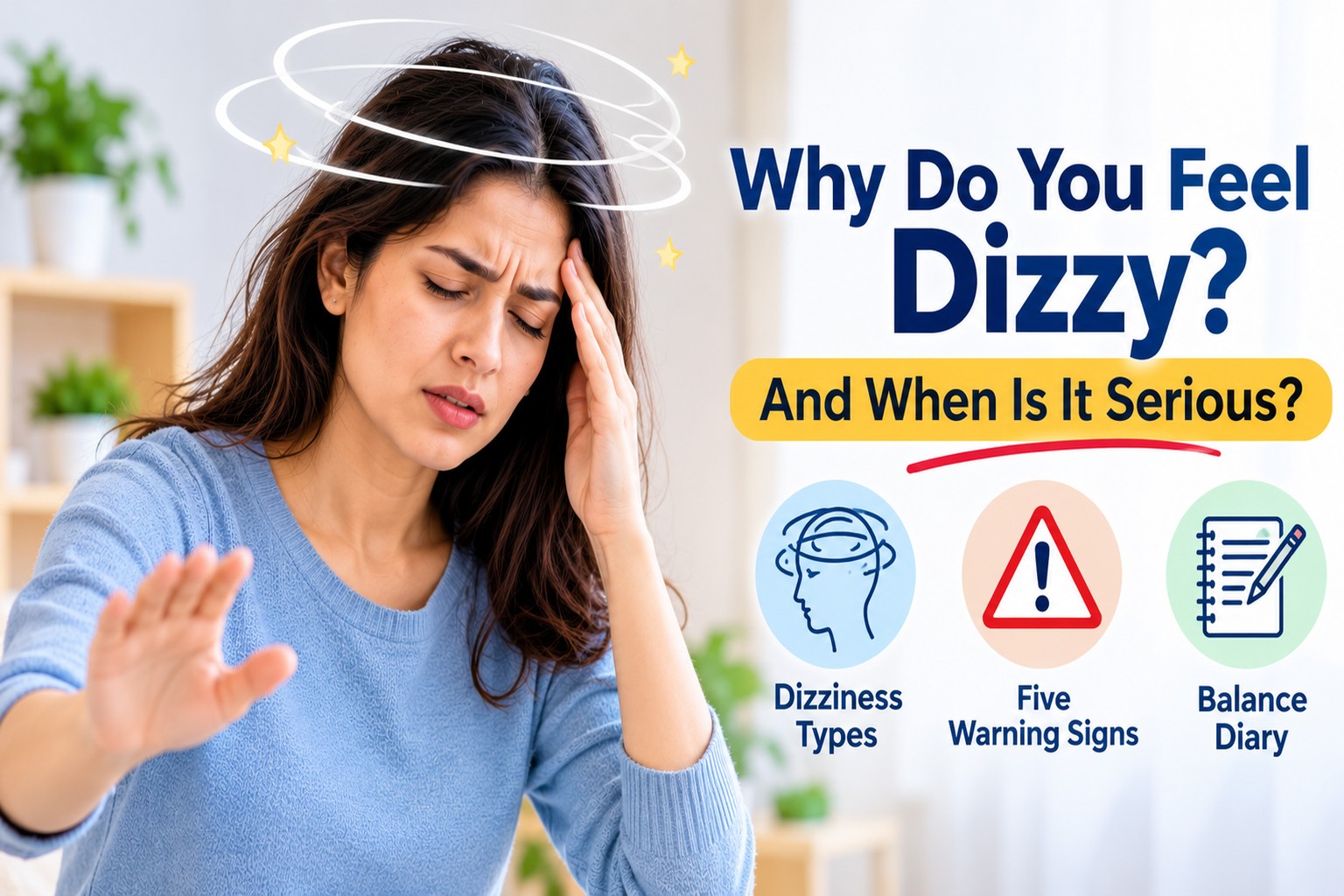
Table of contents
- 1. The Three Types of Dizziness
- 2. Common Causes, From Harmless to Urgent
- 3. Sample Dizziness Pattern: What Different Causes Often Look Like
- 4. Five Warning Signs That Mean Do Not Wait
- 5. Sample Balance Diary to Bring to Your Visit
- 6. What Happens at a Dizziness Visit
- 7. Treatment and Self-Care
- 8. Contact Us and Find Us Online
- Conclusion
- Frequently Asked Questions
- See a Doctor in Elmhurst or Chinatown
Almost everyone feels dizzy at some point: a quick stand-up after sitting, a long day without water, or a cold that settles in the ears. Most episodes pass on their own. But "dizzy" is a word that covers very different problems, from a harmless inner-ear glitch to a medical emergency, and knowing which is which can save you worry, or save your life.
This guide explains the three main kinds of dizziness, the most common causes, the five warning signs that mean you should not wait, and a sample balance diary you can use to give your doctor a clear picture. It is general education, not a diagnosis. If your symptoms are sudden, severe or come with weakness, trouble speaking or vision changes, read our guide on how to recognize a stroke in time and call 911.
| At a Glance | Key Point |
|---|---|
| Most common cause of true spinning (vertigo) | Benign paroxysmal positional vertigo (BPPV), a mechanical inner-ear problem |
| Most common cause of lightheadedness on standing | Dehydration, medicines or a drop in blood pressure (orthostatic hypotension) |
| Emergency signs | Sudden severe headache, double vision, slurred speech, weakness, inability to walk |
| Who to see first | A primary care or urgent care clinician for evaluation |
| Typical BPPV treatment | In-office repositioning maneuver, often one or two sessions |
1. The Three Types of Dizziness
When you tell a clinician you are dizzy, the first question will be: what does it actually feel like? The answer points toward very different causes.
| Type | What It Feels Like | Common Causes |
|---|---|---|
| Vertigo | The room or your body is spinning or tilting | BPPV, vestibular neuritis, Meniere's disease, migraine |
| Presyncope (lightheadedness) | Feeling faint, as if you might black out | Dehydration, low blood pressure, anemia, low blood sugar, heart rhythm issues |
| Disequilibrium | Unsteady on your feet, off balance when walking | Nerve damage, medicines, vision problems, aging-related balance changes |
Some people feel a mix. That is normal, and it is exactly why a short symptom diary (see Section 5) helps so much.
2. Common Causes, From Harmless to Urgent
Here are the causes clinicians see most often:
- BPPV: tiny calcium crystals in the inner ear drift into the wrong canal, causing brief spinning spells (usually under a minute) when you roll over, tip your head back or bend down.
- Vestibular neuritis or labyrinthitis: inflammation of the balance nerve, often after a viral illness, causing days of constant vertigo and nausea.
- Orthostatic hypotension: blood pressure drops when you stand, causing a brief gray-out or lightheadedness. Dehydration and some blood pressure medicines are frequent triggers.
- Dehydration and low blood sugar: too little fluid or food can cause woozy, shaky feelings. See our guide on dehydration warning signs and the urine color chart for early signs.
- Anemia: low red blood cells can cause lightheadedness, fatigue and pale skin. Read why you feel tired all the time for the anemia signs.
- Migraine-related vertigo: dizziness can occur with or without a headache.
- Anxiety and stress: can cause lightheadedness, a floating feeling and a racing heart. Read when stress, low mood or anxiety need a doctor's help.
- Heart rhythm problems: dizziness with a pounding or skipping heartbeat deserves a check. See when heart palpitations need a doctor.
- Stroke or other brain problems: less common, but the most urgent cause, and it can look like simple vertigo.
The U.S. National Institute on Deafness and Other Communication Disorders explains how the inner ear and brain work together to keep you balanced on its page about balance disorders, and Mayo Clinic has a clear overview of vertigo symptoms and causes.
3. Sample Dizziness Pattern: What Different Causes Often Look Like
The table below is an illustrative guide, not a diagnostic tool. Timing and triggers are often the biggest clues.
| Likely Cause | Typical Duration | Typical Trigger | Intensity Graph (Example) |
|---|---|---|---|
| BPPV | Seconds to 1 minute | Rolling over, looking up | ■■■■■■■■ (high, brief) |
| Vestibular neuritis | Days | Often after a viral illness | ■■■■■■■■■■ (high, constant) |
| Orthostatic hypotension | Seconds to a minute | Standing up quickly | ■■■■■ (moderate, brief) |
| Dehydration | Hours | Heat, illness, poor fluid intake | ■■■■ (mild to moderate) |
| Meniere's disease | 20 minutes to hours | Often unpredictable, with ear fullness and ringing | ■■■■■■■ (high, episodic) |
4. Five Warning Signs That Mean Do Not Wait
Call 911 or go to the emergency room if dizziness comes with any of these:
- Sudden, severe headache unlike any you have had before.
- Double vision, sudden vision loss or trouble seeing.
- Slurred speech, face drooping, or weakness or numbness on one side of the body.
- Inability to walk or stand without falling, or loss of coordination.
- Chest pain, shortness of breath, fainting, or a very fast or irregular heartbeat.
Also seek prompt care after a head injury. Our guide to how to tell if a head injury is a concussion explains the danger signs.
5. Sample Balance Diary to Bring to Your Visit
Clinicians often get the diagnosis from the story, not a scan. For one to two weeks, jot down each episode. Below is an example (sample data, not a real patient).
| Day | Time | What It Felt Like | Trigger | Duration | Severity (0-10) |
|---|---|---|---|---|---|
| Mon | 7:30 AM | Spinning | Rolled over in bed | 30 seconds | 8 |
| Tue | 3:00 PM | Lightheaded | Stood up fast | 10 seconds | 4 |
| Thu | 9:00 PM | Spinning | Looked up at a shelf | 40 seconds | 7 |
| Sat | 1:00 PM | Unsteady | After a long walk without water | Most of the afternoon | 3 |
In this example, the brief spinning triggered by head position suggests BPPV, while the lightheaded and unsteady episodes suggest hydration and blood pressure should be reviewed.
6. What Happens at a Dizziness Visit
A typical evaluation at a walk-in or primary care clinic includes:
- Your history: what the dizziness feels like, how long it lasts, what triggers it and what medicines you take.
- Vital signs, including blood pressure lying down and standing up.
- A basic neurological and balance exam, including eye movement checks.
- Positional testing (such as the Dix-Hallpike) if BPPV is suspected.
- Targeted tests when needed, such as blood sugar, blood count or an ECG. See common blood tests explained for what a blood count shows.
- A treatment plan or referral to a specialist, such as ear, nose and throat (ENT) or neurology. Our guide on when your primary care doctor sends you to a specialist explains what to expect.
7. Treatment and Self-Care
Treatment depends on the cause:
- BPPV: a repositioning maneuver (such as the Epley maneuver) performed by a trained clinician often relieves symptoms quickly.
- Vestibular neuritis: short-term medicine for nausea or vertigo, then gradual balance exercises.
- Orthostatic hypotension: drink fluids, rise slowly, and have medicines reviewed.
- Migraine-related dizziness: trigger management and, if needed, preventive treatment.
- Safety tips: sit down at the first sign of dizziness, avoid driving during an episode, use night lights and remove trip hazards.
The CDC also offers practical advice on preventing falls, which matters if dizziness makes you unsteady: see CDC fall prevention resources.
8. Contact Us and Find Us Online
If you are dizzy often, feel off balance, or just want answers, our clinicians can examine you, check your blood pressure, run basic tests and guide next steps. Contact Us to ask a question or plan your visit, or find City Prime Care on Google here: City Prime Care on Google. For a broader look at regular checkups, see our annual physical checkup guide.
Conclusion
Dizziness is common and usually treatable, but the details matter. Note the type, timing and triggers, take the five warning signs seriously, and do not guess when symptoms are sudden or severe. A short diary and a clear conversation with a clinician is the fastest route to the right answer. This article is for general education and does not replace medical advice.
Frequently Asked Questions
See a Doctor in Elmhurst or Chinatown
Have a question about your own health? Book a visit at our Elmhurst, Queens clinic or our Chinatown, Manhattan clinic, or explore our primary care services.
Related articles
Healthcare
How Can You Recognize a Stroke in Time? Reading the BE-FAST Warning Signs, the Five Emergency Steps and the Sample Hospital Timeline
Stroke care is a race against time. Learn the BE-FAST warning signs, the five emergency steps, what happens at the hospital, why a TIA is a warning and which risk factors you can control.
Healthcare
What Are the Warning Signs of Pneumonia, and Who Needs Care Fast? Reading the Symptom Clues, the Five Risk Groups and the Sample Recovery Timeline
Pneumonia is a lung infection that can be mild or serious. Learn how it differs from a cold or the flu, the warning signs, the five higher-risk groups, how severity is judged and what recovery usually looks like.
Healthcare
How Much Alcohol Is Too Much for Your Health? Reading the Drink Sizes, the Risk Levels and the Sample Cut-Back Plan
Alcohol affects the liver, heart, blood pressure, sleep and mood, and risk rises with every extra drink. Learn standard drink sizes, low-risk and heavy drinking limits, warning signs, how to cut back safely, and when to get medical help.





