
HealthcareBy City Prime Care Team
Which STD Tests Do You Need, and How Often? Reading the Risk Groups, the Five Testing Rules and the Sample Annual Testing Calendar
Many infections cause no symptoms, so testing on a schedule matters. See which STD tests fit your risk group, how long after exposure to test, and a sample annual testing calendar.
Medically reviewed by City Prime Care Administrator9 min read
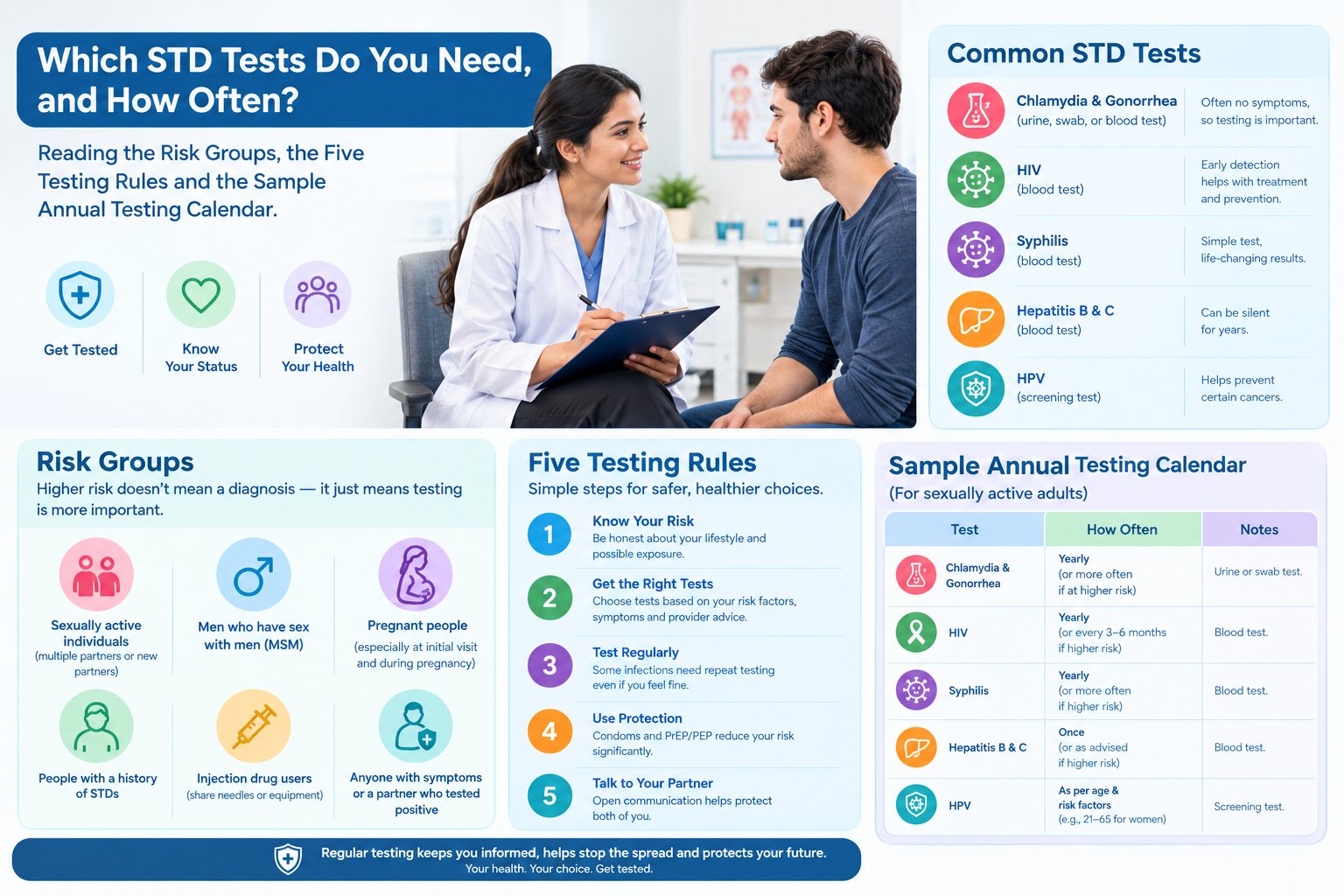
Table of contents
- 1. Why Testing on a Schedule Matters
- 2. Testing Frequency at a Glance
- 3. How Often by Risk Level
- 4. Window Periods: When a Test Can Be Trusted
- 5. Five Testing Rules
- 6. What a Confidential Visit Involves
- 7. After a Positive Result
- 8. A Sample Annual Testing Calendar
- 9. When to Test Right Away
- Conclusion
- Frequently Asked Questions
- See a Doctor in Elmhurst or Chinatown
Many sexually transmitted infections cause no symptoms at all. Chlamydia, gonorrhea, syphilis, HIV and hepatitis can stay quiet for months or years while still being passed to partners and, if untreated, harming fertility, the heart, the liver and unborn babies. So the useful question is not only "Do I have symptoms?" but "When was my last test?"
This guide explains how often adults commonly need STD testing, which tests matter for which risk group, how long after an exposure a result can be trusted, and gives a sample annual testing calendar. It draws on CDC screening recommendations and the U.S. Preventive Services Task Force. Your own schedule depends on your partners, your history and your body, so confirm it with a clinician. This is general education, not personal medical advice. See City Prime Care's men's health page, or find the clinic on Google.
In this article:
- 1. Why testing on a schedule matters
- 2. Testing frequency at a glance (table)
- 3. How often by risk level (graph)
- 4. Window periods: when a test can be trusted (table)
- 5. Five testing rules
- 6. What a confidential visit involves
- 7. After a positive result
- 8. A sample annual testing calendar
- 9. When to test right away
1. Why Testing on a Schedule Matters
Most people with chlamydia or gonorrhea feel fine, and syphilis and HIV can go unnoticed for years. Waiting for symptoms means an infection can spread and cause damage first. Testing turns a hidden problem into a treatable one: chlamydia, gonorrhea, syphilis and trichomoniasis are curable with antibiotics, hepatitis C is usually curable with antiviral medicine, and HIV is controlled very well with modern treatment.
For background on how screening fits into overall care, see our guides on which screenings Elmhurst adults should not skip and how men can plan checkups at every age.
2. Testing Frequency at a Glance
The table summarizes common national recommendations for sexually active adults. It is a starting point, not a prescription.
| Group | Chlamydia and gonorrhea | HIV | Syphilis | Hepatitis C |
|---|---|---|---|---|
| Sexually active women under 25 | Every year | At least once (ages 13 to 64); more often with risk | If risk factors or pregnant | At least once as an adult |
| Women 25 and older with new or multiple partners | Every year | Every year with risk | If risk factors or pregnant | Once, then again if risk continues |
| Men with new or multiple female partners | Consider yearly with risk | Every year with risk | If risk factors | Once, then again if risk continues |
| Men who have sex with men | At least yearly; every 3 to 6 months if higher risk | At least yearly; every 3 to 6 months if higher risk | At least yearly; every 3 to 6 months if higher risk | Once, then again if risk continues |
| Pregnant women | At the first prenatal visit; repeat if risk | First prenatal visit | First prenatal visit; repeat by risk | Every pregnancy |
| Both partners tested, no other partners | One baseline test | Once | Not routine | Once |
3. How Often by Risk Level
The graph below turns the table into a simple picture. Each block is roughly one test per year for the typical person in that group.
| Situation | Tests per year (graph) | Typical interval |
|---|---|---|
| Both partners tested, no other partners | █ baseline | Once, then only if something changes |
| Sexually active, one new partner a year | █ 1 | Every 12 months |
| New or multiple partners | ██ 2 | Every 6 months |
| Higher risk, such as multiple partners or taking PrEP | ████ 3 to 4 | Every 3 to 6 months |
| After a known exposure | ██ 2 | Now, then again after the window period |
4. Window Periods: When a Test Can Be Trusted
Right after an exposure, a test can come back negative because the infection has not built up enough to detect. These approximate windows come from CDC and clinical sources; your clinician may choose a different test or repeat date.
| Infection | Usual test | Earliest reliable result (approximate) | Note |
|---|---|---|---|
| Chlamydia and gonorrhea | Urine or swab | About 1 to 2 weeks | Swabs may be needed for throat or rectum |
| HIV | Lab blood test (antigen/antibody) | About 18 to 45 days | Rapid and self-tests can need up to 90 days |
| Syphilis | Blood test | Several weeks, up to about 3 months | Sores can also be swabbed |
| Hepatitis C | Blood test | Antibody up to about 3 months; RNA test earlier | Ask which test is being run |
| Hepatitis B | Blood panel | About 1 to 3 months | Vaccine protects if you are not immune |
| Trichomoniasis | Swab or urine | About 1 week | More common in women |
| Herpes | Swab of a sore | Test when a sore is present | Routine blood screening without symptoms is not advised |
5. Five Testing Rules
Five simple rules cover most situations:
- Test before sex without condoms with a new partner, and ask the partner to test too.
- If you are sexually active with new or multiple partners, test at least once a year.
- After a recent exposure, test now and repeat after the window period.
- Treat and retest as a team: partners should be tested and treated at the same time to avoid passing infections back and forth.
- Do not wait for the annual test if you notice discharge, burning, sores, a rash or pelvic or testicular pain.
6. What a Confidential Visit Involves
A typical testing visit is short and private:
- Book through the appointment page or by phone and say you want STD testing.
- Tell the clinician about your partners, protection, symptoms and any past infections, so the right tests are chosen.
- Give samples: a urine sample, swabs (sometimes self-collected) and a blood draw, depending on the tests.
- Ask how and when results will be shared and who may be told.
- Follow up as advised for treatment, partner care and any repeat test.
Ask the clinic about insurance and costs before you go; many preventive screenings are covered. Our guide to whether insurance pays for preventive care explains the billing checks to make.
7. After a Positive Result
A positive result is common and manageable. Usual next steps include:
- Start the treatment your clinician prescribes and finish the full course.
- Avoid sex until treatment is complete and symptoms are gone; for many infections CDC advises waiting about 7 days after treatment.
- Tell recent partners so they can be tested and treated.
- Retest about 3 months after treatment for chlamydia or gonorrhea, as advised.
- Ask about vaccines such as hepatitis B and HPV, and about referrals for HIV or hepatitis care through referral services.
8. A Sample Annual Testing Calendar
| When | Checklist |
|---|---|
| January | ☐ Review last year's results ☐ Book your yearly screening |
| Any new partner | ☐ Test before sex without condoms ☐ Ask partner to test |
| Every 3 to 6 months (higher risk) | ☐ HIV ☐ Syphilis ☐ Chlamydia and gonorrhea at every site of exposure |
| Once as an adult | ☐ HIV ☐ Hepatitis C ☐ Hepatitis B |
| After treatment | ☐ Retest at about 3 months ☐ Confirm partners are treated |
| Every year | ☐ Vaccine review ☐ Update the plan with your clinician |
9. When to Test Right Away
Do not wait for your next scheduled test if you have symptoms or a high-risk exposure. For a possible HIV exposure, post-exposure medicine (PEP) works best when started as soon as possible and within 72 hours, so seek care immediately. See the CDC STI information page and HIV.gov for national guidance.
Conclusion
Regular testing is a normal part of staying healthy. Know your risk group, test after new partners, repeat after the window period and keep a simple calendar so nothing slips.
Contact Us: To book a confidential STD test or ask which tests you are due for, reach City Prime Care through our Contact Us page, or find us on Google. This article is for general information and does not replace personal medical advice. In an emergency, call 911.
Frequently Asked Questions
See a Doctor in Elmhurst or Chinatown
Have a question about your own health? Book a visit at our Elmhurst, Queens clinic or our Chinatown, Manhattan clinic, or explore our primary care services.
Related articles
Healthcare
When Should You Get Your Flu Shot This Season? Reading the Vaccine Types, the Priority Groups and the Sample Season Calendar
Aim to get your flu shot by the end of October, but it still helps later. See who needs it most, the 2026-27 vaccine types, what to expect at the clinic and a sample season calendar.
Healthcare
Know Your Numbers: A Plain-English Guide to LDL, HDL and Triglycerides
High cholesterol rarely causes symptoms. Learn what LDL, HDL, and triglyceride numbers mean, who is at risk, 9 practical ways to lower cholesterol, and when to see a doctor.
Healthcare
What Are the Warning Signs of Pneumonia, and Who Needs Care Fast? Reading the Symptom Clues, the Five Risk Groups and the Sample Recovery Timeline
Pneumonia is a lung infection that can be mild or serious. Learn how it differs from a cold or the flu, the warning signs, the five higher-risk groups, how severity is judged and what recovery usually looks like.





