
HealthcareBy City Prime Care Team
What Does a Women's Health Visit in Elmhurst Include? Reading the Service List, the Visit Types and the Sample Pap Schedule
A clear guide to women's health services at the Elmhurst clinic: well-woman exams, Pap and HPV testing, birth control, menopause care, STI testing and mammogram referrals, plus a sample Pap schedule by age.
Medically reviewed by City Prime Care Administrator9 min read
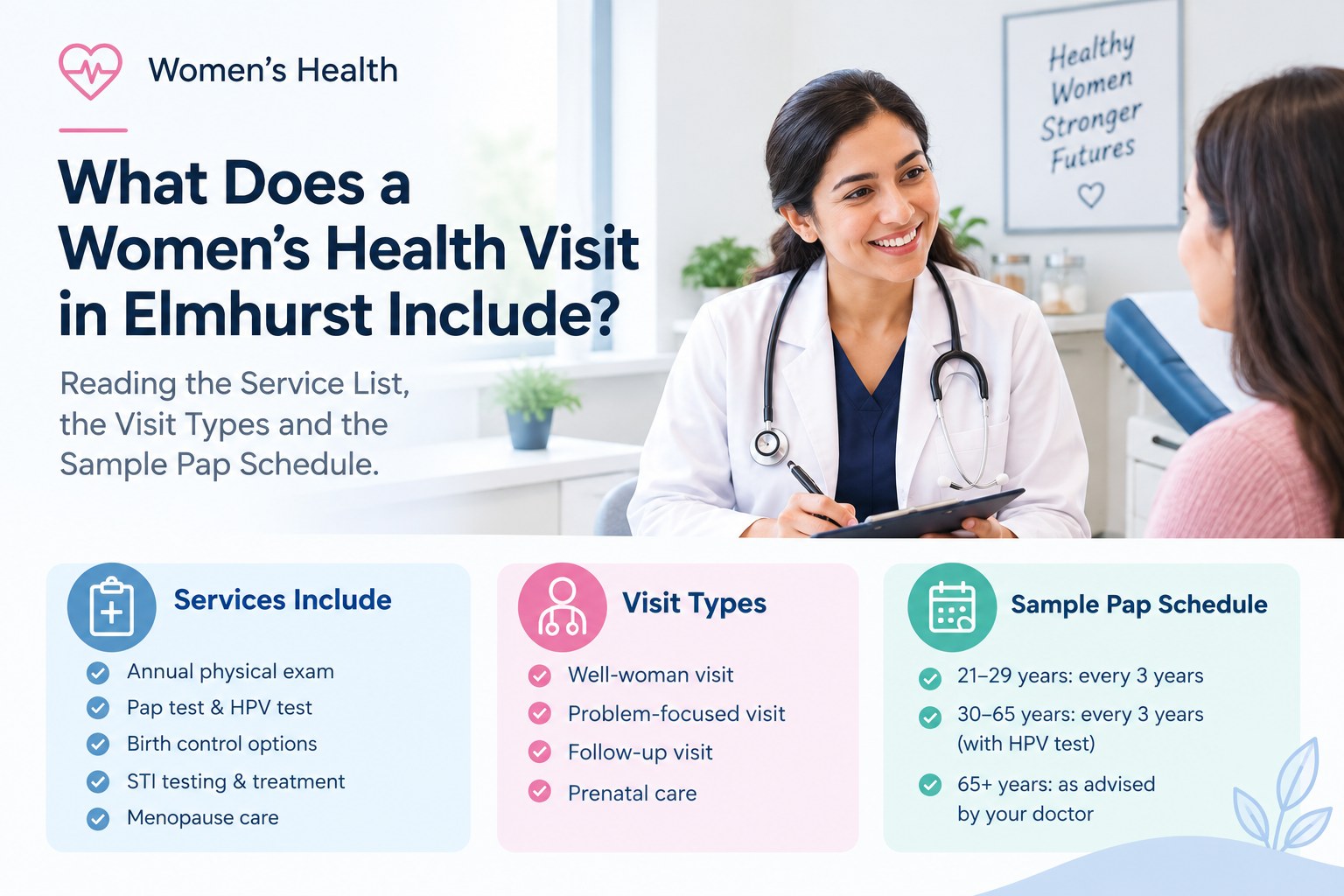
Table of contents
- 1. Women's Health Care Inside Primary Care
- 2. The Service List
- 3. The Well-Woman Exam: What Is Covered
- 4. Pap and HPV Testing: A Sample Schedule
- 5. Birth Control and Menopause Care
- 6. Breast Health and Mammogram Referrals
- 7. Comfort, Privacy, and Language
- 8. Preparing, Booking, and Insurance
- Conclusion
- Frequently Asked Questions
- See a Doctor in Elmhurst or Chinatown
Many women keep their primary care doctor in one place and their gynecology care somewhere else, with separate records, separate appointments, and separate waiting rooms. A women's health visit inside a primary care practice is different: your Pap test, contraception, menopause care, and screenings sit in the same chart as your blood pressure, blood sugar, and vaccines.
This guide walks through the women's health services listed on the City Prime Care website for its Elmhurst clinic at 41-02 75th St: well-woman exams, Pap and HPV testing, birth control, menopause care, STI testing, and breast health with mammogram referrals. It also shows a sample Pap schedule by age and explains how to prepare. Details can change, so confirm them on the women's health page or by calling the clinic. This is general education, not personal medical advice.
In this article:
- 1. Women's health care inside primary care
- 2. The service list (table)
- 3. The well-woman exam: what is covered
- 4. Pap and HPV testing: a sample schedule (graph)
- 5. Birth control and menopause care
- 6. Breast health and mammogram referrals
- 7. Comfort, privacy, and language
- 8. Preparing, booking, and insurance
1. Women's Health Care Inside Primary Care
The clinic says its women's health services are delivered within the same primary care relationship that looks after the rest of your health, by the same physicians and clinicians who manage blood pressure, diabetes screening, and vaccines. Keeping everything under one team means your contraception, menopause treatment, and screening results are seen in the context of your full medical history rather than in isolation.
The clinic also says it coordinates referrals for imaging and specialist care. For reliable background on women's health topics, you can visit the federal Office on Women's Health and the MedlinePlus women's health page.
2. The Service List
| Service | What the clinic says it provides | Done where |
|---|---|---|
| 1. Well-woman exam | A yearly whole-health check-in shaped by age, family history, and what is on your mind | In the clinic |
| 2. Pap and HPV testing | Cervical screening during a routine office visit; samples go to an outside laboratory | In the clinic |
| 3. Birth control | Counseling on every method, prescriptions for the pill, patch, and vaginal ring, emergency contraception, and follow-up for side effects | In the clinic; IUD or implant by referral |
| 4. Menopause care | Symptom and history review, checks for other causes such as thyroid problems or anemia, and treatment discussion | In the clinic |
| 5. STI testing | Confidential testing, often added to the same visit | In the clinic |
| 6. Breast health | Questions about lumps and changes, family history review, and clinical breast exam when appropriate | In the clinic |
| 7. Mammograms and imaging | Orders and referrals to an accredited imaging center; mammograms are not done in the clinic | Outside imaging center |
Related services include preventive care, diagnostic testing, and referral services.
3. The Well-Woman Exam: What Is Covered
The clinic describes a well-woman exam as a yearly check-in on your whole health, not only your reproductive health. Depending on your needs, a visit usually covers the items below.
| Part of the visit | What happens |
|---|---|
| General exam | Blood pressure, weight, and a general physical exam |
| Pelvic exam and cervical screening | When you are due |
| Reproductive and sexual health | Questions about periods, sexual health, pregnancy plans, and contraception |
| Blood work | Cholesterol, blood sugar, and thyroid when indicated; see our guide on common blood tests |
| Vaccines | Review of HPV, flu, and tetanus boosters; see adult vaccines |
| Mental and personal safety screening | Depression, anxiety, intimate partner violence, and sleep problems |
Your provider explains every finding in plain language and agrees on a follow-up plan with you. Many patients schedule the visit alongside the rest of their preventive care so screenings and vaccines happen in one trip.
4. Pap and HPV Testing: A Sample Schedule
The clinic says cervical cancer grows slowly, which gives regular screening a real chance to find changes long before they become cancer. It lists the current national guideline options below. Your own schedule may be more frequent, for example after an abnormal result or with a weakened immune system. Each block is about one year between tests.
| Age | Options listed by the clinic | Interval (graph) |
|---|---|---|
| 21 to 29 | Pap test | ███ Every 3 years |
| 30 to 65 | HPV test alone | █████ Every 5 years |
| 30 to 65 | Pap and HPV co-test | █████ Every 5 years |
| 30 to 65 | Pap test alone | ███ Every 3 years |
The clinic says an abnormal result leads to a phone call, an explanation, and a colposcopy with a gynecologist if needed. For more background, see the MedlinePlus cervical cancer page and the U.S. Preventive Services Task Force recommendations.
5. Birth Control and Menopause Care
The clinic says it talks through effectiveness, side effects, cost, and how each birth control option fits your health history, including blood pressure, migraines, and smoking. Long-acting options such as an IUD or implant are placed by a gynecology specialist it refers you to, and routine care continues afterward.
| Topic | What the clinic describes |
|---|---|
| Birth control counseling | Compare methods side by side |
| Prescriptions | The pill, patch, and vaginal ring |
| Emergency contraception | Advice on when to use it |
| Menopause symptoms | Hot flashes, night sweats, poor sleep, mood changes, vaginal dryness, and irregular bleeding are reviewed; other causes such as thyroid problems or anemia are checked |
| Menopause treatment | Lifestyle changes, non-hormonal medicines, and, for suitable patients, hormone therapy after a careful talk about benefits and risks |
| Long-term health | Bone density scan from age 65, or earlier with risk factors, and heart disease prevention |
For more on this stage of life, see our guide on when to talk to your doctor about menopause.
6. Breast Health and Mammogram Referrals
Breast health is part of every well-woman visit, the clinic says. Your provider asks about lumps, pain, skin changes, or nipple discharge, reviews your family history, and can perform a clinical breast exam. Mammograms are not performed in the clinic. The clinic writes the order and sends you to an accredited imaging center near Elmhurst or Lower Manhattan. National guidelines recommend screening mammograms every two years for women aged 40 to 74, and some women need to start earlier or screen more often.
A typical referral path:
- Your provider reviews your age, family history, and any breast symptoms.
- The clinic writes the order and helps you find an accredited, in-network imaging center.
- You have the mammogram, with your records sent ahead.
- If something needs a closer look, the clinic arranges a diagnostic mammogram, ultrasound, or breast specialist through its referral services.
- The clinic follows up until you have answers.
If you have a strong family history of breast or ovarian cancer, the clinic says it discusses genetic counseling and refers you when appropriate. For background, see the MedlinePlus mammography page. See also our guide on essential health screenings for women.
7. Comfort, Privacy, and Language
The clinic acknowledges that sensitive exams can feel uncomfortable. It says you can request a female provider when you book, ask for a chaperone, or bring someone you trust into the room. The Elmhurst team is listed as speaking English and Spanish, and interpreters are arranged for other languages when requested at booking.
| Need | What to do |
|---|---|
| A female provider | Ask when you book |
| A chaperone or support person | Ask at booking or at check-in |
| Care in Spanish | Mention it when you book |
| Another language | Tell the staff so an interpreter can be arranged |
| Confidential STI testing | Ask for it at your visit |
Read about the clinicians in our article on who you will see at the Elmhurst clinic.
8. Preparing, Booking, and Insurance
Before your visit:
- Note the first day of your last period and any changes in your cycle
- List your medicines, supplements, and any birth control you use
- Write down family history of breast, ovarian, or colon cancer
- Bring past Pap, HPV, or mammogram results if you have them
- Bring your insurance card and photo ID
- Write down questions about periods, sexual health, pregnancy plans, or menopause
The clinic lists Monday to Friday hours of 9:00 AM to 6:00 PM, accepts most major plans including Medicaid and Medicare, and says to call to confirm your plan. Same-day appointments are held back each weekday for urgent concerns. Book through the appointment page and choose Women's Health, and see the Elmhurst clinic page.
Conclusion
Seeing one team for your well-woman exam, screenings, contraception, and menopause care makes your health easier to follow over time. If something needs a specialist or imaging, the clinic coordinates it and stays involved.
Contact Us: To ask about a well-woman exam, Pap test, birth control, or menopause care, reach City Prime Care through our Contact Us page. This article is for general information and does not replace personal medical advice. In an emergency, call 911.
Frequently Asked Questions
See a Doctor in Elmhurst or Chinatown
Have a question about your own health? Book a visit at our Elmhurst, Queens clinic or our Chinatown, Manhattan clinic, or explore our primary care services.
Related articles
Healthcare
What Should You Know Before an STD Test in Elmhurst? Reading the Confidential Testing Steps, the Test Types and the Sample Visit Timeline
Getting tested for sexually transmitted infections is a routine, private part of health care. Learn what testing involves, which tests exist, timing and window periods, how results and treatment work, and a sample visit timeline.
Healthcare
How Can You Spot Skin Cancer Early? Reading the ABCDE Mole Signs, the Five Self-Check Steps and the Sample Monthly Skin-Check Log
Skin cancer is the most common cancer, and it is easiest to treat when found early. Learn the ABCDE mole signs, the main skin cancer types, a five-step self-check, a sample monthly log and when to see a doctor.
Healthcare
What Should You Expect From a Screening Mammogram? Reading the Appointment Steps, the Five Preparation Tips and the Sample Results Pathway
A screening mammogram takes minutes but can feel daunting the first time. Learn when to start, how to prepare, what happens during the exam, what a callback means, how dense breasts are handled, and a sample results pathway.





