
HealthcareBy City Prime Care Team
Is That Painful Blistering Rash on One Side of Your Body Shingles? Reading the Rash Stages, the Five Treatment Steps and the Sample Vaccine Timeline
A burning, blistering rash on one side of the body is the classic sign of shingles. Learn the rash stages, five treatment steps, who should get the vaccine and a sample timeline.
Medically reviewed by City Prime Care Administrator9 min read
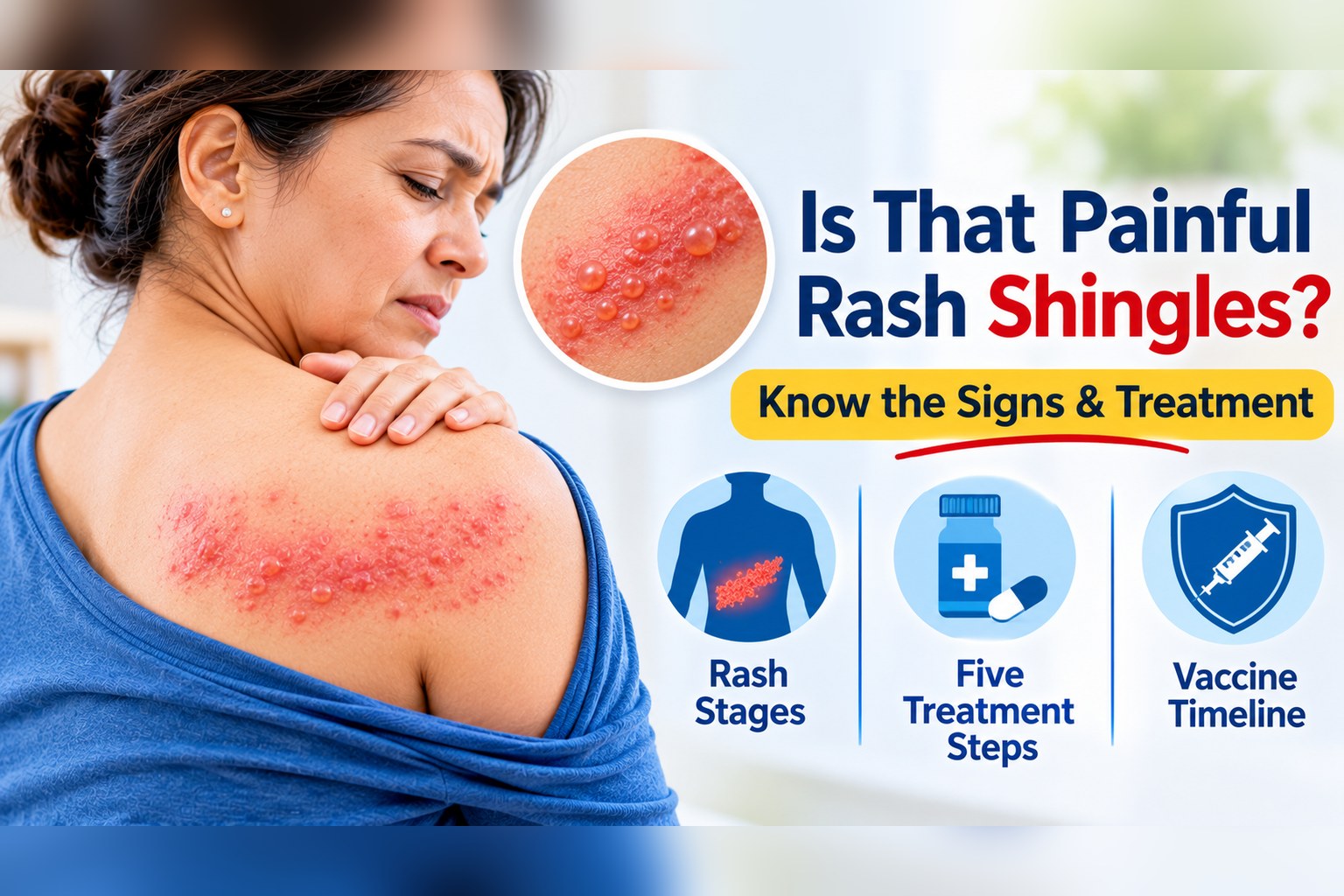
Table of contents
- 1. What Is Shingles and Why Does It Happen?
- 2. The Shingles Rash Stages
- 3. Is It Shingles or Another Rash?
- 4. Five Treatment Steps
- 5. Complications to Watch For
- 6. When to Get Care Urgently
- 7. The Shingles Vaccine: Who Should Get It?
- 8. Sample Timeline With a Pain Graph
- 9. Contact Us and Find Us Online
- Conclusion
- Frequently Asked Questions
- See a Doctor in Elmhurst or Chinatown
Many people first notice shingles as a tingling, burning or shooting pain on one side of the body, often a day or more before any rash appears. Then a band of fluid-filled blisters shows up, usually wrapping around one side of the chest, back, waist or face. Shingles is caused by the varicella-zoster virus, the same virus that causes chickenpox, which can wake up years later in anyone who has had chickenpox.
This guide explains the rash stages, how shingles differs from other rashes, five treatment steps, possible complications, who should get the shingles vaccine and a sample vaccine timeline. It is general education only. A painful one-sided rash, especially near the eye, should be seen by a clinician promptly.
| At a Glance | Key Point |
|---|---|
| What it is | Reactivation of the chickenpox virus in a nerve |
| Classic sign | Painful, blistering rash in a band on one side of the body |
| Best time to act | Antiviral medicine works best when started within about 3 days of the rash |
| Main complication | Long-lasting nerve pain called postherpetic neuralgia |
| Prevention | Two-dose recombinant shingles vaccine for eligible adults |
1. What Is Shingles and Why Does It Happen?
After chickenpox clears, the virus stays dormant in nerve cells near the spinal cord. Age, illness, stress or a weakened immune system can let it reactivate and travel along a single nerve to the skin. That is why the rash follows one strip of skin rather than spreading all over the body.
The CDC estimates that about 1 in 3 people in the United States will develop shingles in their lifetime, and the risk rises with age. You can read more in the CDC overview of shingles and the plain-language summary on MedlinePlus.
2. The Shingles Rash Stages
Shingles usually follows a predictable course over about two to four weeks. The table below shows what many people notice at each stage.
| Stage | Typical Timing | What You May Notice |
|---|---|---|
| Early warning | 1 to 5 days before the rash | Tingling, burning, itching or deep pain on one side; sometimes fever, headache or fatigue |
| Red patches | Day 1 to 3 of the rash | Red, raised area in a band on one side of the body |
| Blisters | Day 3 to 7 | Clusters of fluid-filled blisters |
| Crusting | Day 7 to 10 | Blisters dry out and scab over |
| Healing | Weeks 2 to 4 | Scabs fall off; skin may stay pink, and pain may linger |
3. Is It Shingles or Another Rash?
| Condition | Typical Clue |
|---|---|
| Shingles | Painful band of blisters on one side that stops at the midline |
| Contact dermatitis | Itchy rash where skin touched a plant, metal or product |
| Eczema | Dry, itchy patches that come and go, often in skin folds |
| Hives | Itchy raised welts that move around and fade within hours |
| Cold sores or herpes simplex | Small blisters around the lips or genitals, often recurring in the same spot |
For other itchy skin problems, see our guide on what is behind a stubborn itchy rash. If you are unsure, a clinician can often tell shingles from its look and your symptoms.
4. Five Treatment Steps
Shingles care combines early medicine with comfort measures:
- See a clinician quickly: antiviral medicines are most helpful when started within about 72 hours of the rash appearing, though you should still be seen later if the rash is already a few days old.
- Take the prescribed antiviral: your clinician chooses the medicine and dose based on your age, kidney function and other medicines.
- Manage pain: over-the-counter pain relievers may help mild pain if safe for you, and stronger options exist for severe nerve pain, so ask your clinician.
- Care for the skin: keep the rash clean and dry, wear loose clothing, and use cool compresses; do not pop blisters.
- Protect others: cover the rash and avoid contact with pregnant people, newborns and people with weak immune systems until blisters crust over.
Review any medicine you take with your clinician or pharmacist first. Our guide on taking many medicines safely explains why.
5. Complications to Watch For
| Complication | What It Means | Who Is at Higher Risk |
|---|---|---|
| Postherpetic neuralgia | Nerve pain that lasts for months after the rash heals | Older adults, severe early pain |
| Shingles near the eye | Can threaten vision; needs urgent evaluation | Rash on the forehead, eyelid or tip of the nose |
| Bacterial skin infection | Spreading redness, warmth, pus or fever | Anyone, especially if blisters are scratched |
| Hearing or facial problems | Ear pain, facial weakness or dizziness | Rash in or near the ear |
| Widespread rash | Blisters over a large area of the body | People with weakened immune systems |
6. When to Get Care Urgently
Seek same-day care, or emergency care if severe, if:
- The rash is on your face, especially near the eye, or on the tip of your nose.
- You have a rash and a weak immune system from illness or medicine.
- The rash is spreading, very painful, or has spreading redness, pus or fever.
- You have new facial weakness, confusion, severe headache or a stiff neck.
- You are not sure whether it is shingles and the pain is severe.
Not sure where to go? Our guide on when a problem calls for the emergency room instead of urgent care can help you decide.
7. The Shingles Vaccine: Who Should Get It?
The recombinant shingles vaccine is given in two doses and is recommended by the CDC for adults 50 and older, and for adults 19 and older who have weakened immune systems because of disease or treatment. You should get it even if you have already had shingles or are unsure whether you had chickenpox.
| Group | Vaccine Guidance |
|---|---|
| Adults 50 and older | Two doses, usually 2 to 6 months apart |
| Adults 19 and older with weakened immune systems | Two doses, sometimes 1 to 2 months apart as advised by a clinician |
| People who already had shingles | Still recommended to lower the chance of another episode |
| Currently sick with a moderate or severe illness or a shingles rash | Usually wait until recovered; ask your clinician |
Mild, short-lived side effects such as a sore arm, tiredness, muscle aches or a low fever are common. Our guide to adult vaccines and when you need them covers other shots to plan around.
8. Sample Timeline With a Pain Graph
This illustrative timeline shows a typical course for a healthy adult who starts treatment early. It is a teaching example, and recovery varies. The squares show example pain levels, not a guarantee.
| Time | What Happens | Typical Pain (Example Graph) |
|---|---|---|
| Day 0 | Burning or tingling on one side, no rash yet | ■■■■ |
| Day 2 | Rash appears; clinic visit; antiviral started | ■■■■■■■■ |
| Day 5 | Blisters peak; rest, cool compresses, pain relief | ■■■■■■■ |
| Day 10 | Blisters crust over | ■■■■■ |
| Week 3 to 4 | Scabs fall off; skin heals | ■■■ |
| Month 2 and beyond | Pain fades; call a clinician if it lingers | ■ |
9. Contact Us and Find Us Online
If you have a painful one-sided rash or want to ask about the shingles vaccine, our team can examine you and plan next steps. For non-emergency questions, Contact Us, book a visit, or find City Prime Care on Google: City Prime Care on Google.
Conclusion
Shingles is painful but treatable, especially when caught early. Get a one-sided blistering rash checked quickly, protect people who are vulnerable, and ask whether the shingles vaccine is right for you. This article is for general education and does not replace medical advice.
Frequently Asked Questions
See a Doctor in Elmhurst or Chinatown
Have a question about your own health? Book a visit at our Elmhurst, Queens clinic or our Chinatown, Manhattan clinic, or explore our primary care services.
Related articles
Healthcare
Adult Vaccines Guide: Which Shots You Need and When (Flu, Tdap, Shingles, Pneumonia, COVID-19)
Vaccines are not only for kids. This guide explains which adult vaccines matter, how often they are given, and how to check what you may be missing.
Healthcare
Is It a Food Allergy or Just Food Intolerance? Reading the Reaction Types, the Five Emergency Signs and the Sample Symptom Diary
Hives after peanuts and bloating after milk are not the same problem. Learn how food allergy differs from intolerance, the five emergency signs of anaphylaxis and how a symptom diary helps.
Healthcare
What Should You Do After a Tick Bite, and How Do You Know If It Is Lyme Disease? Reading the Rash Signs, the Five Removal Steps and the Sample Symptom Timeline
Found a tick on your skin or your pet? Learn how to remove it safely, the early signs of Lyme disease, when to see a clinician and a sample timeline of what can follow a bite.





