
HealthcareBy City Prime Care Team
Is an IV Drip Really Better Than a Vitamin Pill? Reading the Absorption Claims, the Five Decision Questions and the Sample Comparison Chart
IV drips are marketed as faster and stronger than supplements, but the evidence is more nuanced. Compare IV therapy with oral supplements, see when each makes sense, and use five questions and a sample chart to decide.
Medically reviewed by City Prime Care Administrator9 min read
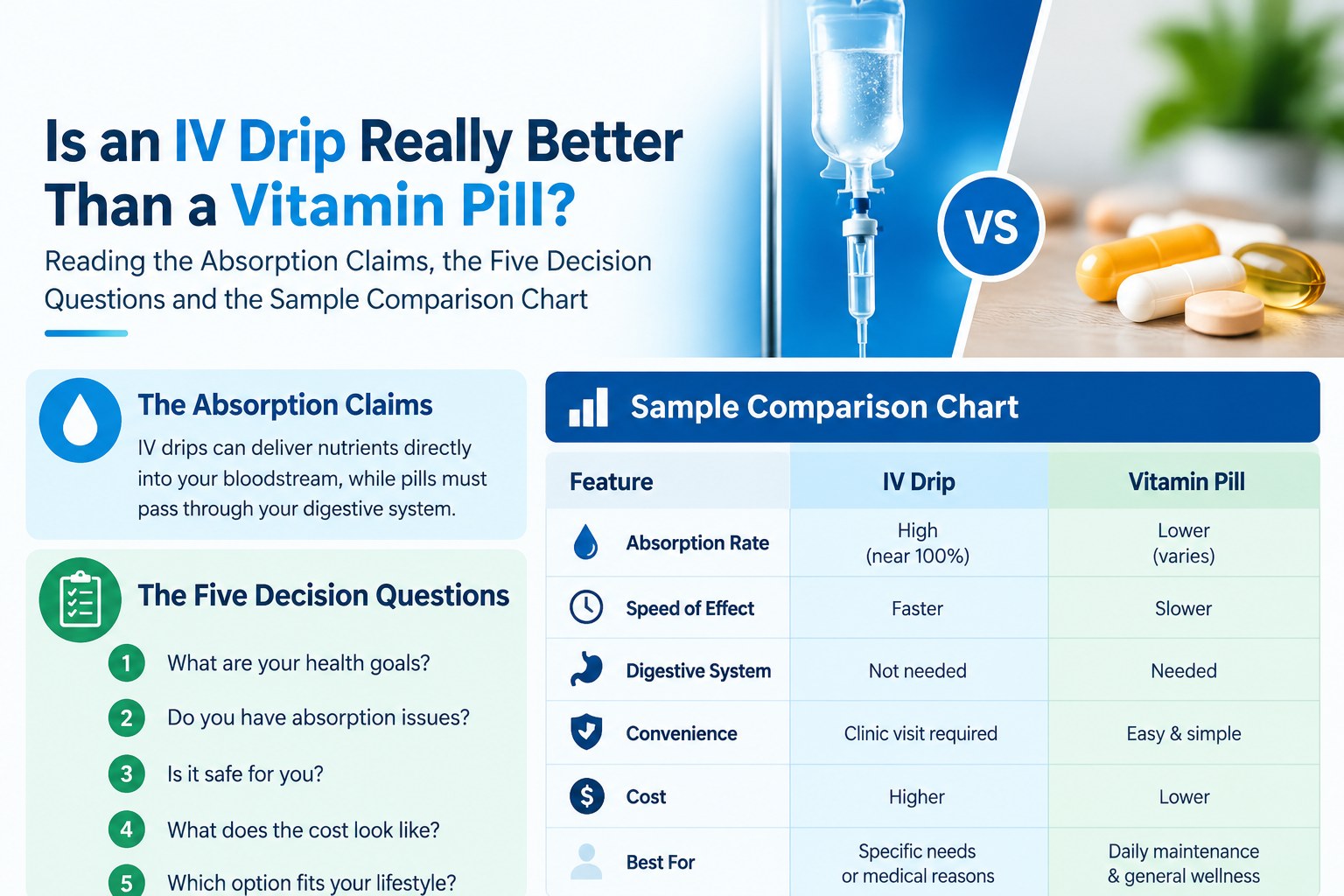
Table of contents
- 1. How Each Route Works
- 2. IV vs Oral Side by Side
- 3. What the Evidence Says
- 4. When Pills Are Usually Enough
- 5. When an IV or Injection May Be Reasonable
- 6. The Five Decision Questions
- 7. A Sample Comparison Chart
- 8. Safety and Red Flags
- Conclusion
- Frequently Asked Questions
- See a Doctor in Elmhurst or Chinatown
Walk past a storefront IV bar or scroll social media and you will hear the same pitch: a drip delivers vitamins straight into your bloodstream, so it works faster and better than pills. There is a kernel of truth in that. An IV bypasses the digestive system. But whether that matters for you depends on why you want it, what your blood work shows, and what your body can already absorb.
This guide compares IV therapy with oral supplements, using the cautious approach on the City Prime Care IV drip therapy and vitamin and mineral infusions pages. It explains when an IV can help, when pills are enough, the evidence in plain terms, five questions to ask before deciding, and a sample comparison chart. It is general education, not personal medical advice. You can find City Prime Care on Google here: City Prime Care on Google. For the clinic's service, see its IV drip therapy page.
In this article:
- 1. How each route works
- 2. IV vs oral side by side (table)
- 3. What the evidence says (graph)
- 4. When pills are usually enough
- 5. When an IV or injection may be reasonable
- 6. The five decision questions
- 7. A sample comparison chart
- 8. Safety and red flags
1. How Each Route Works
Oral supplements are swallowed, digested, and absorbed through the gut. An IV drip delivers fluid and nutrients directly into a vein through a small catheter, so there is no digestion step. The clinic says patients receive fluids and vitamins through a small IV line, given by licensed medical staff only after a short health check.
The clinic's vitamin and mineral infusions page makes a practical point: most people who are low in B12, vitamin D, or iron do well on tablets, so pills are usually the first option. Injections and infusions come into play when levels are very low, symptoms are significant, or the gut cannot absorb enough. For nutrient facts, see the NIH Office of Dietary Supplements.
2. IV vs Oral Side by Side
| Feature | Oral supplements | IV drip or injection |
|---|---|---|
| 1. Route | Swallowed and absorbed through the gut | Delivered directly into a vein or muscle |
| 2. Speed | Slower; builds up over days to weeks | Fluid effects can begin within the hour; vitamin effects are less clear |
| 3. Best known use | Everyday nutrition and many deficiencies | Rehydration; confirmed deficiencies when pills are not enough |
| 4. Absorption problems | Can limit benefit after weight-loss surgery, with celiac or Crohn's disease, or with some medicines | Bypasses the gut |
| 5. Risks | Stomach upset; too much of some vitamins can cause harm | Bruising, vein irritation, infection, allergic reaction; fluid overload in some conditions |
| 6. Medical oversight | Often none for over-the-counter products | Requires a licensed clinician and a health check |
| 7. Cost and insurance | Usually low cost; sometimes prescribed | Wellness drips are usually self-pay; treatment of a diagnosed problem may be covered |
See our related guide on what to expect from an IV drip visit in Elmhurst.
3. What the Evidence Says
The graph below is an illustrative summary of how strong the support is for common uses, reflecting the clinic's cautious language. It is not a study result.
| Use | Strength of support (graph) | Plain summary |
|---|---|---|
| IV fluids for true dehydration | █████████░ Strong | Hospitals use similar fluids |
| B12, iron, or vitamin D for a lab-confirmed deficiency | ████████░░ Strong | Pills first; injection or infusion if pills fail |
| Extra vitamins in a well-nourished person | ███░░░░░░░ Weak | The kidneys clear most of the excess |
| Preventing colds with a vitamin drip | ██░░░░░░░░ Weak | The clinic says research has not shown this in healthy adults |
| Treating migraines or fibromyalgia with a Myers' cocktail | █░░░░░░░░░ Very weak | Small studies are mixed; not an approved treatment |
4. When Pills Are Usually Enough
Oral treatment is usually the first step when:
- Your blood work shows a mild or moderate shortfall of B12, vitamin D, or iron
- Your gut absorbs nutrients normally
- You can take tablets and tolerate them
- You want to maintain levels after you recover
- You have no urgent symptoms and your clinician is rechecking labs after a few months
The clinic's page says vitamin D is well absorbed by mouth, so treatment is usually a prescription-strength oral supplement for a set period, then a maintenance amount, with a repeat blood test after a few months. Our guide on common blood tests explains what these tests measure.
5. When an IV or Injection May Be Reasonable
| Situation | Why an injection or IV may be considered | Notes |
|---|---|---|
| Dehydration from a stomach bug, heat, or heavy exercise | Fluids go in directly when drinking is hard | See dehydration warning signs |
| Confirmed low B12 with significant symptoms or poor absorption | Injections can bypass the gut | Pernicious anemia, weight-loss surgery, long-term metformin use, strict vegan diet |
| Iron deficiency when tablets are not tolerated or absorbed | The clinic says an iron infusion may be arranged through a partner infusion center or specialist | Heavy periods, bariatric surgery, inflammatory bowel disease |
| More than one deficiency at once | A custom infusion built from lab results may be ordered | Ordered for a documented reason |
6. The Five Decision Questions
Ask yourself and your clinician:
- What exactly am I trying to fix: dehydration, a lab-confirmed deficiency, or general tiredness?
- Do my blood tests show a deficiency, and which one?
- Could pills work for me, and have I tried them or do I have trouble absorbing them?
- Is an IV safe for me, given my heart, kidneys, blood pressure, medicines, and pregnancy status?
- What will it cost, and will insurance cover it if there is a diagnosed condition?
If tiredness is the main reason, see our guides on why you feel tired all the time and low energy in men first.
7. A Sample Comparison Chart
The chart below is an illustrative example, not a recommendation. It shows how three different people might weigh the options.
| Person | Likely first step | When an IV or shot may come up |
|---|---|---|
| Adult with mild vitamin D deficiency | Prescription oral supplement and recheck | Rarely |
| Adult with a stomach bug and poor fluid intake | Oral rehydration; call the clinic early | If fluids cannot be kept down, an IV hydration drip after screening |
| Adult with very low B12 and tingling | Lab confirmation and a clinician's plan | B12 injections, then maintenance or oral B12 |
| Healthy adult wanting an energy boost | Sleep, food, and activity; labs if tiredness persists | Usually not needed |
8. Safety and Red Flags
| Warning sign | Action |
|---|---|
| Chest pain, trouble breathing, or swelling of the face or throat during or after treatment | Call 911 |
| Confusion, fainting, or no urine for many hours | Call 911 |
| Tingling, numbness, or weakness that is new | Book a prompt visit for blood tests |
| Pain, redness, or swelling at the IV site | Call the clinic the same day |
| Ongoing tiredness despite treatment | Get a full workup |
The clinic notes that vitamins are not harmless in any amount: too much vitamin D can raise calcium, and extra iron can build up in the organs. See the clinic's vitamin and mineral infusions page and book through the appointment page.
Conclusion
An IV is a useful tool in the right situation, mainly rehydration and certain confirmed deficiencies. For many people, pills, food, sleep, and a proper checkup do more than a drip.
Contact Us: To ask whether an IV or an oral supplement fits your situation, reach City Prime Care through our Contact Us page, or find the clinic on Google: City Prime Care on Google. This article is for general information and does not replace personal medical advice. In an emergency, call 911.
Frequently Asked Questions
See a Doctor in Elmhurst or Chinatown
Have a question about your own health? Book a visit at our Elmhurst, Queens clinic or our Chinatown, Manhattan clinic, or explore our primary care services.
Related articles
Healthcare
What Are the Different Types of Vitamin Infusions? Reading the Nutrient Options, the Delivery Methods and the Sample Treatment Path
B12 shots, vitamin D therapy, iron infusions and custom nutrient infusions are different treatments for different problems. See each type, how it is delivered, when pills are enough and a sample treatment path.
Healthcare
Why Is Vitamin D Low So Often in New York? Reading the Risk Groups, the Testing Steps and the Sample Retest Timeline
Weak winter sun and indoor lives leave many New Yorkers low in vitamin D. Learn who is at risk, the signs, how testing works, how treatment and retesting are usually done, and the risks of taking too much.
Healthcare
What Drives the Price of an IV Drip in Queens? Reading the Cost Factors, the Five Questions to Ask and the Sample Quote Checklist
IV drip prices vary widely and are often not posted online. Learn what affects the cost, why wellness drips are usually self-pay, how to compare quotes fairly, and a sample quote checklist for Queens.





