
HealthcareBy City Prime Care Team
Herniated Disc in Elmhurst, NY: How Back and Leg Pain From a Slipped Disc Develops and What to Expect From Care
A herniated disc can cause back pain, leg pain, numbness and weakness. Learn how slipped discs develop, a numbered self-care plan, red flags and what to expect from primary care in Elmhurst, Queens.
Medically reviewed by Dr. Helen Vasquez9 min read
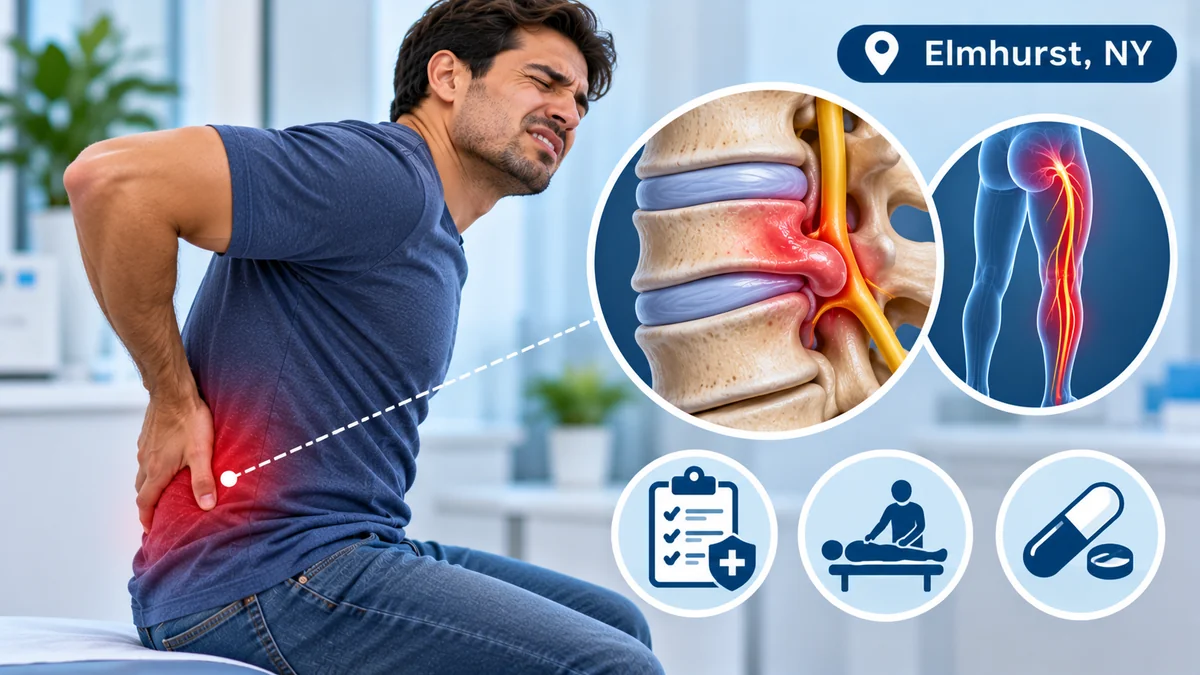
Table of contents
- 1. How a Herniated Disc Develops
- 2. Symptoms by Location
- 3. Illustrative Chart: Where Disc Herniations Commonly Occur
- 4. Five Daily Steps for Relief and Recovery
- 5. Myths vs Facts
- 6. Red Flags: When to Get Care Quickly
- 7. What to Expect at a Primary Care Visit
- 8. Sample Six-Week Recovery Plan
- 9. Finding Primary Care in Elmhurst, Queens
- Conclusion
- Frequently Asked Questions
- See a Doctor in Elmhurst or Chinatown
Back pain that travels into the buttock, leg or arm is one of the most common reasons adults seek care. When the pain is sharp, burning or tingling, and worsens when you sit, bend or cough, one possible cause is a herniated disc, often called a slipped disc. It sounds alarming, but most people improve with time and the right care.
The spine is cushioned by soft discs between the bones. A disc has a tough outer ring and a gel-like center. When part of the center pushes through a weak spot in the ring, it can irritate nearby nerves. In busy Queens neighborhoods like Elmhurst, long commutes, desk work, heavy lifting at work and little time to exercise all put extra stress on the spine.
This guide explains how herniated discs develop, how symptoms differ by location, a numbered self-care plan, red flags that need urgent attention and what to expect at a checkup. It is general information, not a diagnosis or medical advice.
1. How a Herniated Disc Develops
Discs lose water and flexibility with age, so small tears can form in the outer ring. A sudden twist, a heavy lift or years of repeated strain can then push disc material outward. The table below shows common contributors.
| Factor | How it contributes | Common clue |
|---|---|---|
| Age-related wear | Discs dry out and weaken over time | Pain begins in your 30s to 50s without a clear injury |
| Heavy or awkward lifting | Sudden pressure on the lower back | Pain starts right after a lift or twist |
| Long sitting hours | Constant load on lower spinal discs | Pain worse after driving or desk work |
| Excess body weight | More stress on the spine every day | Gradual, recurring low back pain |
| Weak core muscles | Less support for the spine | Pain with standing up or bending |
| Smoking | Reduces blood flow and disc health | Slower recovery from back problems |
| Family history | Some people inherit weaker discs | Relatives with back or disc problems |
2. Symptoms by Location
Symptoms depend on which disc is affected and which nerve is irritated. Most herniations occur in the lower back (lumbar spine), and fewer occur in the neck.
- Lower back disc: back pain, plus burning or shooting pain down one buttock, thigh, calf or foot (sciatica)
- Neck disc: neck pain that spreads to the shoulder, arm or hand, sometimes with tingling in the fingers
- Numbness or pins and needles in the area the nerve supplies
- Muscle weakness, such as a foot that catches or trouble gripping
- Pain that worsens with sitting, coughing, sneezing or bending forward
3. Illustrative Chart: Where Disc Herniations Commonly Occur
The chart below is a teaching sample showing relative frequency, not exact statistics. It illustrates that most herniations involve the lower back.
| Spine region | Illustrative frequency | Bar |
|---|---|---|
| Lower back (lumbar) | Most cases | ██████████ |
| Neck (cervical) | Some cases | ███░░░░░░░ |
| Mid back (thoracic) | Rare | █░░░░░░░░░ |
4. Five Daily Steps for Relief and Recovery
Many people improve with a simple, steady plan:
- Stay gently active: short walks several times a day help more than long bed rest, so avoid lying down all day.
- Change positions often: stand, stretch and walk for a minute or two every 30 minutes if you sit for work.
- Use heat or cold: try a warm pack for stiffness or a cold pack for the first days of sharp pain, 15 to 20 minutes at a time.
- Strengthen your core: once pain settles, add gentle core and hip exercises guided by a clinician or physical therapist.
- Lift smart: bend your knees, keep the load close and avoid twisting while lifting, and ask a clinician before using pain medicines if you have kidney, stomach or heart conditions.
5. Myths vs Facts
| Myth | Fact |
|---|---|
| A slipped disc means the disc slid out of place | The disc bulges or leaks inner material; it does not slip like a loose part |
| You need complete bed rest | Gentle movement usually speeds recovery |
| Every herniated disc needs surgery | Most improve with time, activity changes and therapy; surgery is uncommon |
| An MRI is needed for all back pain | Imaging is usually reserved for severe, persistent or red-flag symptoms |
| Back pain always means serious damage | Many discs look abnormal on scans in people with no pain at all |
Back and neck strain can have related causes. You may also like our guides on whiplash and neck strain and on normal wear and tear versus arthritis.
6. Red Flags: When to Get Care Quickly
See a clinician if back or leg pain lasts more than a week or two, or sooner if you notice:
- Leg or arm weakness that is getting worse, or a foot that drags
- Numbness spreading in the legs or around the groin and inner thighs (saddle area)
- Loss of bladder or bowel control, or trouble urinating, which is an emergency and needs immediate care
- Severe pain that does not ease with rest or at night
- Back pain after a fall, accident or injury, or with fever, unexplained weight loss or a history of cancer
7. What to Expect at a Primary Care Visit
A visit for suspected disc problems typically includes:
- Questions: when pain started, what makes it better or worse, work and lifting habits, and any numbness, weakness or bladder changes.
- Exam: a check of posture, spine movement, reflexes, muscle strength, sensation and tests such as a straight-leg raise.
- Targeted tests: imaging such as an X-ray or MRI only if symptoms are severe, persistent or concerning.
- Treatment: guidance on activity, pain relief, physical therapy and, when appropriate, referral to a spine specialist for injections or surgical opinion.
- Follow-up: a plan to track progress and adjust care over the coming weeks.
8. Sample Six-Week Recovery Plan
| Week | Focus | Illustrative pain level |
|---|---|---|
| Weeks 1-2 | Short walks, position changes, heat or cold, avoid heavy lifting | ████████░░ |
| Weeks 3-4 | Add gentle stretches and core activation, review progress | █████░░░░░ |
| Weeks 5-6 | Build strength, return to normal activity, plan ongoing prevention | ██░░░░░░░░ |
This is a teaching example only. Recovery varies, and your clinician may adjust the plan if symptoms persist or change.
9. Finding Primary Care in Elmhurst, Queens
When back or leg pain will not settle, a primary care doctor Elmhurst NY can examine you, rule out serious causes and guide treatment. Many neighbors search for a family doctor Elmhurst Queens, a walk in clinic Elmhurst NY, an urgent care Elmhurst NY option or a same day doctor appointment Elmhurst when pain flares suddenly. City Prime Care supports urgent care 11373 needs, offers a physical exam clinic Elmhurst NY experience, and provides preventive care Elmhurst NY and chronic disease management Elmhurst NY, including ongoing pain and weight management. If you are comparing the best primary care clinic in Elmhurst Queens, primary care doctors in Elmhurst NY or primary care near me Elmhurst Queens, ask how the team coordinates with physical therapy and spine specialists. We offer men's and women's healthcare in Elmhurst NY and same-day acute care in Elmhurst Queens. See our top primary care clinics guide or visit cityprimecare.com.
Across the city, people also search for a primary care doctor NYC, a primary care doctor near me and primary care clinics and doctors in Queens NY, including the best and top primary care clinics in Queens NY. In Manhattan, common searches include primary care Lower Manhattan, primary care Chinatown NYC, a primary care clinic in Chinatown Manhattan, a doctor near Catherine Street NYC, primary care 75 Catherine St, a walk-in clinic Chinatown NYC, a healthcare center in Chinatown Manhattan NY and a family doctor Manhattan NYC. An annual physical exam NYC, same day primary care NYC or preventive care Lower Manhattan visit is a good time to mention back pain, and primary care doctors serving Todt Hill Staten Island can help neighbors there. Read more on our health blog.
Conclusion
A herniated disc can be painful, but most cases improve with gentle activity, smart lifting, strengthening and time. Knowing the red flags and getting checked when pain persists helps you recover safely and avoid repeat flare-ups.
To book a visit, use our Contact Us page, find City Prime Care on Google, or visit cityprimecare.com. This article is general information, not medical advice. Seek emergency care right away for loss of bladder or bowel control, numbness in the groin area or rapidly worsening weakness.
Frequently Asked Questions
See a Doctor in Elmhurst or Chinatown
Have a question about your own health? Book a visit at our Elmhurst, Queens clinic or our Chinatown, Manhattan clinic, or explore our primary care services.
Related articles
Healthcare
Whiplash and Neck Strain in Queens, NY: How Neck Pain Develops After a Sudden Jolt and What to Expect From Recovery
Neck pain and stiffness after a car accident, fall or sudden jolt can be whiplash or a neck strain. Learn how symptoms develop, how it is evaluated, five recovery steps, a sample six-week plan and red flags that need urgent care.
Healthcare
Shin Splints in Elmhurst, NY: How Lower Leg Pain Builds and What to Expect From Recovery
Aching pain along the inner edge of the shin during running or walking is often shin splints. Learn how they develop, how they differ from a stress fracture, five recovery steps and a sample six-week return plan.
Healthcare
Why Does Your Shoulder Ache When You Lift Your Arm, and Could It Be a Rotator Cuff Injury? Reading the Pain Pattern, the Five Rehab Steps and the Sample Strengthening Plan
Shoulder pain that worsens when you reach overhead or lie on your side may be a rotator cuff problem. Learn the causes, diagnosis, five rehab steps, treatment options and a sample strengthening plan with a simple graph.