
HealthcareBy City Prime Care Urgent Care
Does Urgent Care in Elmhurst Accept Medicaid and Medicare? What the Research Reveals, the Coverage Test It Turns On, and What Each Plan Counts
A Data-Backed Look at Medicaid and Medicare Acceptance, Insurance Coverage Variation, and What Patients Should Verify Before Visiting Urgent Care in Elmhurst
Medically reviewed by City Prime Care Medical Team5 min read
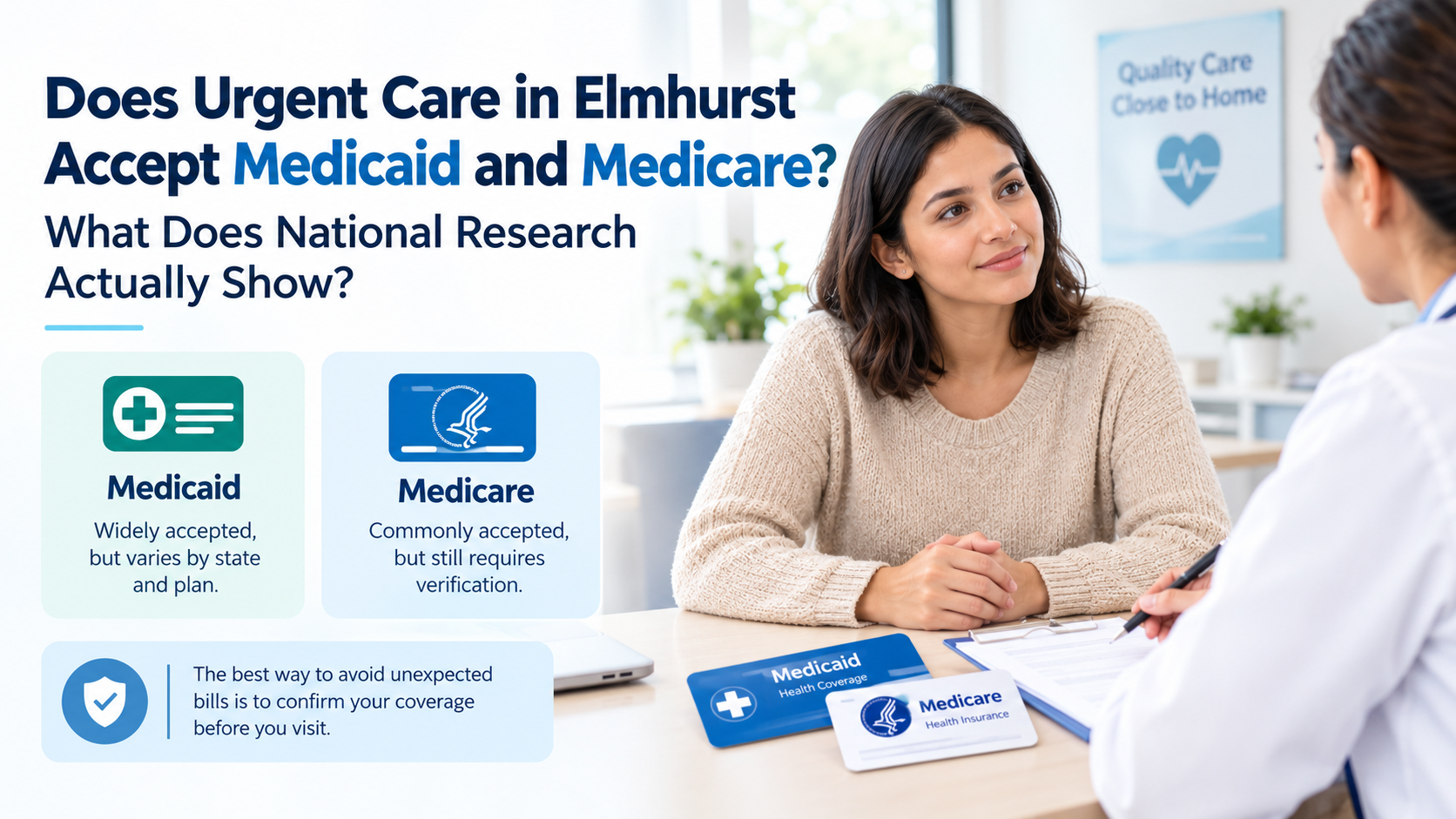
Table of contents
- Key Findings
- What Does National Research Show About Medicaid Acceptance?
- Why Does Medicaid Acceptance Vary by State?
- Does Medicare Coverage Work Differently?
- Does Health System Affiliation Affect Medicaid Acceptance?
- What Should Medicaid Patients Ask Before Visiting?
- What Should Medicare Patients Verify?
- Why Is Calling Ahead Helpful?
- What Does the Research Mean for Patients in Elmhurst?
- What If You Need Urgent Care in Elmhurst?
- Conclusion
- Frequently Asked Questions
- See a Doctor in Elmhurst or Chinatown
Does Urgent Care in Elmhurst Accept Medicaid and Medicare? What Does National Research Actually Show?
If you have Medicaid or Medicare and need urgent care in Elmhurst, one of the first questions you may have is whether your insurance will be accepted. National research shows that insurance acceptance is common, but rates can vary depending on the type of insurance, state, provider, and health system.
For patients looking for urgent care in Elmhurst, Queens, checking your specific coverage before visiting can help reduce uncertainty about insurance participation and potential costs.
Key Findings
- Medicaid Acceptance: Urgent care centers generally accept Medicaid less often than private insurance.
- Insurance Variation: Medicaid acceptance can vary significantly by state, provider, and health system.
- Medicare Coverage: Medicare coverage depends on the provider and the patient’s specific plan.
- Institutional Differences: Larger health system–affiliated centers may have higher Medicaid acceptance rates.
- Verify Coverage: Patients should confirm their specific Medicaid or Medicare plan before visiting urgent care.
What Does National Research Show About Medicaid Acceptance?
A national study of 1,245 randomly selected urgent care centers across all 50 states found that 98.2% accepted private insurance, compared with 78.8% accepting Medicaid.
Another study of 240 urgent care centers found that 99.6% accepted commercial insurance, while 66.2% accepted Medicaid. These findings indicate that Medicaid acceptance is common but less consistent than commercial insurance acceptance.
The exact rate can vary depending on the study population, location, and insurance arrangements being examined.
Why Does Medicaid Acceptance Vary by State?
Medicaid is jointly funded and administered through federal and state programs. Because state Medicaid programs can have different reimbursement structures and participation requirements, acceptance can vary between locations.
Research has found an association between Medicaid physician reimbursement rates and Medicaid acceptance among urgent care centers. Studies have also reported higher Medicaid acceptance rates in states that expanded Medicaid compared with states that did not.
This means patients should not assume that every urgent care center accepts every Medicaid plan simply because the center accepts other forms of insurance.
Does Medicare Coverage Work Differently?
Medicare and Medicaid are separate government health insurance programs. Medicare is primarily a federal program, while Medicaid is administered jointly by federal and state governments.
However, Medicare patients should still verify coverage before visiting an urgent care center. Provider participation, the service being provided, and the patient's specific Medicare arrangement can affect how care is covered.
Patients with Medicare Advantage should also check whether the urgent care center participates in their plan's network and whether any applicable cost-sharing requirements apply.
Does Health System Affiliation Affect Medicaid Acceptance?
Research has found differences in Medicaid acceptance based on how urgent care centers are affiliated or operated.
Some studies found that centers affiliated with academic institutions or larger health systems were more likely to accept Medicaid than certain independently operated or private-practice-affiliated centers.
This does not mean that every independent urgent care center has limited Medicaid participation. Instead, the research suggests that organizational structure can be one factor associated with insurance acceptance.
What Should Medicaid Patients Ask Before Visiting?
If you have Medicaid and need urgent care in Elmhurst, consider confirming these details before your visit:
- Does the clinic accept Medicaid?
- Does it accept your specific Medicaid plan?
- Is the service you need covered?
- Will you have a copayment or other out-of-pocket responsibility?
- Does the clinic participate in your plan's network?
Asking whether a clinic accepts "Medicaid" may not always be enough. Confirming the name of your specific plan can provide a more accurate answer.
What Should Medicare Patients Verify?
Medicare patients should also confirm that the urgent care center participates with their coverage before receiving care.
If you have Original Medicare, ask whether the provider accepts Medicare and whether the service you need is covered.
If you have Medicare Advantage, check your plan's network requirements, applicable copayments, and any other coverage rules that may apply.
Why Is Calling Ahead Helpful?
Insurance participation can change, and a clinic may accept some plans while not participating with others. Calling ahead gives you an opportunity to confirm current information directly with the provider.
You can also contact your insurance company if you need confirmation about network participation, benefits, or potential out-of-pocket costs.
What Does the Research Mean for Patients in Elmhurst?
The national research does not establish that every urgent care center in Elmhurst accepts or rejects Medicaid or Medicare. Instead, it demonstrates that insurance acceptance varies, particularly for Medicaid.
For patients in Elmhurst, the most practical step is to verify the specific insurance plan before visiting. This is especially important for Medicaid patients because acceptance rates have been shown to vary more than private insurance acceptance.
Medicare patients should also confirm provider participation and any plan-specific requirements before receiving care.
What If You Need Urgent Care in Elmhurst?
If you need prompt medical attention and are considering urgent care, you can contact the clinic before visiting to ask about insurance participation and current requirements.
City Prime Care Urgent Care is located at 41-02 75th St, Elmhurst, NY 11373. Patients can call (718) 555-0175 to ask about Medicaid or Medicare coverage before their visit.
Conclusion
National research shows that urgent care centers generally accept private insurance at higher rates than Medicaid, while Medicaid acceptance varies by state, reimbursement patterns, and organizational affiliation.
Medicare coverage also depends on provider participation and the patient's specific plan. Checking your insurance before visiting can help you understand whether the clinic participates with your coverage and whether additional costs may apply.
Frequently Asked Questions
Do most urgent care centers accept Medicaid?
Many urgent care centers accept Medicaid, but national studies have found lower acceptance rates than for private or commercial insurance.
Why does Medicaid acceptance vary between urgent care centers?
Research has associated Medicaid acceptance with factors such as state reimbursement rates, Medicaid policies, and the organizational structure of the urgent care center.
Does Medicare have the same coverage rules as Medicaid?
No. Medicare and Medicaid are separate programs with different eligibility, administration, and coverage structures.
Should I check my specific Medicaid plan before visiting?
Yes. A clinic may accept some Medicaid plans but not every plan or managed-care arrangement.
Should Medicare Advantage patients check the network?
Yes. Medicare Advantage plans can have network requirements, so patients should verify participation before receiving non-emergency care.
Can I call the urgent care center before visiting?
Yes. Calling ahead can help you confirm insurance participation and ask about current coverage requirements.
How can I confirm coverage before visiting City Prime Care?
You can call City Prime Care Urgent Care at (718) 555-0175 or visit 41-02 75th St, Elmhurst, NY 11373 to ask about Medicaid or Medicare coverage.
See a Doctor in Elmhurst or Chinatown
Have a question about your own health? Book a visit at our Elmhurst, Queens clinic or our Chinatown, Manhattan clinic, or explore our primary care services.
Related articles
Urgent Care / Healthcare
Does Urgent Care in Elmhurst Accept Medicaid and Medicare? What the Research Reveals, the Coverage Test It Turns On, and What Each Plan Counts
National research shows that urgent care centers generally accept private insurance more often than Medicaid, while Medicaid acceptance varies by state and provider. Patients should verify their insurance plan, network coverage, and potential costs before visiting urgent care in Elmhurst.
Healthcare
Does Urgent Care Really Make More Sense Than Waiting for Your Doctor? What Your Symptoms Reveal, the Urgency Test It Turns On, and What Each Care Option Counts
This guide explains how to decide between visiting urgent care and waiting for a regular doctor's appointment based on whether symptoms are new, worsening, or significantly affecting daily activities. It also covers when stable concerns can wait, how same-day urgent care can help when primary care is unavailable, and when emergency medical care is more appropriate.
Urgent Care / Healthcare
Does Urgent Care in Elmhurst Really Handle Fever, Cold, and Sore Throat? What the Seasonal Data Reveals, the Care Test It Turns On, and What Each Symptom Counts
Fever, cold, and sore throat are common reasons patients seek urgent care, with respiratory visits often increasing during peak flu season. This guide explains what patients can expect, including possible testing, busier clinic periods, and warning signs that may require more urgent medical evaluation.





