HealthcareBy City Prime Care Team
Raynaud's Phenomenon in Queens, NY: Why Fingers and Toes Turn White in the Cold and What to Expect From Care
Do your fingers or toes turn white, then blue, then red in the cold? That may be Raynaud's phenomenon. Learn the causes, triggers, warm-up steps, red flags and how a clinic visit in Queens works.
Medically reviewed by Dr. Karl E. Latortue9 min read
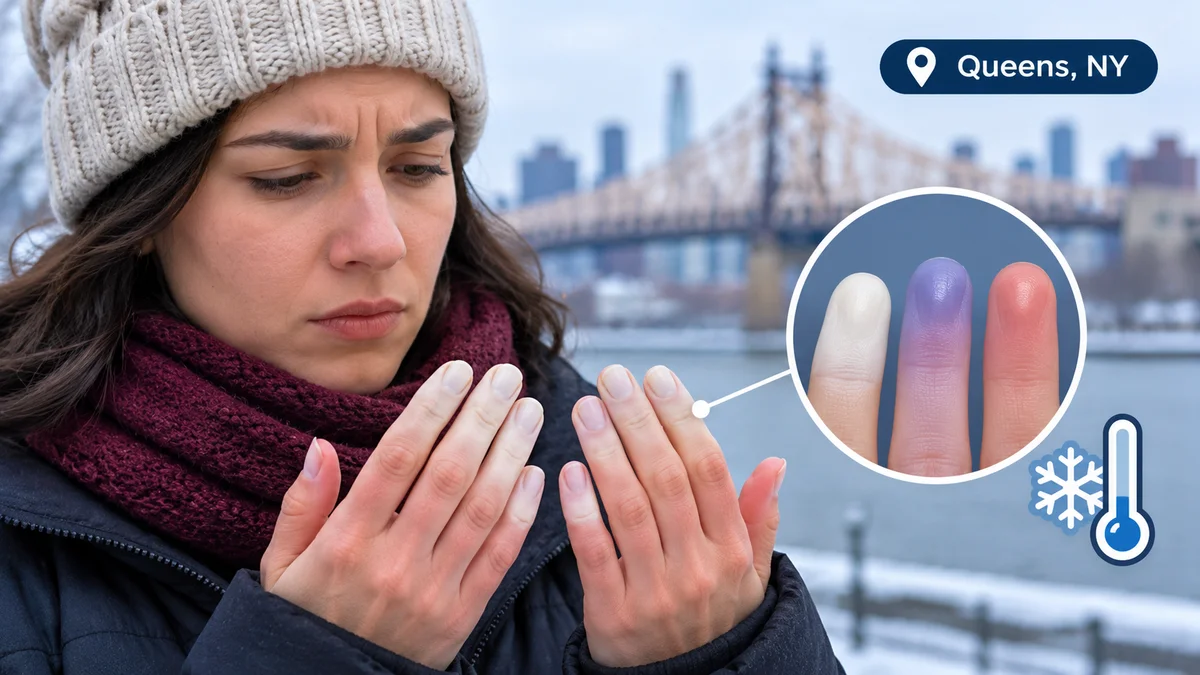
Table of contents
- 1. What Happens During a Raynaud's Attack?
- 2. Primary vs Secondary Raynaud's
- 3. Common Triggers
- 4. Five Warm-Up and Prevention Steps
- 5. Red Flags: When to Seek Prompt Care
- 6. What to Expect at a Primary Care Visit
- 7. Sample Winter Management Plan
- 8. Illustrative Outlook Over a Winter
- 9. Finding Primary Care in Elmhurst, Queens
- Conclusion
- Frequently Asked Questions
- See a Doctor in Elmhurst or Chinatown
Many people notice it first on a winter commute: a few fingers suddenly turn pale or white, feel numb or tingly, then change to blue and finally throb red as warmth returns. This pattern is called Raynaud's phenomenon (or Raynaud's disease). It happens when small blood vessels in the fingers and toes overreact to cold or stress and narrow too much for a short time.
New York winters, windy subway platforms and air-conditioned offices all create the kind of temperature swings that can set off an episode. For most people, Raynaud's is annoying but harmless. For others, it can be a clue to another health condition, which is why it is worth discussing with a clinician.
This guide explains what happens during an attack, the difference between primary and secondary Raynaud's, common triggers, a numbered warm-up plan, red flags and what a visit may include. It is general education and not medical advice.
1. What Happens During a Raynaud's Attack?
Blood vessels in the fingers and toes tighten to save body heat. In Raynaud's, this response is exaggerated, so blood flow nearly stops for minutes to an hour. The skin often passes through a series of colors.
| Stage | Color | What you feel |
|---|---|---|
| 1. Restricted flow | White or pale | Cold, numb, stiff fingers or toes |
| 2. Low oxygen | Blue or purple | Tingling, aching, clumsiness |
| 3. Blood returns | Red | Throbbing, burning, swelling, warmth |
Not everyone sees all three colors, and attacks usually affect fingers most often. Toes, ears, nose and lips can also be involved.
2. Primary vs Secondary Raynaud's
| Feature | Primary Raynaud's | Secondary Raynaud's |
|---|---|---|
| Cause | No underlying disease; vessel sensitivity | Linked to another condition or exposure |
| Typical start | Teens to early 30s, more often in women | Often after age 30 |
| Pattern | Both hands, symmetrical | May be uneven or severe |
| Skin damage | Rare | Possible sores or ulcers |
| Next step | Lifestyle care, reassurance | Look for the underlying cause |
Conditions that may be linked to secondary Raynaud's include autoimmune diseases such as lupus, scleroderma and rheumatoid arthritis, repetitive vibration injury (for example from power tools), carpal tunnel problems, some medications and smoking.
3. Common Triggers
The illustrative chart below shows triggers people commonly report. The bars are a teaching sample to show relative frequency, not exact data.
| Trigger | Illustrative frequency | Bar |
|---|---|---|
| Cold air or winter weather | Very common | ██████████ |
| Handling cold items or cold water | Common | ████████░░ |
| Emotional stress or anxiety | Common | ███████░░░ |
| Air conditioning | Moderate | █████░░░░░ |
| Smoking, caffeine, certain medicines | Moderate | ████░░░░░░ |
4. Five Warm-Up and Prevention Steps
These steps help most people with mild Raynaud's:
- Dress in layers: wear a hat, scarf, warm socks and insulated mittens (often warmer than gloves). Keep your core warm, because a warm trunk helps keep hands warm.
- Warm up early: use hand warmers or warm water before going out, and keep your hands in pockets on the commute.
- Act quickly at the first sign: move to warmth, run hands under warm (not hot) water, wiggle fingers and swing arms in circles.
- Reduce triggers: stop smoking, limit caffeine, handle cold items with gloves and ask a clinician whether any of your medicines can worsen symptoms.
- Manage stress and keep moving: regular exercise, sleep and relaxation breathing support circulation. Take care to avoid direct heat, which can burn numb skin.
5. Red Flags: When to Seek Prompt Care
Seek same-day care or emergency help for:
- Finger or toe sores, ulcers, or skin that turns black or stays blue and painful
- Color change in only one hand or one finger, or sudden severe pain
- Signs of infection such as spreading redness, pus or fever
- New joint pain, rash, dry eyes or mouth, skin thickening or unexplained fatigue
- Attacks that begin after age 30, worsen quickly, or follow a new medication
6. What to Expect at a Primary Care Visit
A typical evaluation includes:
- History: when attacks began, how long they last, triggers, medicines, smoking, work with vibrating tools and family history.
- Exam: a look at the fingers, nail folds, skin and pulses, plus a check for joint swelling or skin changes.
- Basic tests when needed: blood tests for inflammation, blood counts, thyroid and, if suspected, autoimmune markers. Some clinics use nail-fold capillary examination.
- Diagnosis: primary Raynaud's is usually diagnosed when there are no signs of another condition.
- Plan: a lifestyle plan, medicine review and, for troublesome cases, prescription medicines such as calcium channel blockers, or referral to a rheumatologist or vascular specialist.
7. Sample Winter Management Plan
| Time | Action | Goal |
|---|---|---|
| Morning | Layer up, warm mittens, hand warmers in pockets | Prevent first attack of the day |
| Commute | Keep core warm, avoid gripping cold metal poles barehanded | Reduce triggers |
| Work or home | Warm drinks, stretch hands hourly, keep room temperature steady | Maintain circulation |
| Evening | Relaxation breathing, no smoking or late caffeine | Lower stress response |
| Weekly | Track attacks and triggers in a diary | Show patterns to your clinician |
8. Illustrative Outlook Over a Winter
With consistent care, many people notice fewer or shorter attacks. This teaching sample shows a possible pattern and is not a guarantee.
| Period | What many people notice | Illustrative attacks |
|---|---|---|
| Weeks 1 to 2 | Learning triggers and dressing in layers | ████████░░ |
| Weeks 3 to 6 | Quicker warm-up, fewer long attacks | █████░░░░░ |
| Weeks 7 to 12 | Steadier circulation with routines in place | ███░░░░░░░ |
9. Finding Primary Care in Elmhurst, Queens
If your fingers keep changing color, schedule a visit with a primary care doctor Elmhurst NY. Many neighbors search for a family doctor Elmhurst Queens, a walk in clinic Elmhurst NY, an urgent care Elmhurst NY option, or a same day doctor appointment Elmhurst when symptoms start suddenly or skin looks damaged. City Prime Care supports urgent care 11373 needs, offers a physical exam clinic Elmhurst NY experience, and provides preventive care Elmhurst NY and chronic disease management Elmhurst NY. If you are searching for the best primary care clinic in Elmhurst Queens, primary care doctors in Elmhurst NY or primary care near me Elmhurst Queens, choose a team that will review your whole health picture. We offer men's and women's healthcare in Elmhurst NY and same-day acute care in Elmhurst Queens. See more at cityprimecare.com.
Across the city, people also look for a primary care doctor NYC, a primary care doctor near me and primary care clinics and doctors in Queens NY, including the best and top primary care clinics in Queens NY. In Manhattan, searches include primary care Lower Manhattan, primary care Chinatown NYC, a primary care clinic in Chinatown Manhattan, a doctor near Catherine Street NYC, primary care 75 Catherine St, a walk-in clinic Chinatown NYC, a healthcare center in Chinatown Manhattan NY and a family doctor Manhattan NYC. An annual physical exam NYC, same day primary care NYC or preventive care Lower Manhattan visit is a good moment to mention circulation symptoms, and primary care doctors serving Todt Hill Staten Island can offer the same type of follow-up. Read more on our health blog.
Conclusion
Raynaud's phenomenon is common and usually manageable with warm layers, trigger control and steady routines. A clinician can confirm whether it is primary or linked to another condition and guide you if medicines or specialist care are needed.
Need an appointment? Visit our Contact Us page, find City Prime Care on Google, or go to cityprimecare.com. This article is general information and not medical advice. Seek emergency help for blackened skin, severe pain or other urgent symptoms.
Frequently Asked Questions
See a Doctor in Elmhurst or Chinatown
Have a question about your own health? Book a visit at our Elmhurst, Queens clinic or our Chinatown, Manhattan clinic, or explore our primary care services.
Related articles
Healthcare
Contact Dermatitis in Queens, NY: How Skin Reacts to Irritants and Allergens and What to Expect From Treatment
Red, itchy, blistering skin after touching soap, metal or plants may be contact dermatitis. Learn the two types, a numbered trigger-control plan, red flags and what to expect from care in Queens.
Healthcare
Skin Boils and Abscesses in Elmhurst, NY: How Painful Lumps Form and What to Expect From Same-Day Care
A red, painful, pus-filled lump under the skin may be a boil or abscess. Learn how they form, why you should not squeeze them, a numbered care plan, red flags and what to expect in Elmhurst, Queens.
Healthcare
Vaginal Yeast Infections in Elmhurst, NY: How Candida Overgrowth Develops and What to Expect From Care
Itching, burning and thick white discharge may signal a vaginal yeast infection. Learn why it develops, a numbered care plan, red flags and what to expect from women's healthcare in Elmhurst, Queens.