
HealthcareBy City Prime Care Team
Chronic Cough From Postnasal Drip in Queens, NY: How a Lingering Cough Develops and What to Expect From Treatment
A tickle in the throat, constant throat clearing and a cough that lasts for weeks can come from postnasal drip. Learn the causes, how doctors rule out other problems, five home-care steps, a sample four-week plan and red flags.
Medically reviewed by Dr. Helen Vasquez11 min read
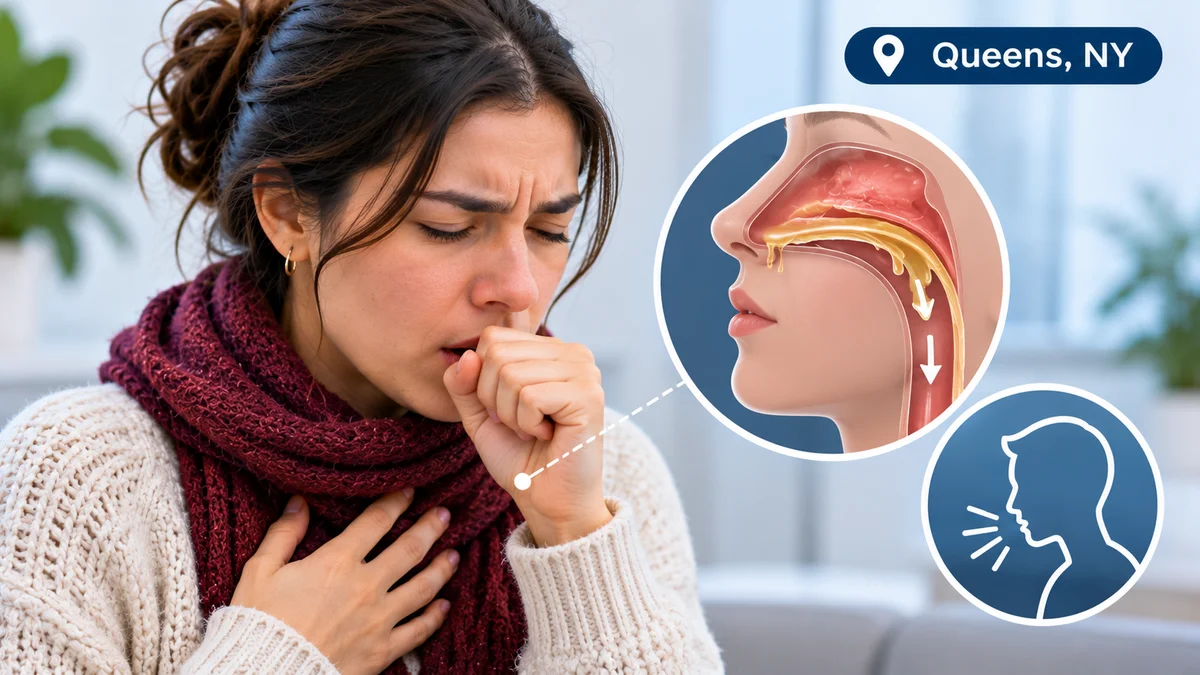
Table of contents
- 1. What Is Postnasal Drip?
- 2. Common Symptoms
- 3. Postnasal Drip vs Other Causes of a Long-Lasting Cough
- 4. Causes and Who Is at Higher Risk
- 5. How a Clinician Diagnoses the Cause
- 6. The Five Home-Care Steps
- 7. Treatment Options at a Glance
- 8. Graph: Illustrative Cough Frequency Over Four Weeks
- 9. Sample Four-Week Cough Care Plan
- 10. Red Flags: When to Get Prompt Care
- 11. Where to Get Care: Elmhurst, Chinatown and Lower Manhattan
- 12. Related Reading From City Prime Care
- 13. Contact Us
- Conclusion
- Frequently Asked Questions
- See a Doctor in Elmhurst or Chinatown
The cold is long gone, but you still feel mucus dripping down the back of your throat, you clear your throat constantly and a dry, tickly cough keeps you up at night. A cough that lasts more than eight weeks is considered chronic, and in adults one of the most common causes is postnasal drip, also called upper airway cough syndrome. It is rarely dangerous, but it can be exhausting, and it can also hide other causes such as asthma or acid reflux that need different treatment.
This guide explains what postnasal drip is, how it differs from other long-lasting coughs, five home-care steps, a sample four-week plan and the red flags that need prompt evaluation. City Prime Care serves patients in Elmhurst, Queens, Chinatown and Lower Manhattan. This article is general education and not personal medical advice. The American Academy of Allergy, Asthma and Immunology explains related issues on its chronic cough resource page.
Quick takeaways:
- Postnasal drip happens when excess or thick mucus from the nose and sinuses runs down the throat and triggers cough and throat clearing.
- Common causes are allergies, colds, sinus infections, dry winter air and irritants like smoke.
- A cough lasting over eight weeks should be checked because asthma, acid reflux and medicine side effects are also common causes.
- Coughing up blood, unexplained weight loss, fever, shortness of breath or chest pain need prompt medical care.
1. What Is Postnasal Drip?
The nose and sinuses make about a quart of mucus every day, which normally flows down the throat without being noticed. When the nose makes more mucus, or the mucus becomes thicker, you may feel a drip, a lump in the throat, a need to clear the throat or a tickle that triggers coughing.
Cough from postnasal drip is often worse when lying down at night or first thing in the morning, because mucus pools in the throat. The cough is usually dry or produces small amounts of clear or white mucus.
2. Common Symptoms
| Symptom | What it feels like | Common clue |
|---|---|---|
| Throat tickle | Constant irritation at the back of the throat | Worse after lying down |
| Frequent throat clearing | Habit of clearing the throat many times a day | Often noticed by others |
| Cough | Dry or small amounts of mucus | Chronic and worse at night |
| Hoarse voice | Raspy, tired voice | From irritation of the voice box; see hoarse voice and laryngitis |
| Stuffy nose or sneezing | Nasal congestion, sniffing | Points to allergies or sinus problems |
| Bad breath or sour taste | Taste from mucus or reflux | May also reflect acid reflux |
| Sore throat in the morning | Scratchy throat that improves during the day | From overnight dripping |
3. Postnasal Drip vs Other Causes of a Long-Lasting Cough
| Condition | Typical clue | How it differs |
|---|---|---|
| Acute bronchitis | Chest cold with cough lasting up to three weeks | Follows a viral illness; see acute bronchitis |
| Asthma (cough-variant) | Dry cough with night or exercise triggers | May be with wheeze or chest tightness; needs breathing tests |
| Acid reflux (GERD) | Cough with heartburn, sour taste, worse after meals | Reflux treatment needed; see chest pain vs heartburn |
| Pertussis (whooping cough) | Coughing fits with a whooping sound | See whooping cough |
| Pneumonia | Fever, fast breathing, productive cough | Needs evaluation; see warning signs of pneumonia |
| ACE-inhibitor cough | Dry cough starting weeks after a blood pressure medicine | Medicine review needed |
| Smoking-related cough | Daily morning cough with mucus | Chronic lung disease must be considered |
4. Causes and Who Is at Higher Risk
Postnasal drip is linked to:
- Seasonal or year-round allergies to pollen, dust mites, pet dander and mold; see allergies or just a cold.
- Viral colds and sinus infections that leave extra mucus; see sinus infection or just a bad cold.
- Dry indoor air from winter heating, which thickens mucus.
- Irritants such as cigarette smoke, strong perfumes, cleaning products and air pollution.
- Structural problems like a deviated septum or nasal polyps.
- Hormonal changes, including pregnancy, and some blood pressure medicines.
- Acid reflux, which can mimic or worsen throat irritation.
People with asthma, frequent sinus infections or a history of allergies are at higher risk of long-lasting cough.
5. How a Clinician Diagnoses the Cause
A visit usually includes:
- A history of how long the cough has lasted, when it is worse, mucus color, smoking, medicines and allergy or reflux symptoms.
- Examining the nose, throat and lungs, and checking oxygen levels.
- Sometimes a chest X-ray if the cough is persistent or there are warning signs; see when an injury or cough calls for an X-ray.
- Breathing tests (spirometry) if asthma is suspected, and allergy testing when allergies are likely.
- A treatment trial and follow-up, since the cause is often confirmed by whether the cough improves with treatment; referral to an ear, nose and throat doctor, allergist or lung specialist if needed. See when your primary care doctor sends you to a specialist.
6. The Five Home-Care Steps
For cough linked to postnasal drip, once warning signs are ruled out:
- Rinse the nose: use a saline spray or a neti pot or squeeze bottle with distilled, boiled and cooled or sterile water, never tap water straight from the faucet.
- Stay hydrated and add moisture: drink plenty of fluids and use a clean cool-mist humidifier in dry winter air, cleaning it often.
- Avoid triggers: stop smoking and avoid smoke, strong scents and known allergens; wash bedding weekly in hot water if dust mites are a trigger.
- Raise your head at night: an extra pillow or a wedge helps mucus drain less into the throat, and avoid eating within three hours of lying down if reflux is possible.
- Use appropriate medicines: a nasal steroid spray or an antihistamine may help allergy-related drip, following the label or a clinician's advice, especially with blood pressure, glaucoma or prostate issues.
Honey in warm water or tea can soothe the throat in adults and children older than one year. Cough suppressants are not usually helpful for cough from postnasal drip.
7. Treatment Options at a Glance
| Option | Best for | Notes |
|---|---|---|
| Saline rinses and humidified air | Most postnasal drip | Safe and low cost |
| Nasal steroid spray | Allergic or long-term nasal inflammation | Works over days to weeks; use daily |
| Antihistamines | Allergies with sneezing and itchy eyes | Newer non-drowsy types are often preferred |
| Antibiotics | Confirmed bacterial sinus infection | Not for most colds or allergy-related drip |
| Reflux or asthma treatment | When these causes are found | Targets the true cause of the cough |
| Specialist care | Persistent or unclear cough | ENT, allergist or lung doctor |
8. Graph: Illustrative Cough Frequency Over Four Weeks
This is a teaching graph, not patient data. It shows how cough often decreases gradually as rinses, trigger control and treatment take effect. Real recovery varies and a cough from a different cause may follow another pattern.
| Time | Coughing episodes per day (illustrative) |
|---|---|
| Week 0 (before care) | ██████████ |
| Week 1 | ████████ |
| Week 2 | ██████ |
| Week 3 | ████ |
| Week 4 | ██ |
| Week 8 | █ |
9. Sample Four-Week Cough Care Plan
| When | Goal | Sample actions | Check |
|---|---|---|---|
| Week 1 | Start basics | Saline rinse twice daily, fluids, humidifier, head raised at night | Is the throat tickle easing in the morning? |
| Week 2 | Add targeted medicine | Nasal steroid spray or antihistamine if allergies are likely, trigger avoidance | Less sneezing and throat clearing? |
| Week 3 | Review | Check for reflux or asthma clues, keep a cough diary | Is the cough lighter at night? |
| Week 4 | Follow-up | Clinician visit if cough persists; consider tests or specialist referral | Is the cough under 50% of its starting level? |
| Weeks 5-8 | Confirm cause | Adjust treatment for reflux or asthma if found | Is a clear pattern emerging? |
| Ongoing | Prevent flares | Allergy plan, humidified winter air, no smoking | Any new fever or breathing trouble? |
10. Red Flags: When to Get Prompt Care
See a clinician promptly, or go to the emergency room if severe, for:
- Coughing up blood or rust-colored mucus.
- Shortness of breath, wheezing, chest pain or fast breathing.
- Fever, drenching night sweats or unexplained weight loss.
- Cough lasting more than eight weeks, or longer than three weeks if you smoke or have lung disease.
- Choking episodes, trouble swallowing or a voice that stays hoarse for weeks.
- Swelling of the face or lips, or a cough that began after starting a new medicine.
- Green or foul mucus with facial pain and fever that lasts more than ten days.
11. Where to Get Care: Elmhurst, Chinatown and Lower Manhattan
A cough that will not go away is a common reason people search for urgent care Elmhurst NY, a walk in clinic Elmhurst NY, urgent care 11373, a same day doctor appointment Elmhurst or Same-Day Acute Care in Elmhurst Queens. For long-term allergy, asthma and reflux follow-up, patients choose a primary care doctor Elmhurst NY, a family doctor Elmhurst Queens, Primary Care Doctors in Elmhurst NY or chronic disease management Elmhurst NY.
People comparing options often search for Best Primary Care Clinic in Elmhurst Queens, Best Primary Care Doctor in Elmhurst Queens, Primary Care Near Me Elmhurst Queens, Best Primary Care Clinics in Queens NY, Primary Care Clinics and Doctors in Queens NY and Top Primary Care Clinics in Queens NY. City Prime Care provides Men's and Women's Healthcare in Elmhurst NY, a physical exam clinic Elmhurst NY and preventive care Elmhurst NY, including evaluation of long-lasting cough.
Downtown, people look for primary care Lower Manhattan, primary care Chinatown NYC, a doctor near Catherine Street NYC, primary care 75 Catherine St, a walk-in clinic Chinatown NYC, a Primary Care Clinic in Chinatown Manhattan or a Healthcare Center in Chinatown Manhattan NY. Citywide searches include primary care doctor NYC, primary care doctor near me, family doctor Manhattan NYC, annual physical exam NYC, same day primary care NYC and preventive care Lower Manhattan. Residents searching for Primary Care Doctors Serving Todt Hill Staten Island are welcome to contact the clinic to ask about care options and travel.
| Area | Common searches | How care can help |
|---|---|---|
| Elmhurst (ZIP 11373) | Urgent care 11373, same day doctor appointment Elmhurst | Prompt cough and breathing check |
| Elmhurst, Queens | Family doctor Elmhurst Queens, primary care doctor Elmhurst NY | Allergy, asthma and reflux follow-up |
| Queens | Best Primary Care Clinics in Queens NY, Top Primary Care Clinics in Queens NY | Easy-to-reach primary care for the family |
| Lower Manhattan | Primary care Lower Manhattan, preventive care Lower Manhattan | Convenient visits near work |
| Chinatown / Catherine Street | Primary care Chinatown NYC, doctor near Catherine Street NYC, primary care 75 Catherine St | Convenient downtown care |
| Citywide | Primary care doctor NYC, family doctor Manhattan NYC, same day primary care NYC | Same-day or scheduled evaluation |
You can also find the clinic on Google or learn more on the City Prime Care website.
12. Related Reading From City Prime Care
13. Contact Us
Has a cough or throat tickle lasted for weeks? Visit our Contact Us page or see our Google listing. If you are coughing up blood, struggling to breathe or have chest pain, call 911 or go to the nearest emergency room.
Conclusion
Postnasal drip is a common and usually harmless cause of a lingering cough, and simple steps like saline rinses, moist air, trigger control and the right medicine often help within weeks. Because asthma, reflux and other causes can look similar, see a clinician if your cough lasts more than a few weeks or comes with warning signs.
Frequently Asked Questions
See a Doctor in Elmhurst or Chinatown
Have a question about your own health? Book a visit at our Elmhurst, Queens clinic or our Chinatown, Manhattan clinic, or explore our primary care services.
Related articles
Healthcare
Contact Dermatitis in Queens, NY: How Skin Reacts to Irritants and Allergens and What to Expect From Treatment
Red, itchy, blistering skin after touching soap, metal or plants may be contact dermatitis. Learn the two types, a numbered trigger-control plan, red flags and what to expect from care in Queens.
Healthcare
Skin Boils and Abscesses in Elmhurst, NY: How Painful Lumps Form and What to Expect From Same-Day Care
A red, painful, pus-filled lump under the skin may be a boil or abscess. Learn how they form, why you should not squeeze them, a numbered care plan, red flags and what to expect in Elmhurst, Queens.
Healthcare
Vaginal Yeast Infections in Elmhurst, NY: How Candida Overgrowth Develops and What to Expect From Care
Itching, burning and thick white discharge may signal a vaginal yeast infection. Learn why it develops, a numbered care plan, red flags and what to expect from women's healthcare in Elmhurst, Queens.